+1 912-206-8811
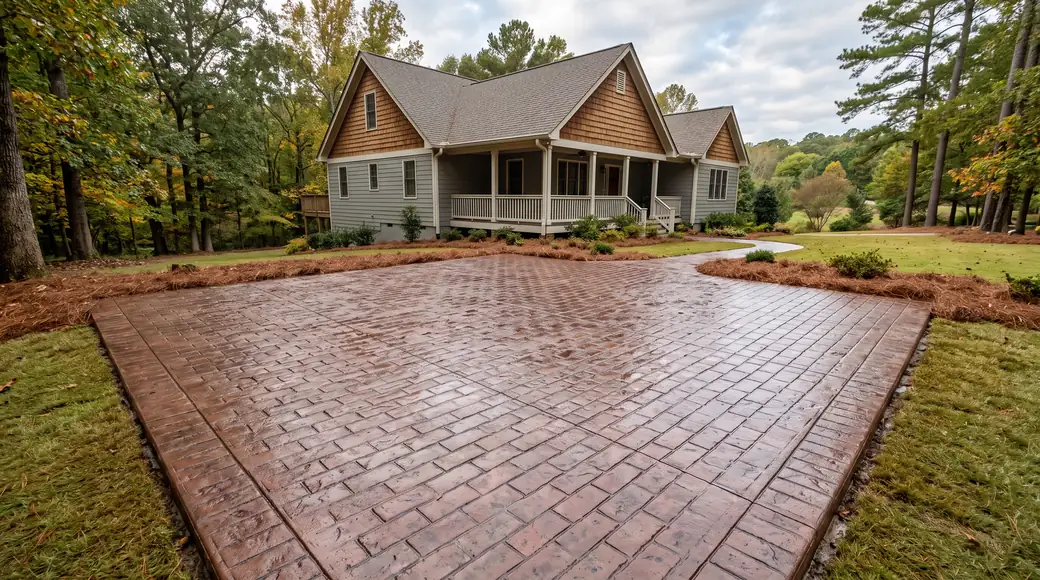
Stamped concrete patio in a running-bond brick pattern at a grey split-level home in Savannah, GA, after a rain shower.

Stamped Concrete Patterns in Hilton Head Island, Georgia

Stamped concrete is a poured slab that gets texture and color pressed into it while the mix is still workable. The pattern comes from mats laid across the surface in sequence, so the seams line up and the finished field reads as stone, brick, or plank instead of a grid of repeated squares. It is still concrete underneath. Everything that makes a plain slab last, meaning thickness, reinforcement, and a compacted base, matters exactly as much here.

Pattern choices fall into a few families: running bond brick, ashlar slate, seamless texture, and wood plank. Color goes on two ways, integral through the whole mix or as a hardener broadcast onto the surface, and a release agent adds the second tone that keeps a pattern from looking flat. Samples and poured test pieces are part of how a stamped job gets quoted. Color reads differently wet, dry, sealed, and in full sun, and photographs lie about all four.

Timing drives the whole pour. There is a window, usually short, where the slab is firm enough to hold an imprint and still soft enough to take one, and the crew has to be standing there with mats ready when it opens. Heat shortens that window. A stamped pour needs more hands on site than a broom finish sidewalk of the same size, and that is the honest reason it takes the crew it takes.

Failures we get called about trace back to the same few things. A base that was never compacted, so the slab settles and cracks along the low spot. No wire mesh or rebar under a driveway that carries a truck. Stamping done too late, which leaves a shallow, blurry pattern that no amount of sealer will fix. Control joints cut in the wrong place, or skipped entirely, which does not prevent cracking so much as give up the right to decide where it happens.

Getting it right is mostly prep, and prep is the part nobody sees. Grade, compact, form, set reinforcement, then pour. Around here the median home was built in 1971, so much of what we tear out is original flatwork that has done its fifty years and is finished. On a median home value of $225,200 and a household income of $56,782, against the Georgia figure of $74,664, we would rather pour one slab that lasts than two that do not.

We work as a concrete contractor in Savannah, Georgia, and out to Pooler, Bluffton, and Hilton Head Island, on the same terms in each. Patios, walkways, pool decks, driveways, sidewalk replacement, and commercial flatwork, stamped or plain. A stamped patio and an exposed aggregate driveway are the same trade, poured by the same crew, off the same truck. Seeing a pattern in person beats picking one off a screen. Call for a free estimate.
Call +1 912-206-8811

Licensed, Bonded, and Insured ยท A combined 15 years of experience

Get Your Free Quote

We warranty all of our work because we believe in what we do.

Our Concrete Work Around Hilton Head Island

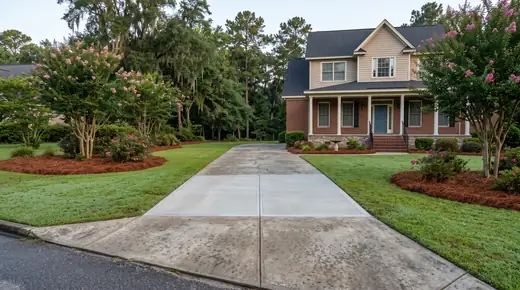
Replaced concrete driveway panel with clean saw-cut edges at a brick-and-siding two-story home in Savannah, GA, in early morning light.

Repair, Leveling & Resurfacing

Cracked and sunken concrete usually traces back to a failed base, not bad mix. We slabjack settled sections back to grade, saw and patch spalled areas, and resurface worn flatwork with a bonded overlay. Sound slabs get saved. Broken-up, heaved concrete gets torn out instead.

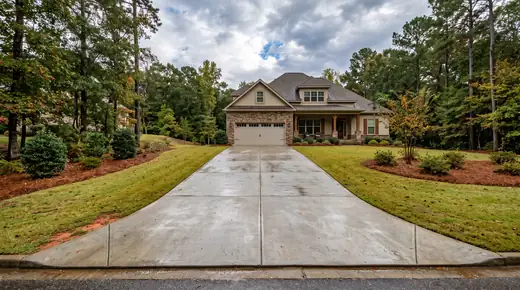
Broom-finished concrete driveway running up to a two-car garage at a stacked-stone and stucco home in Savannah, GA, after a rain shower.

Driveway Installation & Replacement

Most driveways we replace are four inches over compacted base, with rebar or wire mesh depending on the load and the approach. Ones built for RVs or trucks go thicker. We form clean edges, cut control joints early, and pitch the whole run so water leaves the slab rather than sitting on it.

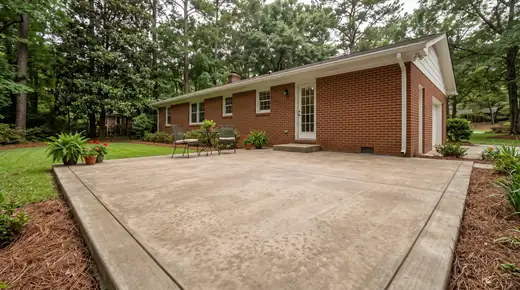
Rectangular concrete patio with a low step up to the rear door at a red-brick ranch home in Savannah, GA, under an overcast sky.

Patio Construction & Outdoor Living

Patios are where stamped concrete earns its keep: ashlar slate, seamless texture, or wood plank, integrally colored and release-shaded so the tone runs deeper than the surface. We set the slab below the door threshold, slope it away from the house, and seal it once the concrete has cured.

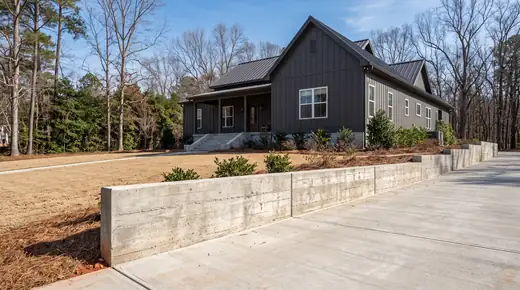
Board-formed concrete retaining wall holding a raised lawn at a charcoal farmhouse-modern home in Savannah, GA, in clear late-morning sun.

Retaining Wall Construction

Walls fail from water, not weight. We build footings below grade, reinforce vertically, and put drainage stone and perforated pipe behind the wall so hydrostatic pressure has somewhere to go. Poured concrete or segmental block, depending on the height and what the grade change actually calls for.

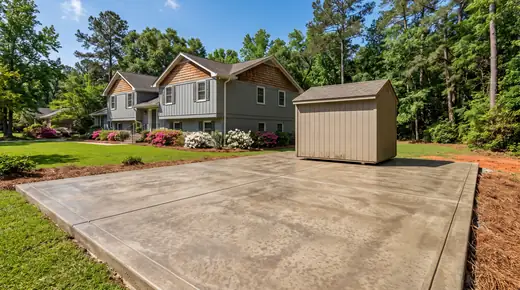
Square-edged concrete slab pad with a storage shed on it at a grey split-level home in Savannah, GA, in clear late-morning sun.

Concrete Slabs & Pads

Shed pads, garage floors, AC and generator pads, hot tub bases: each gets a base compacted in lifts, a vapor barrier under conditioned space, and mesh or rebar sized to the load. We finish flat, broom or trowel to suit, and joint the slab so it cracks where we cut it.

What to Expect on a Hilton Head Island Concrete Job

Every job starts on the property, walking the site with you before anything gets written down. We look at what is there now, where water leaves the site, how close a truck can get, and what the finished surface has to carry. Old flatwork tells us plenty. A slab that broke along one edge usually failed at the base and not the surface, and that changes the scope. We do not write a scope off a photo. The walk takes as long as it takes.

Measurements come next, taken on site rather than off a plat. We mark the outline in paint so you can stand in it and see the real footprint before a single form goes up. Thickness, joint layout, base depth and finish all get settled here. If you want a stamped pattern, this is when the samples come out and get looked at in daylight against your house, because color reads one way in a shop and another way in the yard.

Permitting runs through the City of Savannah on work that calls for it, and we carry that paperwork rather than handing it back to you. Some jobs need a permit and some do not. Replacing a slab in its existing footprint is a different conversation than cutting a new approach or moving where water drains. You will know which one you have before anything gets broken up, and the schedule gets built around the approval instead of around hope.

Demolition is the loud day. Old concrete comes out in pieces and goes onto a truck rather than sitting in a heap by the mailbox. Houses in this market have a median build year of 1971, so a fair amount of what we remove was poured a long time ago and has been moving ever since. We protect what stays: irrigation heads, meter boxes, the lawn edge, the neighbor's grass. Roots under old slabs turn up often enough that we plan for them.

Base work is the part nobody sees and the part that decides how long the slab lasts. We cut grade for drainage first, bring the subgrade to a uniform depth, then compact it in lifts instead of one pass. Soft spots get dug out and replaced rather than bridged over. A concrete driveway poured on loose fill will crack inside a year no matter how clean the finish looked on day one. The hours spent down here are the cheapest hours on the job.

Forms go up straight and get checked twice, because a form set wrong is a slab poured wrong and there is no fixing that later. Steel goes in after. Rebar on driveways and heavier slabs, wire mesh where loads are lighter, and all of it chaired up so it sits inside the concrete instead of underneath it. Steel lying flat on the base does nothing at all. Walkways get their own layout, since a sidewalk carries load differently than a drive.

Pour day starts early. The crew is sized to the pour, so the concrete gets placed, screeded and floated while it is still workable and nobody ends up chasing a slab that set faster than they could move. Stamping happens inside a narrow window, which is why we do not stack a stamped area behind another pour on the same crew and the same day. Colored concrete goes in the mix or onto the surface depending on the pattern you picked.

Concrete cracks. What we control is where it cracks. Control joints get cut on spacing set by slab thickness, usually within the first day, so the crack that wants to happen lands in a straight line you stop noticing. Curing matters more than most people expect. The surface stays damp or sealed while it gains strength, and that first week does more for how the slab holds up than anything anyone does to it afterward.

Cleanup is part of the concrete installation and not a favor at the end. Forms come out, edges get backfilled and raked smooth, and the site is left looking like finished work instead of an active job. Then we walk it with you and say plainly when the surface will take foot traffic and when it will take a vehicle, because those are two different days. Driveways and sidewalks both ask for that patience. Call for a free estimate.

Common Questions From Hilton Head Island Owners

How quickly can you get a crew to Hilton Head Island?

Scheduling depends on the size of the pour, the weather window, and what is already booked. Stamped work needs a dry stretch and enough hands on site to stamp the slab before it sets up, so we schedule it honestly rather than squeezing it in. Call us with the square footage and the pattern you have in mind, and we will tell you where the calendar stands.

Does Hilton Head Island require its own permit for this work?

Permit requirements depend on where the concrete goes and what it touches. A patio slab behind the house is treated differently than flatwork that runs into a right of way or changes drainage. We check the rules that apply to your address before we set forms, and we tell you what the process looks like for your particular job rather than guessing at it up front.

Do you work on older properties in Hilton Head Island?

Yes. Much of the housing stock around here dates back decades (the median home in this market was built in 1971), and older properties are a large share of what we pour. Settled slabs, cracked walks, patios poured thin with no wire mesh or rebar. We look at what is underneath before we quote, because the base is usually what failed, not the concrete.

What is the drive time from Savannah to Hilton Head Island for a site visit?

It is a short haul. We are based in Savannah and Hilton Head Island sits well inside the radius we cover, so a site visit is an ordinary trip and not a special arrangement. We would rather stand on the ground, measure the area, look at the grade, and check how water moves across it than work from a description over the phone.

How many jobs has Savannah Precision Concrete done around Hilton Head Island?

We do not publish a job count. What we can do is walk you through the work itself: how we form and reinforce a slab, which stamp patterns and colors hold up outdoors, what release agent does to the finish, and how we handle control joints. Ask us specific questions about your project and judge the answers.

Get a Free Estimate

Get Your Free Quote

We warranty all of our work because we believe in what we do.

Tap to call +1 912-206-8811