+1 912-206-8811
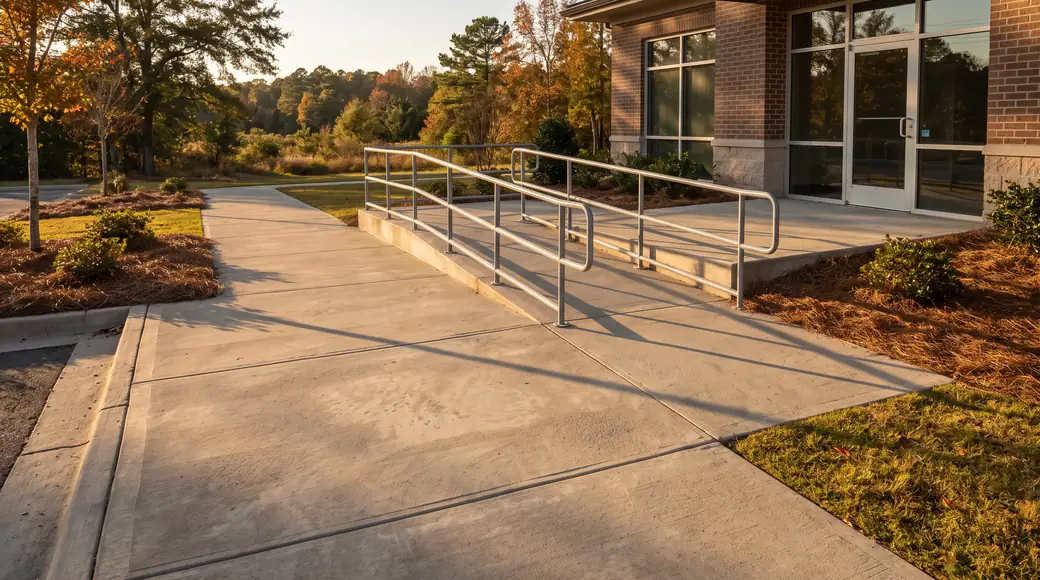
Concrete entry walk and ADA ramp at a medical office building in Savannah, GA, in late afternoon light.

Commercial Concrete for Medical & Dental Offices in Savannah, GA

We pour concrete for medical and dental offices around Savannah: parking areas, the walk from the stall to your entrance, the pad under a dumpster enclosure, the landing at a back door. Patients arrive on a schedule and a front desk cannot absorb a closed entrance, so we phase the work. One run of sidewalk goes in while another stays open, and the door people actually use stays usable.

Concrete at a clinic takes traffic a house never sees. Wheelchairs, walkers, rolling supply carts, a courier at eight in the morning, a service truck backing up to the rear slab. That changes thickness, reinforcement and where we set the joints. Stamped concrete at the entry gives you a finished surface at the doors patients look at, and it holds up the same as the flatwork behind it.

Poor work shows itself first as a lip at a joint, a half inch of settlement right where someone with a cane puts a foot down. Then a crack opens across a drive lane and you are closing off a bay to fix what should have been handled under the slab. We would rather get the base right. A dental office in Pooler and a surgical suite in Savannah get the same subgrade prep and the same concrete contractor standing on the job. Call for a free estimate.

Call +1 912-206-8811

Licensed, Bonded, and Insured ยท A combined 15 years of experience

Get Your Free Quote

We warranty all of our work because we believe in what we do.

What Commercial Concrete for Medical & Dental Offices Involves

Commercial concrete for a medical or dental office is mostly flatwork that people cross before they ever reach your door. Approach sidewalks, the ramp, the landing at the entry, the parking area and the islands inside it. We pour slabs, drive aprons, and the concrete sidewalk runs that tie a lot to a covered entrance. Some of it is a plain broom finish. Some of it is stamped concrete or colored concrete where the front of the building needs to read as finished rather than merely functional.

Access drives the layout. A sidewalk serving a dental practice carries walkers, wheelchairs, canes and parents holding a child by the hand, so cross slope, running slope and joint placement get set before the first form goes in. Landings stay flat. Transitions between the drive apron and the walk stay tight and even. We size panels so that a single cracked section can be sawcut out and replaced years later without disturbing the rest of the entry.

Failures usually start under the slab rather than on top of it. Poor compaction, missing rebar or wire mesh where wheel loads run, control joints cut too late or too shallow: any one of those returns as cracking, settlement, and a lip that catches a toe. Water standing at a threshold is the other common one, and it never fixes itself. A concrete contractor who skips base work can make a driveway look right for one season and no longer.

Getting concrete driveways and walks to hold up means paying for the parts nobody sees afterward. Compacted base at the right depth. Rebar through the drive lanes and under the dumpster pad, wire mesh or fiber in the flatwork, thickened edges where delivery trucks turn. Exposed aggregate and stamped patterns run on their own clock, since the window for washing or imprinting is short and does not reopen. We size each pour so the crew finishes what it starts that day.

We do commercial concrete work in Savannah, Georgia, along with Pooler, Bluffton and Hilton Head Island, on the same terms in every one of them. Concrete installation on an occupied medical property means staging around patient parking and keeping an accessible route open while a section cures, which usually splits the job into halves. Tell us which entrance has to stay live and we build the sequence around it. Call for a free estimate on concrete services for your office.
What Savannah Properties Need From Commercial Concrete for Medical & Dental Offices

Medical and dental offices in Savannah often occupy buildings older than the concrete standards we work to now. The median home here was built in 1971, and plenty of the commercial stock nearby dates from the same stretch, so the walkways and parking aprons at a lot of practices have been patched more than once. We handle concrete installation on those properties: entry sidewalks, ramps, dumpster pads, service aprons, and the flatwork patients cross before they reach your door. The work is ordinary commercial concrete. What changes is who walks on it.

Sidewalk installation at a clinic carries loads a residential driveway never sees. Wheelchairs, walkers, rolling equipment carts, and people who are already unsteady on their feet. We size the slab for that, run rebar or wire mesh through it depending on the pour, and set joints where they will not catch a caster or the tip of a cane. Surface texture matters as much as thickness does. A broom finish holds grip when wet, and exposed aggregate does the same while hiding wear. Stamped and colored concrete suits the entry when you want the frontage to read finished.

Our concrete services cover Savannah and the practices out toward Pooler, and every address gets the same approach: look at what is there, say plainly what is failing and what is fine, then pour only what needs pouring. Some buildings need one panel cut out and replaced. Others need the whole approach removed and rebuilt, because water has been running the wrong direction across it for years and the base underneath is gone. We walk the property with you and put the scope in writing before anything gets broken up. Call for a free estimate on your concrete work.

How a Commercial Concrete for Medical & Dental Offices Job Runs in Savannah

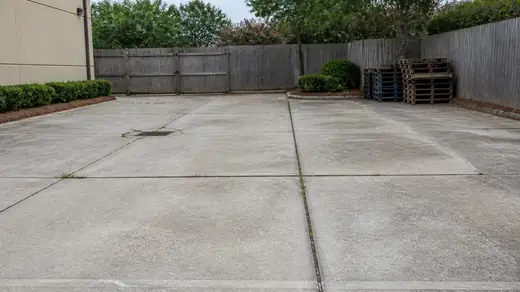
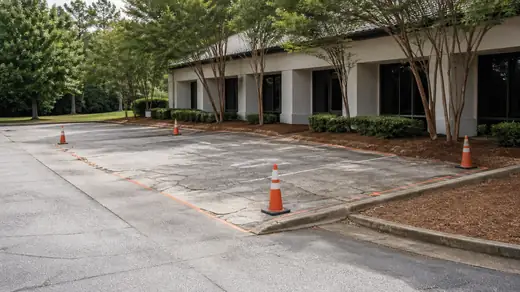
Cracked commercial parking bay marked out for replacement in Savannah, GA, under bright midday cloud.

Step 1: Site Evaluation

We walk the property and look at what is already there: slab thickness at broken edges, how water moves across the lot, where delivery trucks turn. Patient parking and entry doors set the sequence. We measure, note utility locations, and mark anything that has to stay open during work.

Service yard slab assessed where heavy vehicles have broken it up in Savannah, GA, under bright midday cloud.

Step 2: Written Estimate and Permits

You get scope in writing: square footage, slab thickness, reinforcement (rebar or wire mesh), finish, joint layout, and how the work is phased around office hours. Permit paperwork and any required drawings get filed before we schedule. Nothing starts until you have read the estimate.

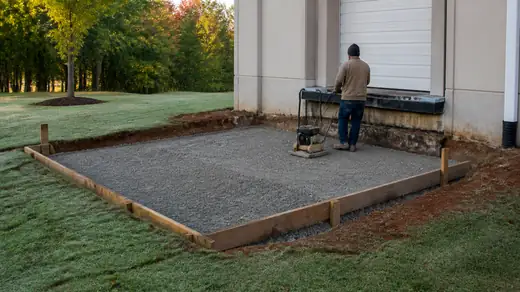
Loading dock apron broken out with the subgrade compacted in Savannah, GA, in early morning light.

Step 3: Demolition and Base Prep

Old concrete comes out in sections and gets hauled off. Soft subgrade is dug out and replaced with compacted graded aggregate, usually four to six inches, compacted in lifts. Skipping compaction is what settles a concrete driveway into a birdbath two winters later.

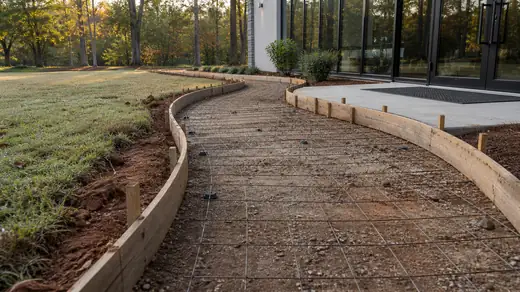
Curved walkway forms bent and staked outside a commercial entrance in Savannah, GA, in early morning light.

Step 4: Forming, Steel and the Pour

Forms get set to grade with slope built in, generally a quarter inch per foot on sidewalks so water leaves the walking surface. Rebar sits on chairs, not on the dirt. We place concrete in one continuous pour where the layout allows, screeded and bull floated immediately.

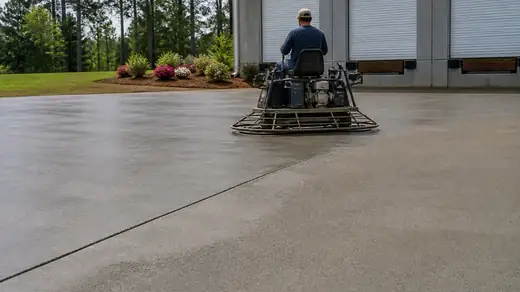
Dock slab power-trowelled to a hard dense surface in Savannah, GA, under bright midday cloud.

Step 5: Finishing, Curing and Final Walkthrough

Broom finish across sidewalks and driveways for traction when wet. Control joints get cut early, before shrinkage picks its own cracks. Curing compound goes on the same day, and the concrete installation stays closed to foot traffic and vehicles for the full period. Then we walk it with you.

Commercial Concrete for Medical & Dental Offices Pricing in Savannah, GA

Two lots on the same block can price out differently, and the reasons are usually visible before anyone pours. Most of what follows you can walk out and check yourself.

What changes the priceWhich wayWhy
Old slab or asphalt already in placecosts moreIt gets broken out, loaded and hauled off before any new flatwork starts.
Firm, well graded subgrade under the workcosts lessLess stone, less import fill, less machine time getting to a flat base.
Mixer can reach the pour on its own chutecosts lessWheelbarrow runs or a pump add crew hours to every yard placed.
Buried irrigation, conduit or a gas service crossing the areacosts moreLocates and hand digging slow the excavation and change how we form around them.
Slab carrying ambulance, delivery or dumpster trafficcosts moreThicker section and rebar on chairs instead of wire mesh in a light residential pour.
Site that already drains away from the buildingcosts lessFewer grade changes, no added area drain, less forming to hold the fall.
Stamped, colored or exposed aggregate finishcosts moreAdditional labor, release, sealing and cure time layered on the flatwork.
Work touching a public sidewalk or right of waycosts morePermitting runs through the City of Savannah, with inspection and specified materials.

Comparing bids, look at slab thickness, reinforcement, base depth, joint spacing, and who carries haul off and permit costs. Two numbers only mean something when they cover the same scope.

Commercial Concrete for Medical & Dental Offices: Questions We Are Asked Most

What surfaces suit a Savannah medical car park?

Reinforced concrete flatwork holds up best under the traffic a clinic sees: shuttle vans, delivery trucks, and cars idling in the same spots every day. We pour slabs on a compacted base with rebar or wire mesh, thickened at drive lanes and dumpster pads. Broom finish is standard for the parking field. Stamped or colored concrete works well at entry aprons and walkways where the building wants a finished look.

How do you keep ambulance and drop-off access open at a Savannah clinic?

We pour in phases and never close the full frontage at once. Before a single form goes in, we walk the site with your facilities contact and mark which lane stays live, where patients enter on foot, and where the temporary route runs. Barricades, cones, and a plated crossing keep the path continuous. Fresh concrete needs cure time, so the sequence gets built around the lane you cannot lose.

What accessibility standards apply to a medical entrance in Savannah?

Medical entrances fall under ADA requirements for accessible routes: running slope no steeper than 1:12 on ramps, cross slope under two percent on landings and walks, and level landings at doors. Detectable warnings go at curb ramps. We shoot grades with a laser before the pour and check them again on the finished concrete, because a walk that misses by a fraction is a walk that gets torn out.

Can you keep a Savannah medical practice open while you work?

Yes. Most of our commercial concrete work at clinics happens in sections small enough that the building never closes. We stage material away from patient doors, keep one accessible route open at all times, and pour the remaining sections after the first ones carry traffic. Larger jobs take more phases and a longer calendar. That tradeoff is worth discussing early, since it changes the schedule more than anything else.

Can you work around a clinic's hours in Savannah?

Yes. Evening and weekend pours are common on medical sites, and we plan them when the exposure is a main entrance or the only ambulance lane. Concrete has its own clock, though. Finishing and curing do not stop because the office opens at eight, so some slabs need barricades into the next business day even when the crew is gone.

How do you control dust and noise near patients in Savannah?

Demolition is the loud part, and it is short. We wet-cut with saws that suppress dust at the blade, run poly sheeting and tarps at doors and intake vents, and schedule breaking and sawing for the windows you give us. Exhaust and debris stay downwind of entrances. Crews sweep and wash the site at the end of each day so nothing tracks into a waiting room.

Get a Free Estimate

Get Your Free Quote

We warranty all of our work because we believe in what we do.

Tap to call +1 912-206-8811