+1 912-206-8811
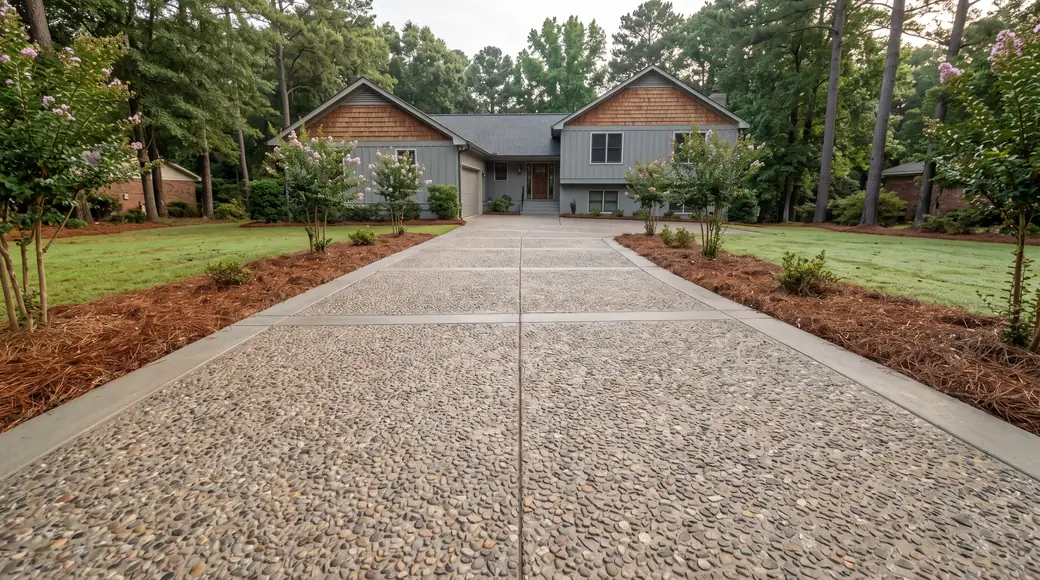
Exposed aggregate concrete driveway showing washed river-rock stone at a grey split-level home in Savannah, GA, in early morning light.

Exposed Aggregate Finishes in Savannah, GA

Exposed aggregate is concrete finished so the stone in the mix shows at the surface. We place the slab, then wash back the top layer of cement paste before it hardens, leaving the pebbles standing slightly proud. What you get is a surface with grip underfoot and a texture that hides staining far better than a smooth trowel finish does. People put it on driveways, patios, pool surrounds and the front sidewalk. It is one of the older decorative treatments in the trade, and it has held up.

A pour like this turns on timing. The wash window is short, and it moves with the temperature and the mix, so we watch the slab instead of the clock. Too early and the stone loosens. Too late and the paste sets hard over the top, and you are left with a dull, patchy face that no amount of scrubbing brings back. As a concrete contractor we would rather stand around waiting than rush that call. It decides the whole finish.

Things go wrong underneath more often than they go wrong on top. A slab poured over soft or uneven base will crack eventually, however good the surface looks in the first year. Reinforcement gets skipped. Wire mesh gets laid flat on the ground rather than lifted into the pour where it actually does something, and control joints get cut shallow or cut late. The median home here dates to 1971, so we see a lot of old work that was placed thin.

Doing it properly puts the money into the parts nobody ever sees: a compacted base, honest thickness, rebar where the loads want it, and a mix chosen around the stone you want showing at the end. Exposed aggregate asks about as much of a crew as stamped concrete does, and both are unforgiving of a rushed subgrade. We would rather price a job straight than win it cheap and come back later to a failure. Call for a free estimate.

Call +1 912-206-8811

Licensed, Bonded, and Insured ยท A combined 15 years of experience

Get Your Free Quote

We warranty all of our work because we believe in what we do.

What Exposed Aggregate Finishes Involves

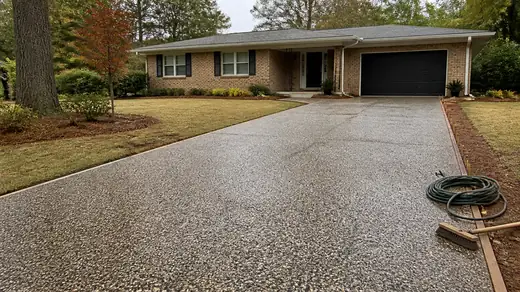
Newly washed exposed aggregate driveway with the stone just revealed at a buff-brick ranch home in Savannah, GA, under bright midday cloud.

Exposed aggregate driveway

We pour exposed aggregate driveways at four inches over compacted base, with rebar or wire mesh tied in before any concrete arrives. The surface retarder comes off the next day, washing away paste to leave the stone. Poor timing on that wash is what ruins most driveways: too late and the aggregate stays buried.

What Savannah Properties Need From Exposed Aggregate Finishes

Exposed aggregate is concrete with the stone left showing. We pour a standard slab, then wash and brush the top layer of cement paste away before it hardens fully, so the rock in the mix becomes the finished surface. It grips underfoot when wet. It hides dirt and tire marks better than a smooth trowel finish, and it does not ask for the upkeep schedule that stamped and colored work does. Most of what we place goes in as driveways, front walks and patios.

The median home in Savannah was built in 1971. On a house that age, the driveway and the front walk are often original, or one replacement deep, and the concrete has spent decades under vehicles and foot traffic. When a slab like that comes out, exposed aggregate is a sensible thing to put back in its place. It reads as a finish somebody chose. Gray flatwork poured to fill a hole reads as exactly that, and the difference shows from the street.

Two things ruin this finish. Washing too early cuts the paste too deep, the stone sits loose, and pop-outs start within a few seasons. Washing too late leaves the rock under a haze that no scrubbing brings back. Both mistakes are permanent, since you cannot put paste back or lift haze off. The other failure sits under everything: a slab placed on loose base, without rebar or wire mesh where the load calls for it, cracks on its own schedule no matter how clean the top came out.

Doing this well costs time more than material. The window between too early and too late is short, so we staff the pour to match it, and we do not stretch a crew across two jobs on a wash day. The rest lives in the base: grading, compaction, and the steel that goes in before any concrete arrives. Skipping any of that saves money once and spends it again in five years. The finish is the last hour of a job that is mostly preparation.

We work Savannah and the surrounding area, and the same crew that pours a driveway here pours one out toward Pooler. Exposed aggregate suits driveways, sidewalks, patios and commercial concrete where a plain slab would take a beating and show it. If you have a drive breaking up, or a walk that has shifted, call for a free estimate and tell us what you want the finished surface to do. We can talk through stone size, color and how much texture you actually want.
How a Exposed Aggregate Finishes Job Runs in Savannah

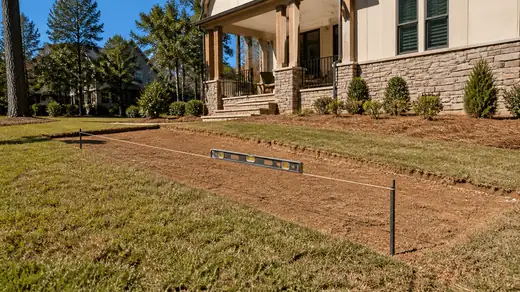
Backyard grade checked with a level and string before a patio pour at a stacked-stone and stucco home in Savannah, GA, in clear late-morning sun.

Step 1: Site Evaluation

We walk the area with you, check drainage and slope, and look at what the existing slab is doing. Cracking, settling, tree roots, a downspout dumping right where water should run off. Measurements and elevations get taken then, not guessed at later.

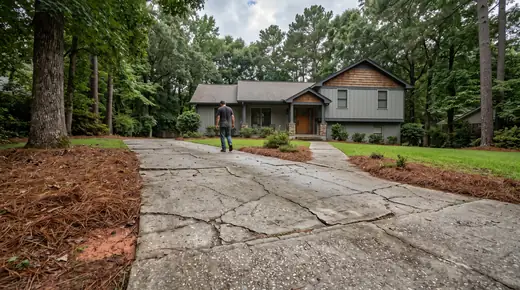
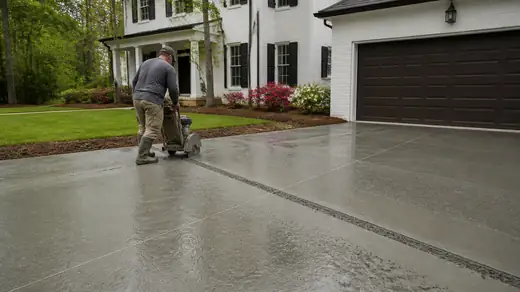
Concrete driveway and walk at a home, the kind of job an estimate covers at a grey split-level home in Savannah, GA, after a rain shower.

Step 2: Written Estimate and Permits

You get the scope in writing: square footage, slab thickness, reinforcement, aggregate type, finish. Any permit work gets handled before we schedule. Nothing starts until you have read what we intend to build and agreed to it, so there are no surprises mid-job.

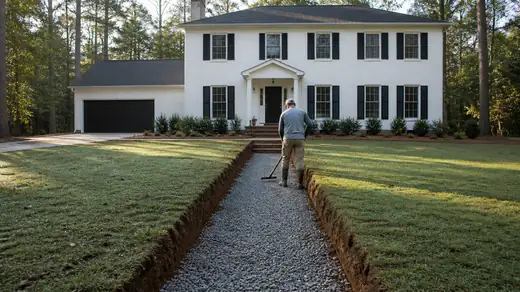
Front walkway removed and the trench squared out for a new pour at a painted-white-brick two-story home in Savannah, GA, in early morning light.

Step 3: Demolition and Base Prep

Old concrete comes out and gets hauled off. We excavate to grade, then compact a graded stone base in lifts. Skipping this is why driveways crack in the wheel paths. Soft spots get dug out and replaced rather than filled and hoped over.

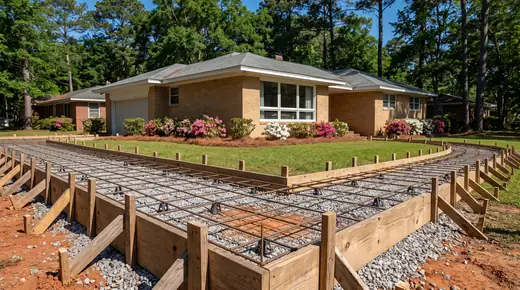
Wooden forms and rebar grid set and tied, ready for concrete at a buff-brick ranch home in Savannah, GA, in clear late-morning sun.

Step 4: Forming, Steel and the Pour

Forms go in, staked and strung to hold line and slope. Rebar on chairs for a concrete driveway, wire mesh for lighter flatwork, all of it held up off the base. Concrete installation runs continuous, screeded and floated, with control joints laid out before we leave.

Control joints cut into a new slab the day after the pour at a painted-white-brick two-story home in Savannah, GA, under an overcast sky.

Step 5: Finishing, Curing and Final Walkthrough

Timing carries this stage. We wash off the surface paste at the right window to expose the stone evenly, then seal and cure. Wash too early and aggregate rolls loose. We walk the driveways and sidewalks with you and go over cure time and sealer.

Exposed Aggregate Finishes Pricing in Savannah, GA

Price on an exposed aggregate job comes down to what sits under the slab and what has to happen before we pour. Two driveways of the same size can land far apart. Most of what moves the number is something you can walk out and look at yourself, today, before anyone quotes you.

What changes the priceWhich wayWhy
Old slab or asphalt still in placeCosts moreIt has to be broken out, loaded and hauled off before we can grade, and that is a full day of machine time on some lots.
Soft or filled subgradeCosts moreGround that pumps under a boot needs undercutting and compacted stone, or the finish cracks no matter how good the pour is.
Truck can back to the formsCosts lessA short chute run puts concrete straight in the forms. A narrow gate or a long carry means buggies or a pump line.
Thickness the use calls forCosts moreA patio walked on and a driveway parked on are not the same slab. Vehicle loads want more depth and rebar rather than wire mesh.
Tree roots, irrigation, buried linesCosts moreAnything in the pour path gets cut, rerouted or hand dug, and roots near the edge change how we lay out control joints.
Site already drains away from the houseCosts lessWe set the slope to what is there. A low spot means fill, a drain, or reworking grade before forms go down.
Stone size and how deep it is exposedCosts moreLarger decorative aggregate and a seeded surface cost more to place and wash than a lightly exposed standard mix.
Sidewalk or right of way workCosts moreAnything touching public sidewalk goes through City of Savannah permitting, with drawings, review and an inspection.

Set two bids beside each other and read past the total. Look for slab thickness in inches, whether reinforcement is rebar or wire mesh and how it is held off the grade, base depth, and who hauls the old concrete. A bid missing those is not cheaper, only vaguer.

Exposed Aggregate Finishes: Questions We Are Asked Most

How does exposed aggregate compare on price in Savannah?

It sits above a plain broom finish and below most stamped work. The stone itself is the variable. A common local gravel costs less than a washed river rock or a specified decorative blend, and the wash-and-brush step adds labor that a broom finish does not need. On a house near the $225,200 median value here, the difference usually shows up in the stone selection more than in the square footage.

What stone options do you use for exposed aggregate around Savannah?

We pour a lot of river rock in tans and browns, pea gravel for a tighter and more uniform look, and darker granite blends when someone wants contrast against a light house. Seeded aggregate lets us set a specific decorative stone into the surface after placement, which opens up quartz and colored glass. We bring samples out and pour test panels before anything gets scheduled.

Does exposed aggregate need sealing in Georgia?

Yes. Sealer is what keeps the stone bright and the paste between it from picking up stains, and it slows the surface from graying out. We seal after the concrete has cured, then it wants resealing every couple of years depending on sun exposure and traffic. A shaded walkway goes longer between coats than a driveway that bakes all afternoon.

Is exposed aggregate too rough underfoot around a Savannah pool?

No, not if the exposure depth is right. A light wash leaves the tops of the stones rounded and proud enough for grip without the sharp edges people worry about. Deep exposure on angular crushed stone is the finish that turns harsh. We keep pool decks at a shallow to medium exposure with rounded river rock or pea gravel, which reads as textured rather than abrasive.

Can you expose aggregate on an existing slab in Savannah?

No, not on the existing slab itself. The finish comes from washing the surface paste off fresh concrete to reveal stone already in the mix, so it has to happen the day of the pour. What we can do on sound existing concrete is an overlay with aggregate seeded into it, or tear out and repour. Which one makes sense depends on the condition underneath.

How does exposed aggregate wear on a Savannah driveway?

It wears well. The stone carries the traffic instead of a thin troweled skin, so it does not scuff or show tire marks the way a smooth finish does, and small surface chips disappear into the texture. Vehicle loads still need the structure underneath: proper thickness, rebar or wire mesh, and control joints cut on time. Much of the housing here dates to around 1971, and driveways of that age are usually thin and unreinforced.

Get a Free Estimate

Get Your Free Quote

We warranty all of our work because we believe in what we do.

Tap to call +1 912-206-8811