+1 912-206-8811
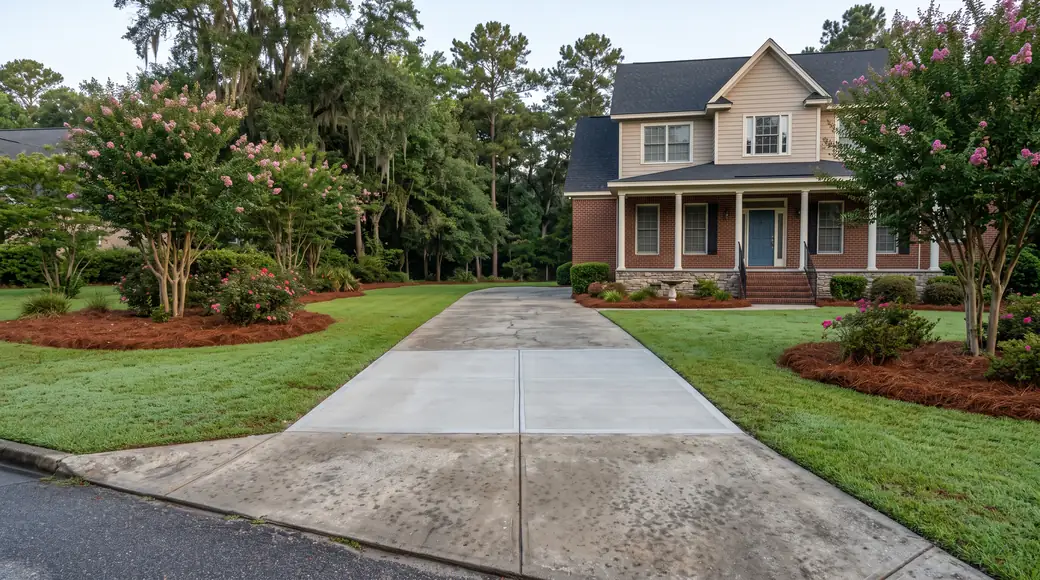
Replaced concrete driveway panel with clean saw-cut edges at a brick-and-siding two-story home in Savannah, GA, in early morning light.

Repair, Leveling & Resurfacing in Savannah, GA

Old concrete usually does not need replacing. A slab that has settled, cracked, or worn rough on the surface can often be brought back level and sound with far less disruption than a tear-out. We are a concrete contractor working in Savannah, and a good share of what we do is repair rather than new pours. Sunken driveway sections, a sidewalk panel lifted at the joint, a patio surface gone chalky and pitted. Each of those has a fix that stops short of demolition, and we will tell you plainly when it does not. That call gets made at the slab, not before.

Most of the concrete around Savannah homes has some age on it. The median house here was built in 1971, so driveways, walks and porch slabs were poured decades ago, many of them without the rebar or wire mesh that goes down today. Age by itself is not the problem. Movement underneath is, and so is water that finds a crack and works it wider every season. We look at what sits below before deciding what goes on top, because a resurfaced slab bridging a void will fail again in the same spot. Sometimes the honest answer is a new pour.

Leveling brings a settled slab back to grade. Resurfacing puts a new wearing layer over concrete that is sound underneath but rough, stained or patched, and that layer can be plain, colored, or stamped concrete if you would rather the patio not read as a gray rectangle. Repair covers the rest: control joints, spalled edges, a sidewalk trip hazard, a corner broken off by a truck tire. We do this work in Savannah and out through Pooler, on houses and on commercial flatwork both. Call for a free estimate. The slab that bothers you most is the one to start with.
Call +1 912-206-8811

Licensed, Bonded, and Insured ยท A combined 15 years of experience

Get Your Free Quote

We warranty all of our work because we believe in what we do.

What Repair, Leveling & Resurfacing Involves

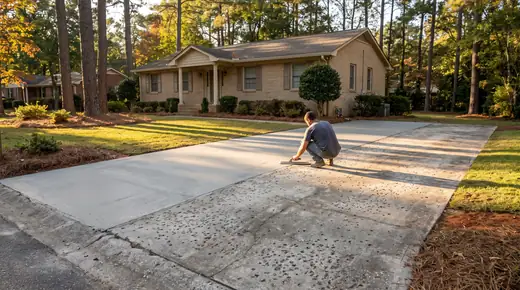
Thin concrete overlay being troweled onto an old worn slab at a tan-brick colonial in Savannah, GA, in late afternoon light.

Concrete resurfacing

Resurfacing bonds a new wear layer over sound concrete. We grind the slab, patch spalls, then place a polymer-modified overlay. Stamped concrete and colored finishes go on at this stage. A driveway that is cracked all the way through will not hold an overlay.

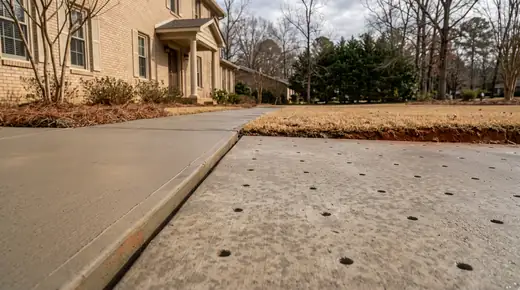
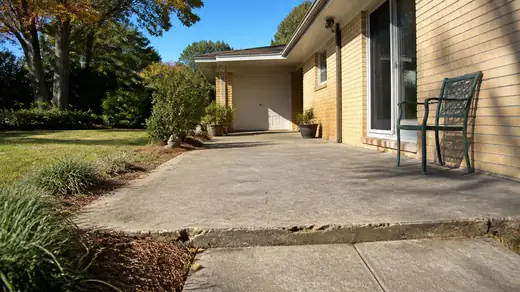
Sunken concrete slab with small drill holes for leveling at a tan-brick colonial in Savannah, GA, after a rain shower.

Concrete leveling

Leveling brings a sunken slab back to grade without replacing it. We drill small ports through the concrete, fill the void underneath, and lift in stages while watching the joint lines. Works on a concrete sidewalk, a patio, a garage floor or a driveway panel.

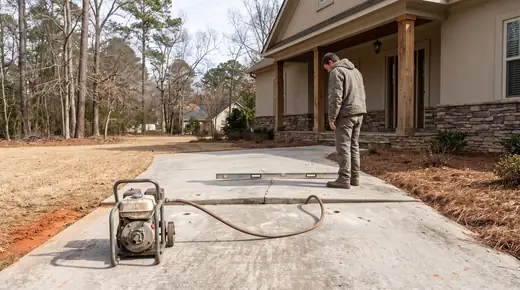
Slab-jacking pump lifting a sunken concrete slab back level at a stacked-stone and stucco home in Savannah, GA, under bright midday cloud.

Concrete lifting

Lifting handles the trip hazard where one sidewalk panel has dropped below the next. Polyurethane foam goes in through half-inch holes, expands, and raises the slab within an hour or so. The holes get patched. Traffic returns the same day on most residential work.

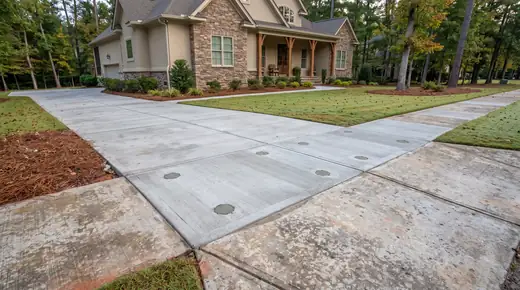
Concrete slab leveled with small patched holes from mudjacking at a stacked-stone and stucco home in Savannah, GA, in early morning light.

Mudjacking

Mudjacking is the older method: a sand, cement and water slurry pumped under the slab through larger holes. It is heavy, and it can settle again on soft fill. We use it where the slab is thick, the void is wide, or the job is commercial concrete carrying real load.

What Savannah Properties Need From Repair, Leveling & Resurfacing

Most of the concrete we work on in Savannah is older than the people parked on it. The median home here went up in 1971, so a driveway or walk poured with the house has taken fifty years of sun, roots, and delivery trucks. Some of that concrete is still sound under a rough surface. Some has broken its back and belongs in a dumpster. Repair, leveling and resurfacing covers the ground in between: slabs worth keeping that have settled, cracked, or worn down to exposed aggregate that was never meant to show.

Reading a slab takes longer than patching one. We look at where the concrete sits against the door threshold, whether the control joints have opened or held, if the cracks run straight across a panel or wander, and whether the edges still have anything under them. A panel that dropped as a unit is a base problem. A surface flaking while the slab stays flat is a finish problem. Homeowners often ask for resurfacing when what they have is a leveling job.

Old flatwork fails in ways we see over and over. Tree roots lift one corner of a concrete sidewalk and leave a lip that catches a toe. Water gets under a driveway edge and washes out fines until the slab has nothing to bear on. Surfaces spall after decades of hose water and hot sun. Bad repairs fail too: overlays bonded to dirty or crumbling concrete, patches feathered so thin at the edges they break off the first winter, and skim coats hiding a crack that keeps moving underneath.

Getting a repair to hold comes down to the parts nobody sees afterward. Unsound concrete gets cut out rather than covered. Overlays go over a profiled, clean surface. Replacement panels get rebar or wire mesh, a compacted base, and joints sawcut where the slab wants to crack anyway. Stamped and colored work needs the release and the finish matched against concrete that has been fading since it was placed, which is its own kind of patience. That is the same standard on a patio in Pooler or a sidewalk installation downtown. Call for a free estimate.

How a Repair, Leveling & Resurfacing Job Runs in Savannah

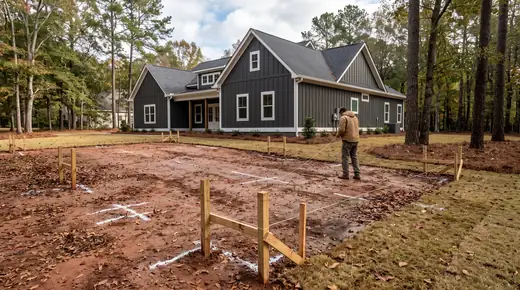
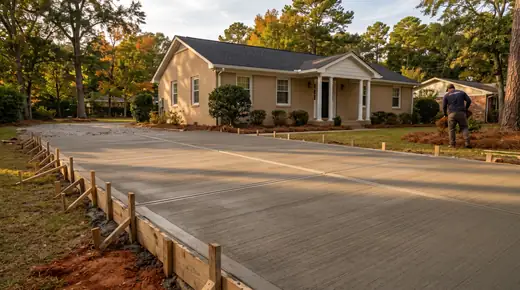
String lines and grade stakes laid out across a yard before a pour at a charcoal farmhouse-modern home in Savannah, GA, after a rain shower.

Step 1: Site Evaluation

We walk the slab with you and read what it is telling us. Settlement cracks, spalled edges, a driveway pitched back toward the garage. We check thickness at a broken edge, look for rebar or wire mesh, and find where water is going.

Worn back patio and steps of the kind a written estimate prices at a buff-brick ranch home in Savannah, GA, in clear late-morning sun.

Step 2: Written Estimate and Permits

You get the scope in writing: square footage, what gets torn out, what gets patched, the finish, and the schedule. Repairs on driveways and sidewalks sometimes need approval before we cut. We handle that paperwork and tell you what it covers.

Broken-out concrete removed and the base rebuilt before a new pour at a painted-white-brick two-story home in Savannah, GA, under an overcast sky.

Step 3: Demolition and Base Prep

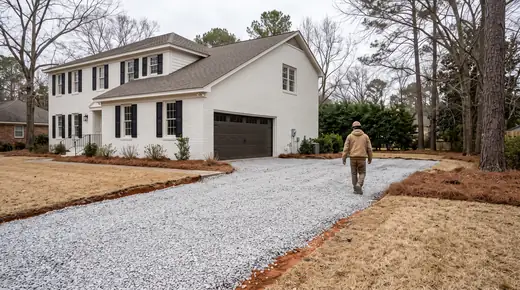
Broken concrete comes out in sections, hauled off, not buried on site. Then the base gets graded and compacted, because most failed flatwork failed underneath first. Soft spots get dug out and replaced with compacted stone so the new pour sits on something solid.

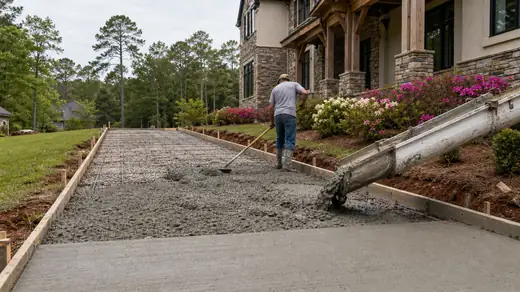
Concrete coming down the chute into formed driveway bays at a stacked-stone and stucco home in Savannah, GA, under bright midday cloud.

Step 4: Forming, Steel and the Pour

Forms go up to the grade and slope we set, usually four inches for sidewalks and five or six for a concrete driveway. Rebar or wire mesh sits on chairs, up in the slab where it works. Concrete installation happens in one continuous pour.

Freshly finished concrete slab curing under a clean broom texture at a tan-brick colonial in Savannah, GA, in late afternoon light.

Step 5: Finishing, Curing and Final Walkthrough

Finish depends on the job: broom texture for traction, stamped and colored for a patio, exposed aggregate where you want grip and pattern. We tool the control joints, cure it properly, and come back to walk it with you once it has hardened.

Repair, Leveling & Resurfacing Pricing in Savannah, GA

Price on repair, leveling and resurfacing work comes down to what we find under the slab and how hard the slab is to get to. Two driveways of the same size can land well apart on the same street. Most of what moves the number is visible from your own back door, so here is what to look at before anyone quotes you.

What changes the priceWhich wayWhy
A slab that is cracked but still sitting on solid basecosts lessLeveling and resurfacing keep the concrete you have, so there is no tear-out and no haul-off.
Voids or washed-out base under the slabcosts moreThe cavity gets filled and the ground stabilized first, because nothing poured on top of a hollow will hold.
How close a truck can getcosts more when access is tightA gate the mixer cannot fit through means a pump or wheelbarrows, which is hours and extra hands.
Old concrete that has to come outcosts moreBreaking, loading and hauling a driveway is a full job of its own before any new flatwork begins.
Thickness and reinforcement the use calls forcosts more for heavier dutyA slab that parks a truck needs depth and rebar. A garden walk does fine on wire mesh.
Water that stands on the surface after raincosts moreGrade has to be corrected, or the same failure comes back under the new surface.
Stamped, colored or exposed aggregate finishcosts moreThose finishes add steps at the pour and a tighter window to work in.

Compare bids line by line: stated slab thickness, rebar or mesh, what base prep is included, whether removal and haul-off are in the number, and how each contractor plans to move water off the concrete.

Repair, Leveling & Resurfacing: Questions We Are Asked Most

Will a resurfaced Savannah slab match the concrete next to it?

No, not exactly. A resurfacer is a new layer of material cured under different conditions than the slab beside it, so the color reads close but rarely identical. We can tint an overlay or run a stamped or colored finish across the whole area to make the difference intentional. Matching a small patch to aged concrete is the harder job, and honest expectations beat a repair that draws the eye.

How soon can we walk on repaired concrete in Georgia weather?

Most patching and overlay work takes foot traffic in about a day, though we tell you the number for your specific mix before we leave. Vehicles wait longer. Humidity slows surface drying, and cool nights slow the whole cure, so a slab poured in one week behaves differently than the same slab in another. We give you a walk-on time and a drive-on time separately.

Is my Savannah concrete worth repairing, or should it be replaced?

It depends on what the cracks are doing. Surface spalling, worn finishes and shallow scaling are resurfacing work, and the slab underneath still does its job. Cracks that run full depth, sections that rock underfoot, or a slab broken into several floating pieces usually mean the base failed, and a new surface on a bad base fails too. We look before we recommend.

Is repair cheaper than replacement for a Savannah driveway?

Usually, yes. Repair keeps the existing slab, which means no demolition, no hauling, and far less new concrete. That gap narrows as damage spreads. Once we are patching more than we are leaving alone, or the base needs rebuilding anyway, replacement stops being the expensive option and starts being the sensible one. We tell you which side of that line your driveway sits on.

What causes concrete to sink in Savannah, Georgia?

Concrete sinks when the ground under it moves, not because the slab itself failed. Water is the usual culprit: a downspout dumping beside the driveway, a bad grade pushing runoff under the edge, a leaking line washing fines out of the base. Poorly compacted fill settles on its own over years. With a median build year of 1971 in this area, plenty of slabs have had decades for that to happen.

How does concrete lifting work, and does it last in Georgia?

We drill small ports through the slab and pump material underneath until the void fills and the slab rises back to level, then patch the ports. The slab you already own stays where it is. Lifting lasts as long as the cause is handled, so we deal with the water first. Fix a downspout, fix a grade, and the fill stays put.

Get a Free Estimate

Get Your Free Quote

We warranty all of our work because we believe in what we do.

Tap to call +1 912-206-8811