+1 912-206-8811
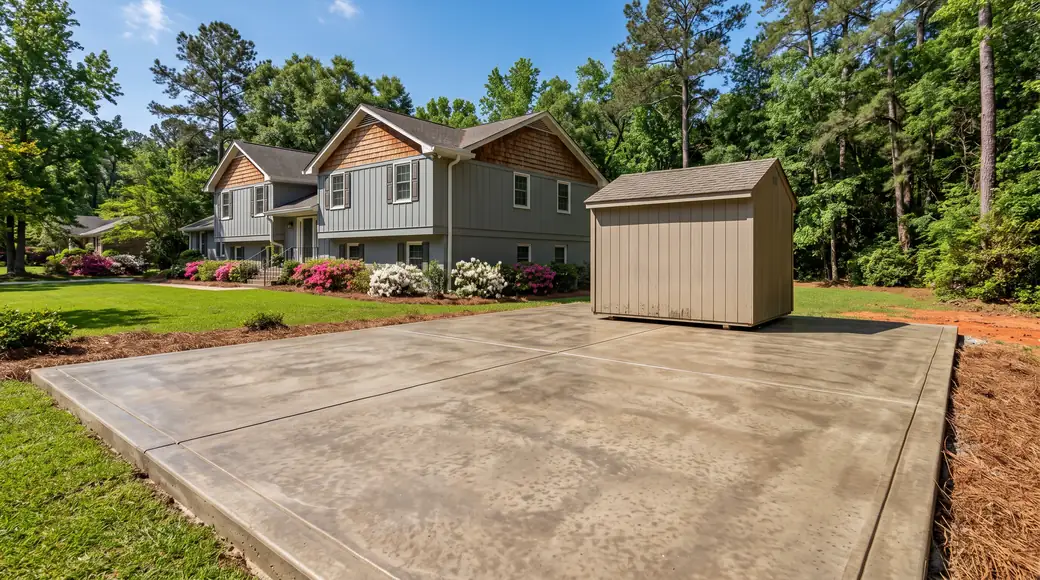
Square-edged concrete slab pad with a storage shed on it at a grey split-level home in Savannah, GA, in clear late-morning sun.

Concrete Slabs & Pads in Savannah, GA

A slab is flat concrete poured on prepared ground and left to carry weight: a shed floor, a garage pad, a patio, the base under an addition. Thickness, reinforcement and the dirt underneath decide how long it lasts. We pour plain gray, and we pour stamped concrete when a patio should read as something other than a driveway. The work is not complicated. Doing it right is mostly a matter of not skipping the parts nobody ever sees.

Most of what we do sits at ground level. Slabs, pads, driveways, sidewalk installation, the flatwork around a house that gets walked on every day of the year. As a concrete contractor working in Savannah, we spend more time on grading, base and forms than on the pour itself. Rebar or wire mesh goes in before anything wet arrives. By the time the truck backs up, the shape of the job is already settled.

Old slabs tell you what was skipped. A lot of houses here date to around 1971, and their pads show it: cracks running corner to corner, one corner dropped an inch, a sidewalk that heaves at a single joint. Some of that is simply age. Much of it is thin concrete poured over loose fill with no steel inside. We look at why the old one failed before talking about replacing it.

What a slab costs to get right is mostly preparation and labor, and that is where the money belongs. Compacted base, honest thickness, steel where it does some good, control joints cut before the concrete decides on its own where to crack. Skip those and you pay for the slab twice. We keep the scope plain and the measurements written down, whether the job is in town or out toward Pooler. Call for a free estimate on a slab, a pad, or the flatwork around it.

Call +1 912-206-8811

Licensed, Bonded, and Insured ยท A combined 15 years of experience

Get Your Free Quote

We warranty all of our work because we believe in what we do.

What Concrete Slabs & Pads Involves

Concrete slab area formed and prepped, wire mesh set before the pour at a painted-white-brick two-story home in Savannah, GA, under an overcast sky.

Slab installation

Most slabs we set here run four inches thick on compacted base, with rebar or wire mesh tied through the field and thickened edges where the load sits. Bad base is what cracks a slab, not thin concrete. We compact before anything gets poured.

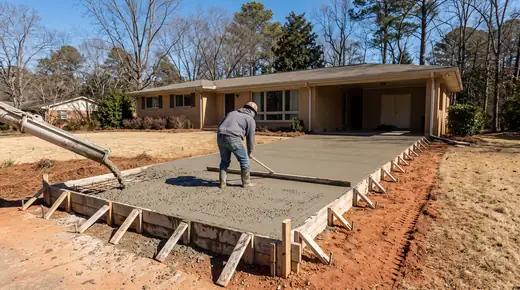
Concrete being poured and screeded across a formed slab at a buff-brick ranch home in Savannah, GA, in clear late-morning sun.

Concrete pouring

Pouring is one continuous push: place, screed, bull float, then wait for bleed water to leave before finishing. Finish too early and you seal moisture in, which leaves a dusty, flaking surface. Control joints get cut the same day, roughly every ten feet.

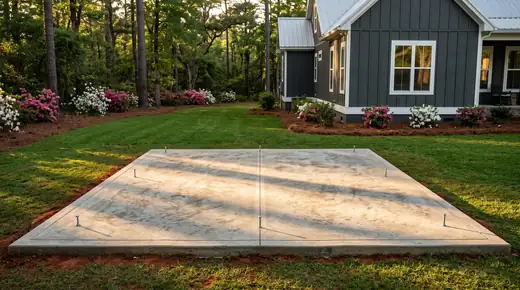
Small square concrete pad poured for a storage shed, anchor bolts set at a charcoal farmhouse-modern home in Savannah, GA, in late afternoon light.

Shed slab

A shed slab wants a thickened perimeter and anchor bolts set while the concrete is still wet, so the building has something to hold. Six inches of compacted stone underneath, poly vapor barrier if you are storing anything that rusts, and a broom finish for footing.

What Savannah Properties Need From Concrete Slabs & Pads

A slab is flat concrete poured on ground you have prepared first, and a pad is the same thing sized to carry one object: a shed, a heat pump, a generator, a hot tub. Most of what we pour in Savannah goes next to a house built around 1971, the median year for housing here. Those houses came with flatwork that has been working for five decades. Some of it is still sound and holds a straight edge. Some of it has broken into pieces you can pick up by hand, and the new slab has to land where the old one sat.

Sizing comes before anything else. We measure what the pad has to carry and what it has to meet: an existing garage floor, a back step, a driveway apron, a threshold sitting at whatever height it sits at. Access matters just as much. An older lot in town can have a fence line, a grown tree, and six feet between the house and the property line, so concrete moves by buggy or pump instead of straight off the chute. Newer streets out toward Pooler usually open up more. We settle that standing on the ground.

Most slab failures start below the surface. Concrete poured over loose fill, or over a base nobody compacted, will settle, and no amount of finish work on top corrects it later. We see wire mesh left flat on the dirt where it does nothing at all. We see slabs poured thin at one end because the grade went unchecked, and control joints cut too late or too shallow to steer anything. Concrete cracks. The only real question is whether it cracks on a line we put there deliberately or straight across the middle of your patio.

Getting it right is unglamorous work. Strip the topsoil rather than pour over it, compact in lifts, set rebar or mesh up on chairs so it lands in the concrete instead of under it, and hold thickness across the whole pour, not just at the visible edges. Finish is the last call, not the first: broom for grip, exposed aggregate, or stamped and colored concrete when the pad is going to be lived on. Then it cures without traffic. Against a house that has already stood since the early seventies, a slab done this way should be the part nobody thinks about again. Call for a free estimate.
How a Concrete Slabs & Pads Job Runs in Savannah

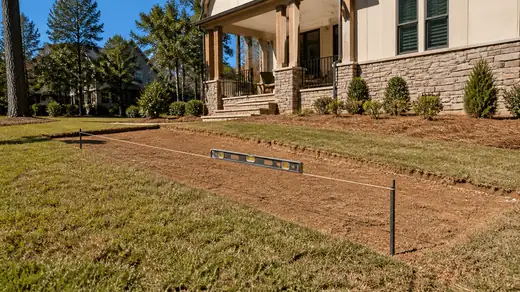
Backyard grade checked with a level and string before a patio pour at a stacked-stone and stucco home in Savannah, GA, in clear late-morning sun.

Step 1: Site Evaluation

We walk the area, check drainage, and probe for soft spots or old fill. Slope, tree roots, buried utilities and access for a truck all get noted. Most homes here were built around 1971, so we look at what the original slab is doing before planning anything.

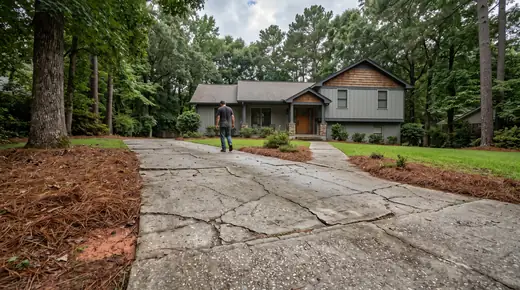
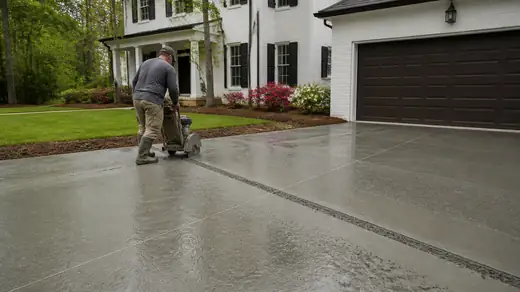
Concrete driveway and walk at a home, the kind of job an estimate covers at a grey split-level home in Savannah, GA, after a rain shower.

Step 2: Written Estimate and Permits

You get the scope in writing: square footage, slab thickness, reinforcement, finish, and how the concrete installation is staged. We handle permit paperwork where the job needs it. Nothing starts until you have read the estimate and told us to go ahead.

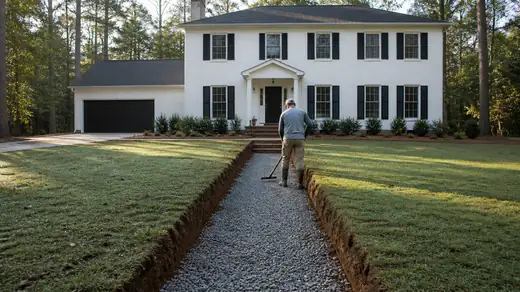
Front walkway removed and the trench squared out for a new pour at a painted-white-brick two-story home in Savannah, GA, in early morning light.

Step 3: Demolition and Base Prep

Old concrete comes out and gets hauled off. We excavate to grade, then compact four to six inches of crushed stone in lifts. Skipped compaction is the usual reason a slab settles and cracks, so this step takes longer than people expect.

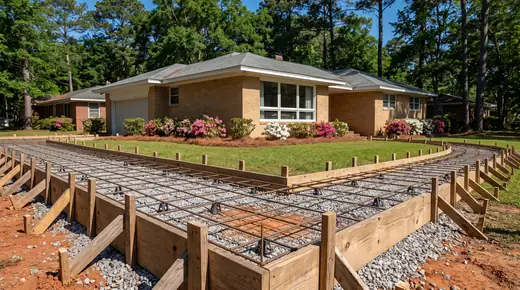
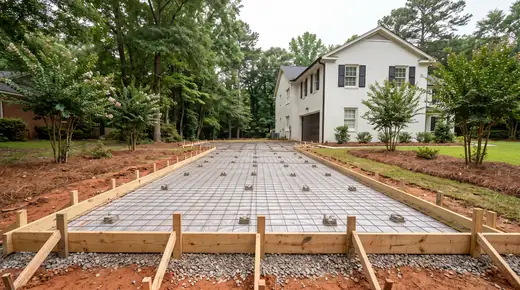
Wooden forms and rebar grid set and tied, ready for concrete at a buff-brick ranch home in Savannah, GA, in clear late-morning sun.

Step 4: Forming, Steel and the Pour

Forms get set and checked for pitch so water runs off, not toward the house. Rebar or wire mesh sits on chairs in the middle of the slab, not on the ground. Concrete goes in continuously, screeded and bull floated as it comes.

Control joints cut into a new slab the day after the pour at a painted-white-brick two-story home in Savannah, GA, under an overcast sky.

Step 5: Finishing, Curing and Final Walkthrough

Sidewalks and driveways get a broom finish for traction. Control joints are cut early to steer cracking. We cure the slab, then walk it with you: joint spacing, edges, drainage, and how long to stay off a concrete driveway before parking on it.

Concrete Slabs & Pads Pricing in Savannah, GA

Every slab gets priced off the site, not off a catalog. Two pads of the same size on the same street can land far apart depending on what sits under them and how a truck reaches the forms. The median home in Savannah was built in 1971, so an original walk or pad often has to come out before anything new goes down. Most of what moves the number, you can walk out and look at yourself.

What changes the priceWhich wayWhy
An old slab, walk or pad inside the footprintCosts moreBreaking it up, loading it and hauling it off is its own day of work before a single form goes in.
How close the mixer can back to the pourCosts less the closer it getsA truck at the forms discharges straight in. When it cannot, concrete moves by pump or buggy, and that is labor and time.
Tree roots, buried lines or an old footing under the gradeCosts moreAnything we find has to be worked around or removed, and it changes how we excavate.
Thickness the use calls forCosts more as it goes upA patio and a pad that parks a truck are different pours. Thicker slab, more concrete, more base under it.
Rebar in place of wire meshCosts moreRebar is heavier steel, tied on chairs, and takes longer to set than rolled mesh.
Which way the ground falls and where water landsCosts more when it has to be regradedFlatwork has to shed water away from the house. Cutting, filling and compacting to hold slope is real work.
Stamped, colored or exposed aggregate finishCosts more than broom finishThese add forming, release, washing and sealing steps, plus return trips.
Whether the work needs a City of Savannah permitCosts morePermit fees and inspection scheduling belong in the bid, not in a surprise later.

Set two bids next to each other and the real differences hide in the parts nobody photographs. Ask what thickness each contractor is pouring, what reinforcement goes in, who hauls the broken concrete, whether the subgrade gets compacted, how many control joints are cut and where, and whether the permit sits inside the number. A bid that names those is comparable. One that says only "concrete patio" is not.

Concrete Slabs & Pads: Questions We Are Asked Most

Do I need a permit for a slab on my Savannah property?

Yes, in most cases. Slabs that carry a structure, change drainage, or sit within a setback are reviewed before you pour, and detached slabs are often treated differently than attached ones. Requirements vary with what the slab supports and where it sits on the lot. We pull what the job calls for and build to the approved plan. Ask us early and we will tell you what your slab needs.

Can you pour a slab in Savannah in winter?

Yes. Cold weather changes the schedule, not the outcome. We watch overnight lows against the pour date, protect fresh concrete with blankets when the forecast calls for it, and hold off on finishing until the surface is ready rather than working it early. Concrete sets slower in cold, so stripping forms and putting weight on the slab both move out. We plan the calendar around that instead of forcing it.

Does a slab need a vapour barrier in Georgia?

Yes, for anything enclosed or finished. A sheet of polyethylene under the slab keeps ground moisture from moving up through the concrete into flooring, framing, or stored goods. Garage slabs, workshop floors, and any pad that will get a coating or tile want one. An open patio or a plain equipment pad matters less. We install the barrier over compacted base, lap the seams, and keep it intact while we set rebar.

What thickness of slab do I need for a shed or workshop in Savannah?

A four inch slab handles a garden shed, a shop with hand tools, and normal foot traffic. Go to five or six inches with rebar on chairs when you plan to park a vehicle, run a lift, set heavy machinery, or store lumber and steel. Thickness is only part of it. The compacted base under the concrete does as much work as the concrete does, so we do not skip it.

How level can you get a Savannah slab, and how is that measured?

Very close, and it is measured with a straightedge or a laser across the finished surface. Interior floors get screeded and floated flat, then checked for high and low spots before the concrete stiffens. Exterior flatwork is different: driveways, patios, and sidewalks are pitched deliberately so water runs off instead of standing. Flat and level are not the same target outside, and we set the fall on purpose.

Would a monolithic or a floating slab suit a Savannah property?

Depends on what sits on top. A monolithic slab pours the footing and the floor together in one placement, which suits garages, additions, and small structures on a stable, well drained lot. A floating slab is poured separately from the foundation and moves independently, which fits sheds and outbuildings. We look at the load, the site, and the drainage, then recommend one.

Get a Free Estimate

Get Your Free Quote

We warranty all of our work because we believe in what we do.

Tap to call +1 912-206-8811