+1 912-206-8811
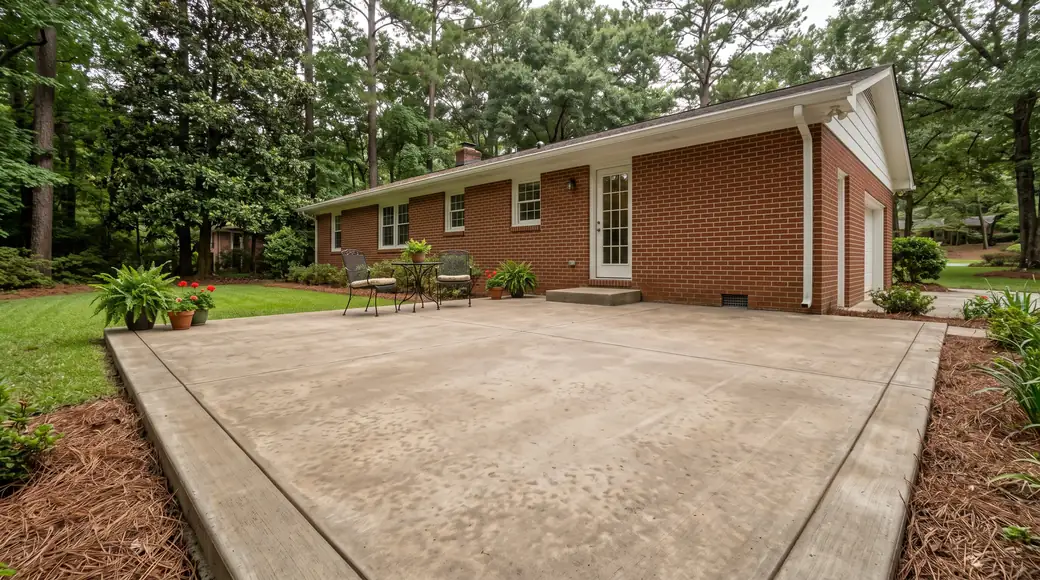
Rectangular concrete patio with a low step up to the rear door at a red-brick ranch home in Savannah, GA, under an overcast sky.

Patio Construction & Outdoor Living in Savannah, GA

We pour patios, and we build the concrete that goes around them: slabs for a grill and a table, steps down into the yard, a sidewalk running from the drive to the back door. Some of it is plain broom finish. Some of it is stamped concrete cut to read as stone or plank. As a concrete contractor, we treat a patio the way we treat any flatwork, which means the part you never see is the part that decides how long the part you do see holds up.

Layout comes first, then the digging. We strip topsoil, compact the base, set forms to the fall we want water to take, and tie in rebar or wire mesh before a truck ever backs up to the site. Pour day is short. Finishing is not. Broom, stamped, colored, exposed aggregate: each has its own window, and that window closes when the concrete says so, not when we are ready for it to.

Most of the failed patios we get called out to look at failed from underneath. The median home here was built in 1971, so we see a lot of slabs poured on loose fill, with no steel in them, sloped back toward the house instead of away. Cracks follow. So does water standing against a foundation that would rather stay dry. Once a slab has moved, patching the same corner every couple of years costs more attention than tearing it out and pouring it correctly.

Doing this right means spending on the parts nobody photographs: base, steel, slab thickness, and control joints cut before the concrete picks its own place to crack. A stamped patio over a bad base is a bad patio with a pattern on it. Permits, on the jobs that need them, go through the City of Savannah, and we pull them ourselves. We work in Savannah and out toward Pooler. Call for a free estimate.

Call +1 912-206-8811

Licensed, Bonded, and Insured ยท A combined 15 years of experience

Get Your Free Quote

We warranty all of our work because we believe in what we do.

What Patio Construction & Outdoor Living Involves

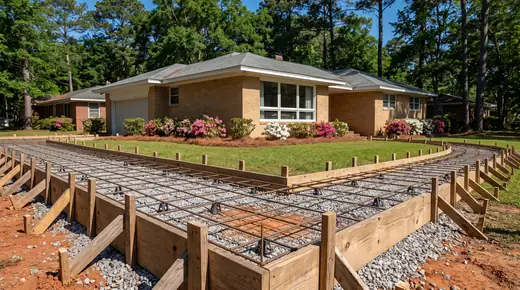
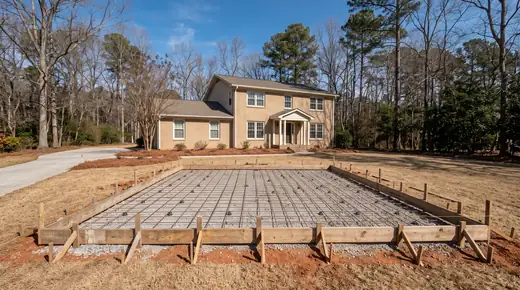
Concrete patio formed and prepped, base and rebar visible before the pour at a tan-brick colonial in Savannah, GA, in clear late-morning sun.

Patio construction

Grading and a compacted base come first, then a four inch slab over wire mesh or rebar. We work as a concrete contractor on homes and commercial concrete jobs, and the base gets the same attention either way. Thin or soft base is what breaks patios.

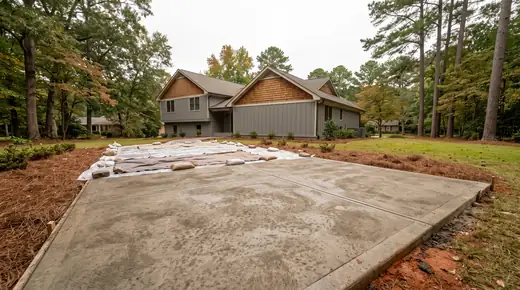
Freshly poured concrete patio still curing under plastic sheeting at a grey split-level home in Savannah, GA, under an overcast sky.

Concrete patio installation

Finish choices get set before the pour: broom, exposed aggregate, or stamped concrete colored to match the house. We cut control joints so the slab cracks on a line we chose, not across the middle. A short concrete sidewalk tying the patio to the driveway pours the same day.

What Savannah Properties Need From Patio Construction & Outdoor Living

A patio is flatwork you actually live on, so it gets judged differently than a driveway. Housing here runs to a median build year of 1971, and those homes mostly came with a small back slab poured thin, no rebar, sometimes not even wire mesh. They cracked, settled toward the house, and got covered over with pavers or outdoor carpet. We pour the replacement at full thickness, on compacted base, sized for how the yard actually gets used.

Finish is where most of the decision sits. Stamped concrete takes a pattern off the form and holds it. Colored concrete carries tone through the slab instead of sitting on top of it, and exposed aggregate gives you texture underfoot that stays honest when the surface is wet. We pour all three. Which one suits a house from the early seventies usually comes down to the brick, the trim, and whatever the roofline is already doing.

Failures in a concrete patio are boring and predictable. Water is the main one: a slab poured flat, or pitched back toward the foundation, sends runoff exactly where it does the most damage. Thin pours crack in a grid. Slabs poured tight against a house with no isolation joint will push at the brick as they move. Reinforcement, rebar or wire mesh, does not prevent a crack, but it keeps the two halves in plane.

Outdoor living means more than the slab now. Grill pads, seat walls, steps down to grade, a concrete sidewalk running from the drive around to the back gate: we pour those with the patio, in one go, so the joints line up and the color matches across everything. Adding them later rarely matches, no matter how careful the mix is. We would rather lay out the whole footprint once, even if you build it in pieces over several years.

Doing it right costs time more than it costs anything else. Base preparation, forming to a real slope, letting the pour cure before anything heavy sits on it: skip any of that and a new patio looks twenty years old inside of three. We do this work throughout Savannah and west toward Pooler, on new construction and on tired slabs from the original build alike. Call for a free estimate.
How a Patio Construction & Outdoor Living Job Runs in Savannah

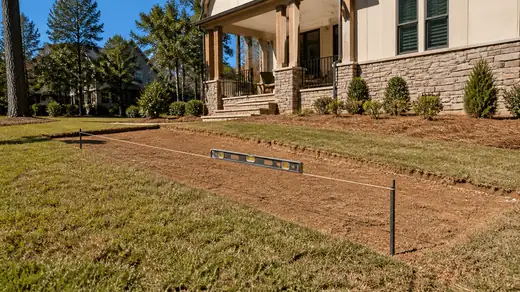
Backyard grade checked with a level and string before a patio pour at a stacked-stone and stucco home in Savannah, GA, in clear late-morning sun.

Step 1: Site Evaluation

We walk the area with you and check the things that decide the job: drainage direction, how the ground sits against the house, tree roots, and where water already pools after rain. We measure, note access for a truck, and mark where the slab has to tie into existing driveways.

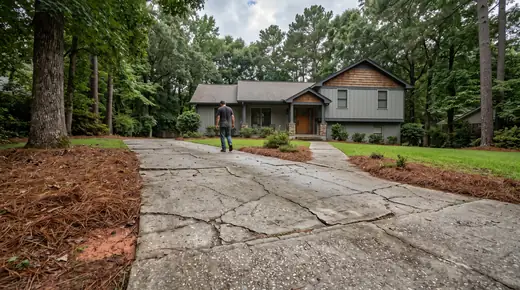
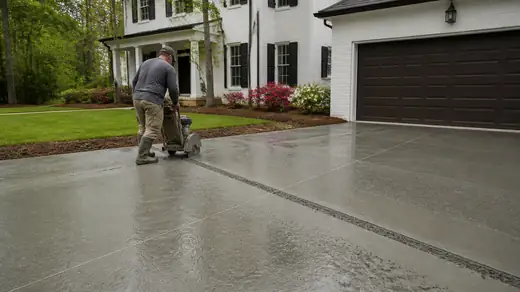
Concrete driveway and walk at a home, the kind of job an estimate covers at a grey split-level home in Savannah, GA, after a rain shower.

Step 2: Written Estimate and Permits

You get the scope in writing: square footage, slab thickness, reinforcement, finish, joint layout. We pull whatever permit the work calls for before anything comes out. Anything that could change once we open the ground, like buried debris or a soft subgrade, gets named in the estimate.

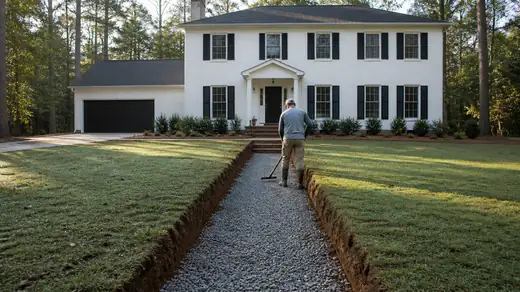
Front walkway removed and the trench squared out for a new pour at a painted-white-brick two-story home in Savannah, GA, in early morning light.

Step 3: Demolition and Base Prep

Old concrete comes out and gets hauled off. We excavate to grade, then compact a graded aggregate base in lifts, usually four inches, with a plate compactor or roller. Skipping compaction is what cracks slabs later. We set the slope for runoff here, before any forms go up.

Wooden forms and rebar grid set and tied, ready for concrete at a buff-brick ranch home in Savannah, GA, in clear late-morning sun.

Step 4: Forming, Steel and the Pour

Forms get staked and strung to the grade we set. Number three rebar on chairs for driveways and heavier slabs, wire mesh lifted off the base for lighter flatwork. Steel sitting on dirt does nothing. Concrete installation happens in one continuous pour where the layout allows, screeded and bull floated.

Control joints cut into a new slab the day after the pour at a painted-white-brick two-story home in Savannah, GA, under an overcast sky.

Step 5: Finishing, Curing and Final Walkthrough

Finish depends on what you picked: broom for traction, stamped and colored, or exposed aggregate. Control joints get cut early, roughly a quarter of the slab depth, so cracks land where we put them. We cure it, keep traffic off, then walk the sidewalks and driveways with you.

Patio Construction & Outdoor Living Pricing in Savannah, GA

Two patios the same size can come in at very different numbers, and the gap is almost always decided before the truck ever backs in. Most of what moves the price is something you can walk out and look at yourself.

What changes the priceWhich wayWhy
An old slab already sitting where the patio goesCosts moreThe median home in Savannah was built in 1971, so a lot of these jobs start with breaking out concrete, loading it, and hauling it off before any new flatwork begins.
A clear path from the street to the pourCosts lessWhen the truck can get a chute to the forms, concrete goes in fast. A narrow gate, a fence, or a slope means wheelbarrows or a pump, and that is labor.
Thickness and reinforcement the slab calls forCosts moreA patio carrying a kitchen, a fire feature, or vehicle traffic gets a thicker pour and rebar instead of wire mesh.
Tree roots, stumps, or soft fill under the padCosts moreAnything that will rot, settle, or push has to come out, and the hole gets backfilled and compacted before we set grade.
Which way water runs off the finished slabCosts moreIf the yard drains back toward the house, the fix is regrading, a drain line, or both, and that work happens under the concrete.
Broom finish versus stamped or colored concreteCosts moreStamped and integral color add material, more hands on site during a short working window, and a sealing step at the end.
Steps, tie-ins, and a big drop from the door thresholdCosts moreForming risers, matching an existing slab, and building up elevation all take forming time that a flat rectangle does not.

Ask every bid to put the same items in writing: slab thickness, rebar or wire mesh, base depth, who removes and hauls the old concrete, where the control joints land, and the exact finish. A bid missing those is not cheaper. It is less specific.

Patio Construction & Outdoor Living: Questions We Are Asked Most

What finish wears best on a patio in Georgia?

Broom finish holds up longest with the least fuss. The texture gives you grip when the surface is wet, and it hides the small marks that any patio picks up over years of chairs, planters and foot traffic. Exposed aggregate wears well too and reads warmer underfoot. Stamped concrete looks the sharpest, though the sealer on stamped and colored work needs redoing periodically to keep the color from going flat.

Can a Savannah patio be extended later without the join showing?

No, not entirely. A cold joint between an old pour and a new one is always visible if you look for it, because the two slabs cure years apart and the color never matches exactly. What we can do is make the join deliberate: run it along a control line so it reads as a design break rather than a repair. Broom direction and edge detail get matched as closely as possible.

How do you stop a patio holding water after Savannah rain?

Slope. We set the slab to fall away from the house at a consistent pitch, usually about a quarter inch per foot, and we hold that grade with string lines and screed pins during the pour rather than trying to correct it afterward. Where a patio sits low or a downspout dumps nearby, we tie in a drain or a channel before any concrete goes down. Flat patios puddle. Sloped ones do not.

What size patio makes sense for a typical Savannah back garden?

Start with the furniture, not the yard. A table with six chairs pulled out needs roughly twelve by twelve feet before anyone is squeezing past. Add a grill or a seating area and you are into sixteen by twenty. Most homes here were built around 1971, so the back gardens tend to be regular rectangles with room to work. We lay it out in paint first so you can walk it.

Can you pour a patio around an existing deck or pool in Savannah?

Yes. Pouring against a deck means isolating the posts so the slab can move without pushing on them, and we form a clean edge rather than butting concrete up hard against wood. Around a pool, the work is a bond beam detail and careful slope away from the water. Both are ordinary flatwork with more forming and more hand finishing at the edges.

Will a concrete patio get too hot to walk on in Georgia summers?

Yes, in direct afternoon sun, like most hard surfaces. Color changes it: lighter gray and pale integral colors stay noticeably cooler than dark charcoal or deep browns. Shade matters more than the mix does, so we talk about where the sun lands before choosing color. If the patio is barefoot territory near a pool, we steer toward the lighter end.

Get a Free Estimate

Get Your Free Quote

We warranty all of our work because we believe in what we do.

Tap to call +1 912-206-8811