+1 912-206-8811
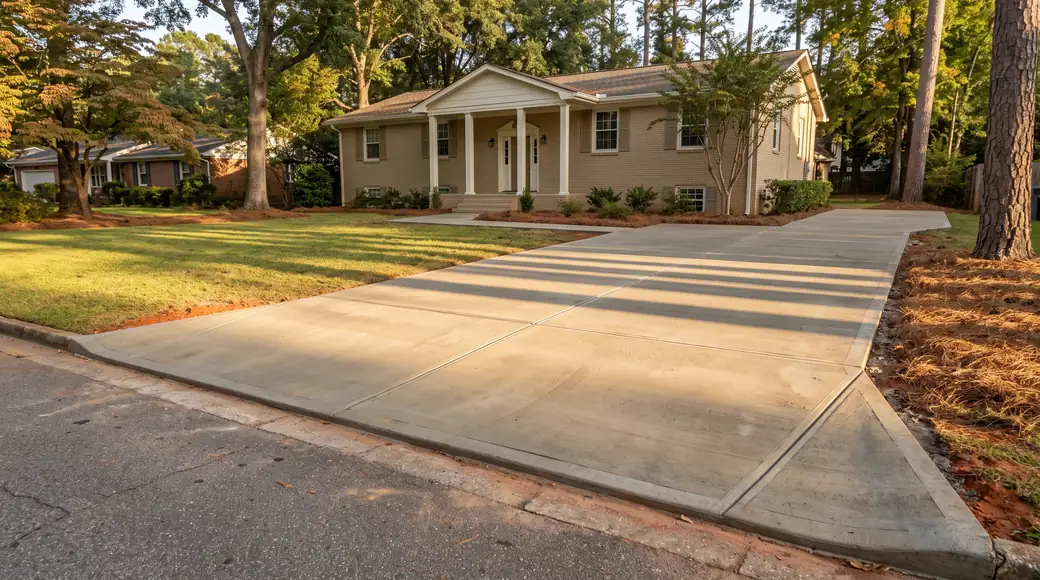
Wide view of finished concrete flatwork across the front of a home at a tan-brick colonial in Savannah, GA, in late afternoon light.

Garage & Shed Floors in Savannah, GA

A garage or shed floor is a concrete slab that lives a harder life than most flatwork. It carries vehicle weight on four small tire patches, holds under jack stands, and gets scraped by toolboxes, mowers and bike kickstands. We pour it flat, reinforced, and pitched so water runs toward the door instead of standing at the back wall. Thickness, mix and steel get picked for what the building actually holds. A shed for a mower is not a two-car garage.

Most of the work happens before any concrete shows up. The base gets graded and compacted, forms go up square to the building, and rebar or wire mesh is tied and held up off the dirt where it can do something. The pour itself is a few steady hours with enough hands to finish the whole slab on time. Then it cures, and it needs to be left alone while it does.

Failures repeat themselves, and we see the same short list. Slabs poured thin over soft fill. Wire mesh lying flat on the ground. No control joints, so the slab picks its own crack line, usually straight across the middle. Floors pitched back into the building. A shed slab with no thickened edge under the wall plate. Whether the building is a detached garage down a side street or a metal shop in Pooler, none of it announces itself the first year.

What it takes to get a floor right sits almost entirely in the parts nobody looks at twice: base prep, steel placement, real thickness, joints cut on time. We work as a concrete contractor across driveways, patios, sidewalk pours and stamped concrete, and a garage floor gets the same groundwork as any of them. In a city where the median home went up in 1971, plenty of these buildings are older than the vehicles parked in them, and the slab is what decides how the next thirty years go. Call for a free estimate and we will come look at what you have.

Call +1 912-206-8811

Licensed, Bonded, and Insured ยท A combined 15 years of experience

Get Your Free Quote

We warranty all of our work because we believe in what we do.

What Garage & Shed Floors Involves

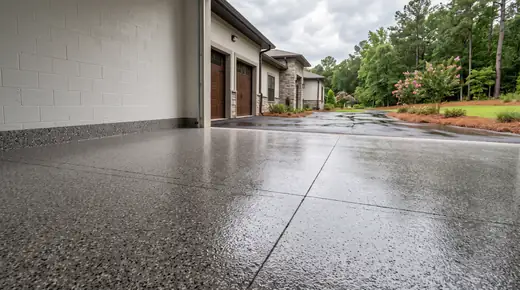
Epoxy-coated garage floor with speckled grey and charcoal flakes in Savannah, GA, after a rain shower.

Garage floor coating

Coating fails on prep. We grind the slab open, check it for moisture, fill the pitting, then roll epoxy or polyaspartic and broadcast flake. Oil gets degreased out first, since no concrete contractor can bond a coating to a greasy slab. Color can match stamped concrete outside.

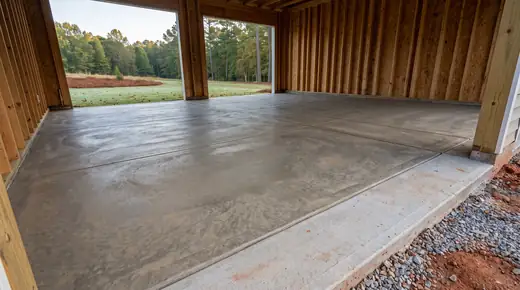
New concrete garage floor slab troweled smooth in an unfinished garage in Savannah, GA, in early morning light.

Concrete floor installation

Shed and garage slabs start below grade: compacted base, vapor barrier, four inches of concrete, rebar or wire mesh tied in. We saw control joints early so shrinkage cracks land where we put them. Same mix and methods we use for a concrete sidewalk or commercial concrete pour.

What Savannah Properties Need From Garage & Shed Floors

Garages and sheds sit on the same flatwork as any slab, but they take loads a patio never sees. A vehicle parked in the same spot for years, a jack stand, a rolling toolbox, a shed full of bagged mulch. We pour and replace those floors across Savannah, on houses new and old. The median home here was built in 1971, so plenty of these slabs are working past what they were poured to do. That is not a defect. It is age.

Most jobs start with us standing on what you have. Slab thickness, how the ground moved under it, whether the old pour has rebar or wire mesh or nothing at all, where water gets in at the door. Some floors can be ground flat and overlaid. Others come out to the base and get poured again. We say which one we think it is, and why, before anything gets loud. Sheds and garages are not the same problem, and we do not scope them the same way.

Cracks in a slab poured in 1971 usually tell you something about what is under the concrete, not about the concrete itself. Fill in the base that settled, a downspout emptying against the slab edge, no control joints cut while the pour was young. Patch the crack, leave the cause, and it opens along the same line again. Spalling at the door line is its own problem, worth catching early, because it works inward. We would rather fix the reason.

The work that decides whether a floor lasts happens before the truck arrives. Base compacted in lifts, thickness matched to what will park on it, rebar or wire mesh held up in the pour instead of lying on the dirt, joints cut on time. Finish sits on top of that: broom texture for grip, exposed aggregate, stamped or colored concrete where a shed floor shows. None of it rescues a bad base. Concrete is unforgiving that way. What you skip stays skipped.

Homes here carry a median value of $225,200, and household income runs below the Georgia median at $56,782 against $74,664. That shapes how we talk about a floor: what has to be done now, what can wait, and what would be spending for its own sake. We do concrete work through Savannah and out toward Pooler, and the terms are the same wherever the truck goes. Most of these floors do not need replacing. They need someone to look at them honestly. Call for a free estimate on a garage or shed floor.
How a Garage & Shed Floors Job Runs in Savannah

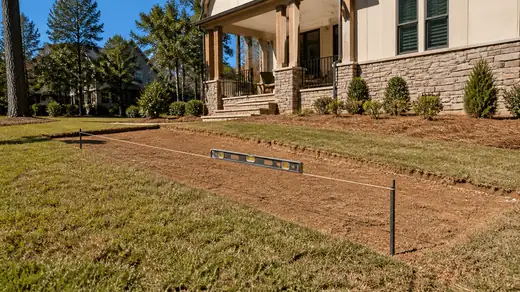
Backyard grade checked with a level and string before a patio pour at a stacked-stone and stucco home in Savannah, GA, in clear late-morning sun.

Step 1: Site Evaluation

We walk the space, measure it, and check how water moves across the pad and where it exits. Slope, existing slab condition, access for a truck or buggy, and soft spots underfoot all get noted. Most Savannah homes we look at sit on stock built around 1971.

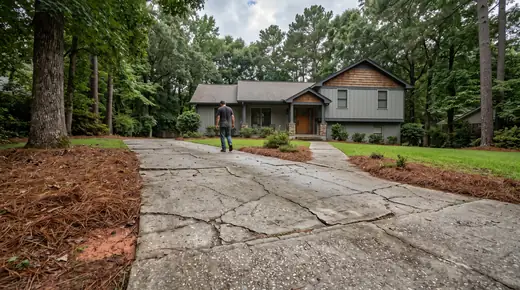
Concrete driveway and walk at a home, the kind of job an estimate covers at a grey split-level home in Savannah, GA, after a rain shower.

Step 2: Written Estimate and Permits

You get an itemized written estimate: square footage, slab thickness, reinforcement, finish, and any demolition or haul-off. Permitting gets handled where the job calls for it. Nothing starts until you have read the scope and agreed to it, so there are no surprises mid-pour.

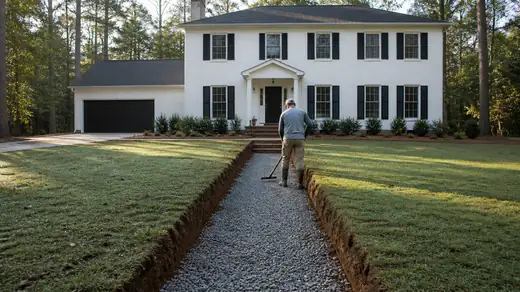
Front walkway removed and the trench squared out for a new pour at a painted-white-brick two-story home in Savannah, GA, in early morning light.

Step 3: Demolition and Base Prep

Old slabs come out and get hauled off. Then we cut to grade and build a compacted stone base, usually four to six inches, running a plate compactor in lifts. Skipping this step is what causes settling and cracking later, and no amount of good concrete installation fixes bad ground.

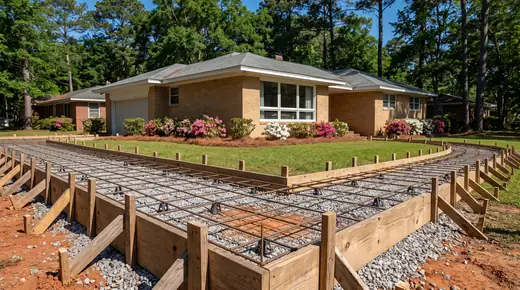
Wooden forms and rebar grid set and tied, ready for concrete at a buff-brick ranch home in Savannah, GA, in clear late-morning sun.

Step 4: Forming, Steel and the Pour

Forms get set to line and grade, then rebar on chairs or wire mesh goes in, tied and lifted so the steel sits inside the slab instead of on the dirt. Four inches is typical, thicker where vehicles park. Concrete gets placed, screeded, and bull floated.

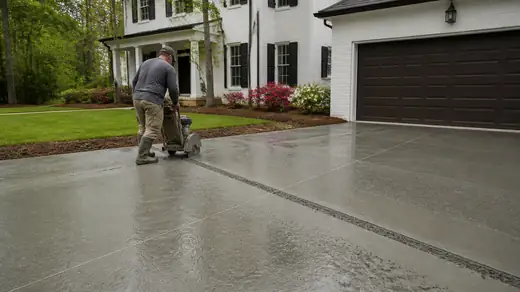
Control joints cut into a new slab the day after the pour at a painted-white-brick two-story home in Savannah, GA, under an overcast sky.

Step 5: Finishing, Curing and Final Walkthrough

Finish depends on use: a broom finish for traction, a trowel finish for a garage, stamped or colored concrete where it ties into patios, driveways or sidewalks. Control joints get cut early to steer cracking. Curing runs several days, and we walk the finished concrete driveway or slab with you.

Garage & Shed Floors Pricing in Savannah, GA

Two garage floors of the same size can land well apart, and the reasons are usually visible before anyone pours. Most of it comes down to what is already on the ground, how close a concrete truck can get to it, and how thick the slab has to be for what you park on.

What changes the priceWhich wayWhy
An old slab that has to come outcosts moreBreaking, loading and hauling a slab is its own day of work, and rebar buried in it slows that down further.
Bare ground already close to gradecosts lessNo demolition, so we go straight to grading and compacting, then forming.
A truck that can back within chute reachcosts lessConcrete off the chute goes in fast. Wheelbarrowing or pumping around a fence, a slope or a tight side yard adds crew and hours.
Slab thickness the use calls forcosts more as it climbsA shed floor under a mower is not a floor under a truck. Thicker slab, more concrete, deeper base.
Rebar instead of wire meshcosts moreMesh handles light flatwork. Rebar tied in a grid and set on chairs is material and labor both, and heavy loads call for it.
Ground that holds water at the doorcosts moreDrainage gets solved before the pour, whether that means regrading, a drain, or pitching the slab so water leaves.
Soft or filled ground under the padcosts moreAnything that will not compact comes out and gets replaced with clean stone, measured in truckloads.
Stamped, colored or exposed aggregate finishcosts moreA broom finish is one pass. Decorative work is more product, more labor, and a longer finish window on the same slab.

Compare bids line by line rather than by the number at the bottom. Look for slab thickness, reinforcement and its spacing, base depth and material, whether demolition and haul-off are included, and how the edges are formed. A bid well under the others is usually short in one of those places.

Garage & Shed Floors: Questions We Are Asked Most

Do you do workshop and shed floors around Savannah too?

Yes. A detached shop, a garden shed, a two-bay garage: the slab work reads the same to us. Sheds usually sit on a thinner slab than a garage because nothing heavy parks on them, though we will thicken the pour where a lift, a lathe or a loaded bench is going. Tell us what lands on the floor and we size the slab, the rebar and the wire mesh to it.

Can you pour a new garage floor over the old one in Savannah?

Sometimes. A bonded overlay works when the existing slab is sound underneath, well drained, and only worn on the surface. If it is cracked through, pumping water, or moving at the joints, an overlay just cracks along the same lines in a year or two. We look at the old slab first, cut a core if the picture is unclear, and tell you honestly which way it should go.

Can you level a sloping garage floor in a Savannah home?

Yes, though the fix depends on why it slopes. Plenty of garages were built with deliberate fall toward the door so water runs out, and that slope is worth keeping. Settlement is different. We can grind high spots, pour a self-leveling topping over a stable slab, or tear out and repour where the subgrade underneath has given way. Houses here often date to around 1971, so both show up.

What coating holds up on a garage floor in Georgia humidity?

Polyaspartic and quality epoxy both hold up, but the coating matters less than what happens before it. Moisture moving up through a slab is what lifts a coating off, so we test the slab, grind rather than acid etch, and use a moisture-tolerant primer when the readings call for it. A coating over a damp, unground floor peels no matter what is printed on the bucket.

How long before I can drive on a new Savannah garage floor?

Usually about a week for cars, longer for anything heavy. Foot traffic comes sooner, often within a day or two, and we will tell you when. Concrete keeps gaining strength for weeks after it looks finished, and driving on it early leaves marks you cannot undo. Weather shifts the schedule, so we give you the real date once we see how the slab cures.

Why does my Savannah garage floor dust, and can it be fixed?

Dusting means the surface paste is weak, usually from water worked into the finish, a fast dry, or curing that got skipped. It can be fixed. A densifier hardens the top layer and stops most of it, and grinding removes the soft skin where the dusting runs deeper. Where the slab is failing further down, a topping or a repour is the honest answer. Call for a free estimate.

Get a Free Estimate

Get Your Free Quote

We warranty all of our work because we believe in what we do.

Tap to call +1 912-206-8811