+1 912-206-8811
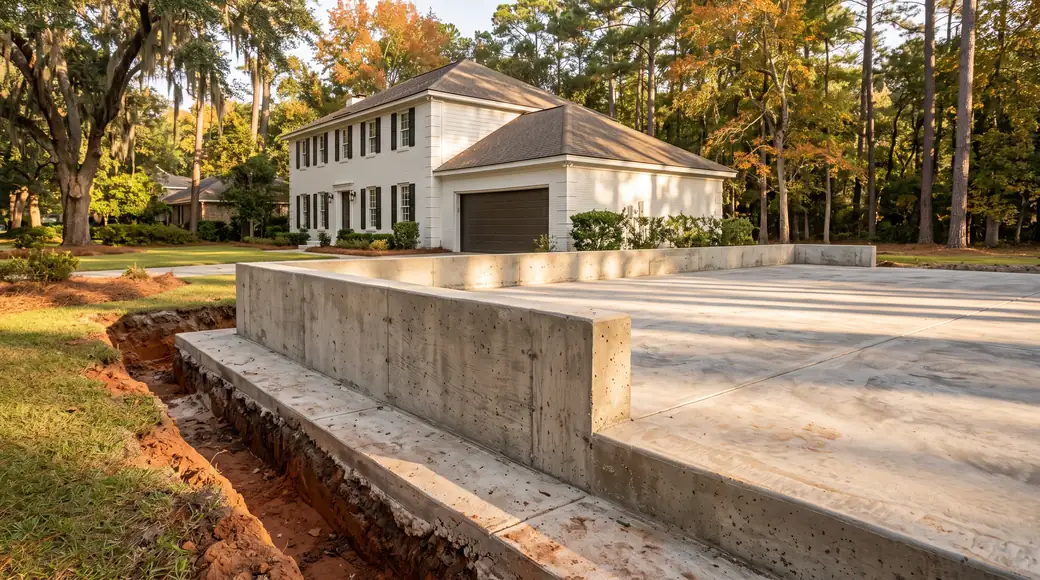
Poured concrete foundation wall and footing for a room addition at a painted-white-brick two-story home in Savannah, GA, in late afternoon light.

Foundation Pouring & Repair in Savannah, GA

We pour and repair foundations in Savannah: footings, slabs, piers, and the concrete that ties a house to the ground it sits on. Most of this work disappears the day it is finished, which is a strange thing to sell. So judge a concrete contractor on the parts that stay visible. Look at the forming, the reinforcement, the edges, the finish across the top of a pour. We do the work with our own crew, and the people who set the forms are the people who come back to strip them.

Savannah's median house was built in 1971. That means a good half of what we walk into has carried fifty years of additions, patches, and repairs done by whoever was available in a given year, and the foundation carries all of it. We start by reading what is already there: which cracks are moving and which have sat still, where a slab has dropped at one corner, where a sidewalk has lifted against a step. Sometimes the answer is a full pour and a long week. Often it is smaller than the homeowner walked in expecting.

Permits and inspections for this work run through the City of Savannah, and we handle that paperwork ourselves instead of leaving it on your kitchen table. Our range covers the city and the towns around it, Pooler included, all on the same terms. Foundation work is the bulk of what we do, but the same crew pours driveways, patios, walks, and general flatwork, plain broom finish or stamped concrete when you want the patio to read as something other than a gray slab. If a repair tears up a walk or an apron on the way to the footing, we put it back rather than leaving you with a patch that announces itself. Call for a free estimate.

Call +1 912-206-8811

Licensed, Bonded, and Insured ยท A combined 15 years of experience

Get Your Free Quote

We warranty all of our work because we believe in what we do.

What Foundation Pouring & Repair Involves

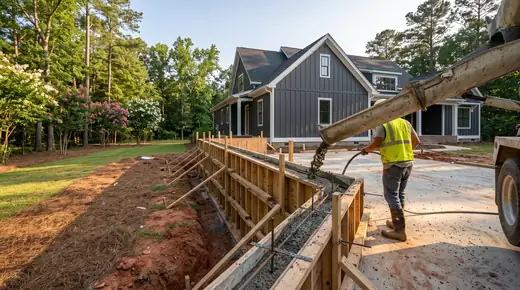
Concrete being poured into foundation wall forms at a charcoal farmhouse-modern home in Savannah, GA, in late afternoon light.

Foundation pouring

We form and pour footings and slabs sized to what sits on them, with rebar tied on chairs and wire mesh where the slab calls for it. Concrete goes down at spec thickness, gets screeded, floated and cured slowly. Rushed curing is what cracks a slab.

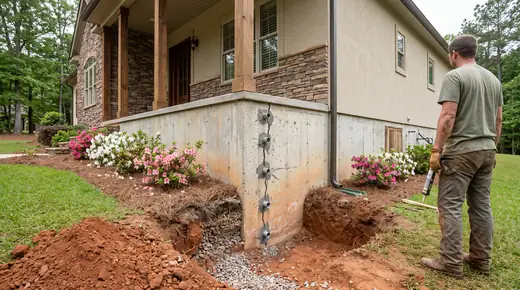
Foundation wall crack being repaired with an injection port at a stacked-stone and stucco home in Savannah, GA, under an overcast sky.

Concrete foundation repair

Most repairs start with why the concrete moved: water at the perimeter, a footing bearing on fill, or steel that rusted and spalled the face. We chip back to sound material, epoxy in dowels and repour. Hairline shrinkage cracks get routed and sealed.

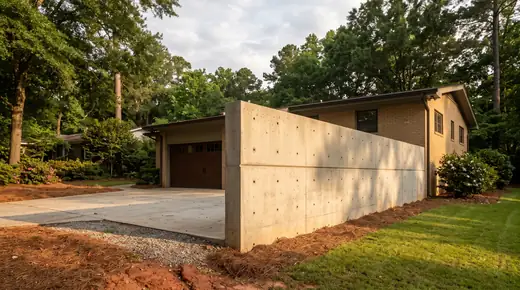
Tall poured concrete basement wall with snap-tie holes visible at a buff-brick ranch home in Savannah, GA, in late afternoon light.

Poured concrete walls

Poured walls go up in forms with two curtains of rebar, vertical bar hooked into the footing, horizontal bar lapped at the corners. We pour in lifts and vibrate each one so the wall comes out solid, no honeycombing along the base or around penetrations.

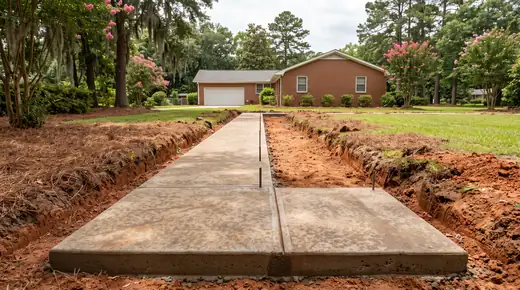
Concrete footing poured at the base of an excavated trench, dowels set at a red-brick ranch home in Savannah, GA, under bright midday cloud.

Footing

A footing spreads the load into bearing soil, so it goes below frost and on undisturbed ground, never on backfill. We dig it wide and level, set continuous rebar with proper lap, and leave a keyway or dowels so the wall above ties in.

What Savannah Properties Need From Foundation Pouring & Repair

We pour and repair foundations for houses and small commercial buildings around Savannah. Most of the homes we work on are older than they look. The median home here went up in 1971, which means a lot of the concrete under this city has been carrying load for more than fifty years, poured to standards that have since moved on. Some of it is holding fine. Some of it needs footings replaced or a slab section cut out and repoured. We cover Savannah, Pooler, Bluffton and Hilton Head Island on the same terms.

Every job starts with us on the slab or under the house, looking at what is actually there. A crack a homeowner has been watching for a year is sometimes cosmetic, sitting in the surface and going nowhere. Sometimes it is a footing that has dropped. Those are two different jobs with two different repairs, and guessing between them wastes real money. We tell you which one you have before anything gets scheduled, and we say so plainly if the answer is that you do not need us yet.

Failures in houses of this era repeat themselves. Slabs poured thin. No rebar or wire mesh where there should have been some, footings sized for a lighter building than the one that ended up on top of them. Add five decades of load and the small movements compound. Cracks widen. Doors stop closing square, floors run out of level, and the drywall keeps opening at the same corner no matter how many times someone patches it. Those symptoms show up in the living room long before anyone thinks to look at the concrete.

Doing this right comes down to depth, steel and cure time, and none of the three can be hurried without the repair coming apart a few years on. The typical home in this market runs around $225,200, and the concrete holding it up is not the place to save a weekend. We hold the same standard on the rest of our flatwork: concrete driveways, sidewalk installation, patios, stamped and colored concrete, exposed aggregate. If something under your house has you unsure, call for a free estimate and we will take a look at it.
How a Foundation Pouring & Repair Job Runs in Savannah

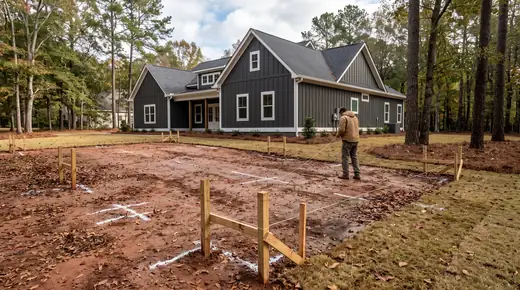
String lines and grade stakes laid out across a yard before a pour at a charcoal farmhouse-modern home in Savannah, GA, after a rain shower.

Step 1: Site Evaluation

We walk the whole slab and the ground around it. Cracks get measured, doors and windows get checked for bind, and we look at where water goes after a hard rain. Downspouts, grade, existing driveways and sidewalks all tell us what the foundation has been dealing with.

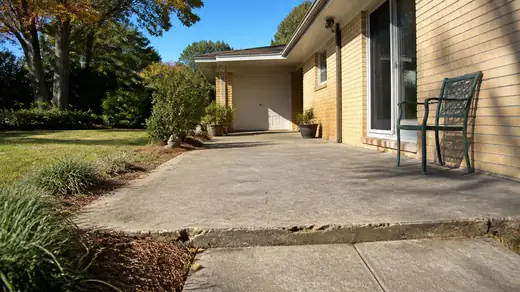
Worn back patio and steps of the kind a written estimate prices at a buff-brick ranch home in Savannah, GA, in clear late-morning sun.

Step 2: Written Estimate and Permits

You get the scope in writing: slab thickness, reinforcement, finish, and what we haul away. Permit work is handled before anything gets broken out, since inspections hold the job at set points. Any concrete installation outside that scope gets written up first, not added on after the fact.

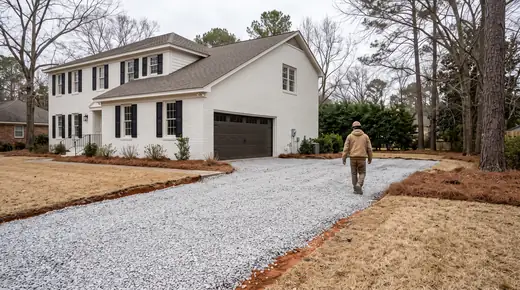
Broken-out concrete removed and the base rebuilt before a new pour at a painted-white-brick two-story home in Savannah, GA, under an overcast sky.

Step 3: Demolition and Base Prep

Old concrete comes out in sections and leaves the site. Then we cut the subgrade to depth, pull out soft spots and organics, and compact graded aggregate base in lifts. A weak base is why most driveways crack early, so this step gets the time it needs.

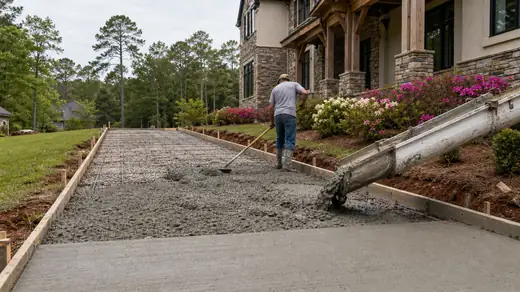
Concrete coming down the chute into formed driveway bays at a stacked-stone and stucco home in Savannah, GA, under bright midday cloud.

Step 4: Forming, Steel and the Pour

Forms go up on string lines with the fall set for drainage. Rebar sits on chairs, tied and lapped, with wire mesh where the design calls for it. Concrete is placed in one continuous pour, screeded, then consolidated so no voids sit under the steel.

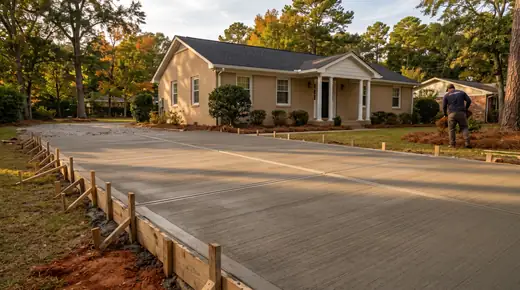
Freshly finished concrete slab curing under a clean broom texture at a tan-brick colonial in Savannah, GA, in late afternoon light.

Step 5: Finishing, Curing and Final Walkthrough

Finish depends on what you picked: broom texture for a concrete driveway, stamped or colored for patio work, exposed aggregate where you want grip and grain. We cut control joints, cure the surface, and tell you when it takes foot traffic and when it takes a vehicle.

Foundation Pouring & Repair Pricing in Savannah, GA

Foundation work gets priced off what a crew finds when they open the ground, not off square footage alone. Two houses on the same street can come in far apart because one has clean access and firm bearing and the other does not. Here is what moves a number up or down, and most of it you can check yourself before anyone quotes you.

What changes the priceWhich wayWhy
Old slab, footing or stump left in the pour areaCosts moreDemolition, breaking out and hauling off happen before a single yard of concrete goes down.
A mixer truck can back within its chute reachCosts lessDirect discharge is fast. If we have to buggy, pump or wheelbarrow the load around a house, that is labor and equipment on top.
Thickness and reinforcement the load calls forCosts more as it climbsA slab carrying a wall is not a patio. Rebar mats, tighter bar spacing and deeper sections all add steel and concrete.
Wire mesh where the plan allows it instead of rebarCosts lessMesh suits lighter flatwork. Where the engineering calls for bar, mesh is not a substitute, so ask which one your job needs.
Water standing near the foundation after rainCosts moreDrainage has to be corrected or the new work sits in the same conditions that damaged the old work.
Digging depth and how much dirt leaves the siteCosts more with depthDeeper excavation means more spoil, more hauling and more forming below grade.
Utilities, irrigation lines or mature roots in the pathCosts moreThese get located and worked around by hand, which is slow.
Tight lot lines and overhead limitsCosts moreSmall equipment or hand work replaces a machine that would finish in a morning.

Comparing bids, look past the total. Get the slab thickness, the bar size and spacing, the concrete strength, whether excavation and haul-off are included, and what the bid says about drainage. Homes around Savannah built near 1971 often need work the original slab never had, so make sure every bid is pricing the same scope.

Foundation Pouring & Repair: Questions We Are Asked Most

What foundation problems are common in Savannah, Georgia?

Yes, patterns repeat. Older houses here, and the median build year in this area is 1971, tend to show slab edges that have dropped, cracked perimeter footings, and separation where an addition meets the original structure. Add crawl space piers that have shifted and slabs poured before wire mesh and rebar were standard practice. Most of what we see is age and water, not catastrophe.

How do you tell settlement from ordinary curing cracks in Georgia?

Curing cracks are hairline, shallow, and stable. They show up early in the slab's life, wander, and stay the same width year after year. Settlement cracks are wider at one end, run diagonally through a corner, and keep opening. We measure them, mark the ends, and come back. Doors that stick and floors that slope tell you more than the crack alone.

Do foundation repairs need a Savannah permit and an engineer's letter?

It depends on the scope. Patching a spalled slab edge or replacing a section of flatwork usually does not rise to that level. Structural work, underpinning, and anything that changes how load moves through the building generally does, and a stamped letter is often part of it. We tell you which category your job falls into before we start.

How long does a Savannah foundation cure before we can build on it?

Concrete reaches most of its design strength in the first month, and framing typically starts well before that. Forms come off in days. The slab keeps gaining strength for a long time after you stop watching it. What matters more than the calendar is the mix, the weather during the pour, and whether the concrete stayed wet long enough to cure properly.

Will foundation work affect my home's value in Savannah?

A sound foundation protects the value already there. With the median home value around $225,200 in this area, a settling slab is the kind of thing that turns up in an inspection and takes a bite out of a sale. Repair documented and done right reads as maintenance. Repair deferred reads as a problem the next owner inherits, and buyers price it that way.

Can you pour a foundation on a sloped Savannah lot?

Yes. A sloped lot means stepped footings, retaining work, or a stem wall that carries the grade change, and more attention to drainage than a flat pour needs. We survey the fall, decide where water goes before we set a single form, and size the rebar for the load. It costs more work than flat ground. It is ordinary concrete work.

Get a Free Estimate

Get Your Free Quote

We warranty all of our work because we believe in what we do.

Tap to call +1 912-206-8811