+1 912-206-8811
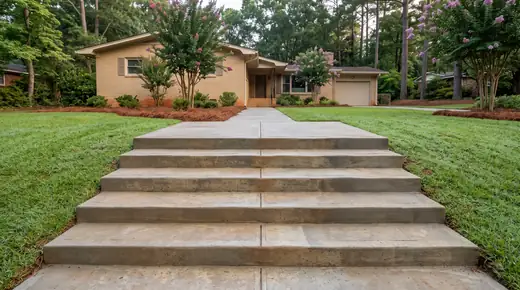
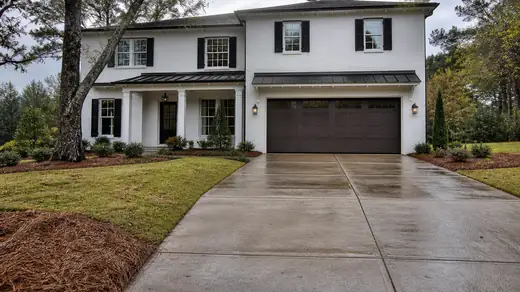
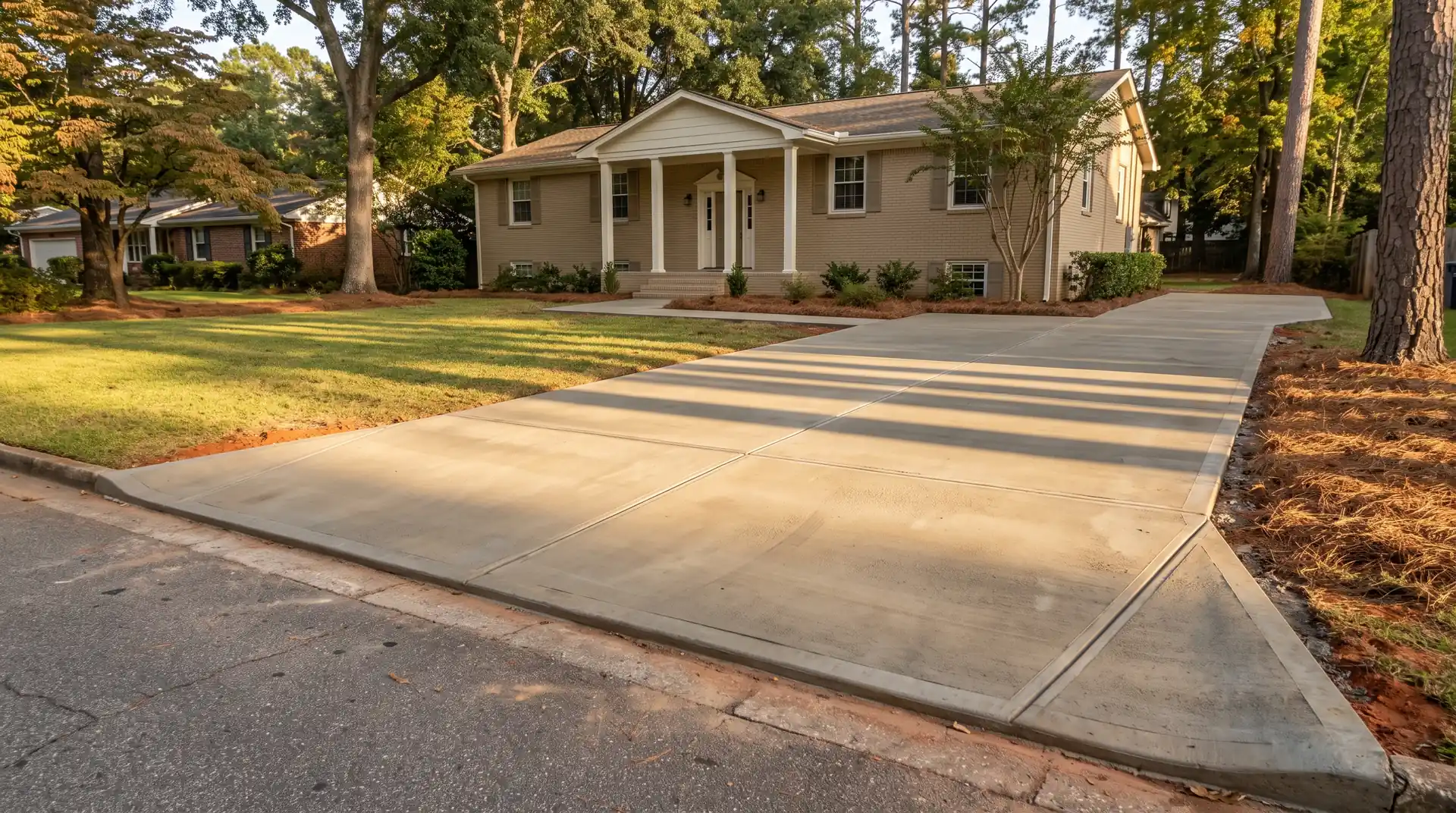
Wide view of finished concrete flatwork across the front of a home at a tan-brick colonial in Savannah, GA, in late afternoon light.

Savannah Precision Concrete: Residential & Commercial Repair & Resurfacing, Driveways, Patios & Retaining Walls

We pour concrete in Savannah: driveways, patios, sidewalks, garage and shed slabs, steps, and the walkways that tie them together. We also repair and resurface flatwork that has cracked, settled or spalled, which on a housing stock with a median build year of 1971 accounts for a good share of the work. Some jobs are plain gray, floated and broomed, which is the right answer more often than people expect. Others are stamped concrete, colored to sit closer to the brick or siding on the house, or finished as exposed aggregate. A driveway is the largest single piece of concrete most homeowners own, and it is the first thing anyone sees.

Work starts with what goes underneath. We strip the old slab or the sod, cut the grade, compact the base, and set forms to a line and a fall that carries water away from the house. Reinforcement is rebar or wire mesh, chosen for the slab and the load it will carry, not for whatever happens to be on the truck. Anything in the public right of way, a sidewalk replacement or an apron out at the street, gets permitted through the City of Savannah before we pour. Picking a concrete contractor mostly comes down to whether they will tell you what is under the slab before they cover it. Call for a free estimate.

Call +1 912-206-8811

Licensed, Bonded, and Insured ยท A combined 15 years of experience

Get Your Free Quote

We warranty all of our work because we believe in what we do.

The Concrete Work We Take On in Savannah

We pour flatwork. Driveways, patios, garage and shed slabs, steps, and the concrete sidewalk that runs from your porch out to the street. Colored and stamped concrete go in the same forms, finished before the pour sets up.

Commercial concrete is the same trade at a larger scale: loading pads, walkways, equipment slabs. Every concrete installation gets rebar or wire mesh sized to what will sit on it, and forms checked square before the truck arrives.

Business and Multi-Family Concrete in Savannah

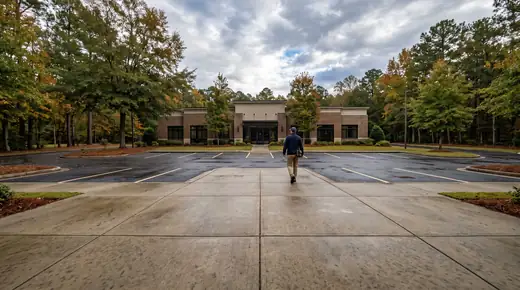
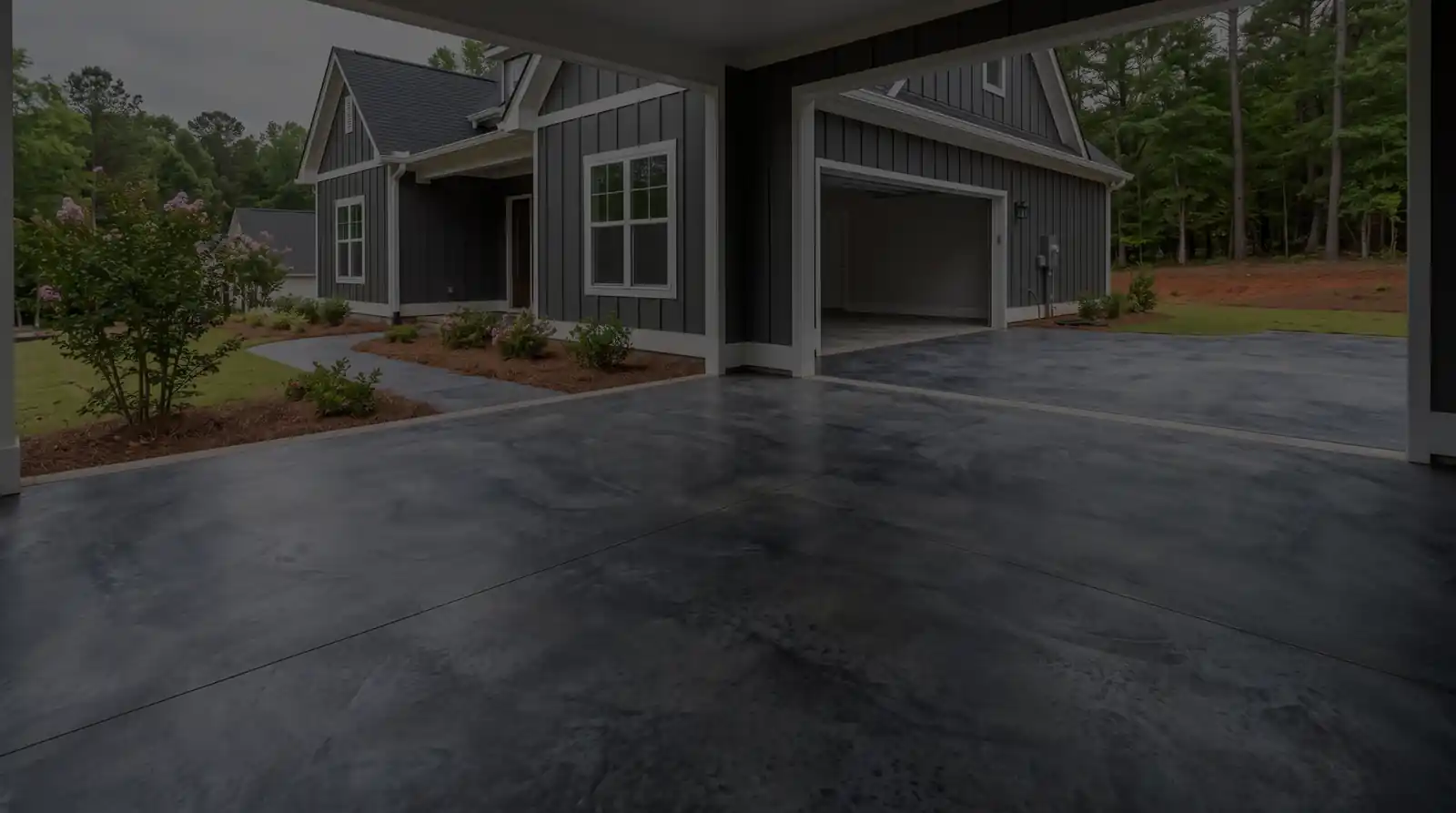
Concrete walkway and entry paving at a suburban office building in Savannah, GA, after a rain shower.

Offices & Corporate Properties

Office lots take steady foot traffic and delivery vans, so we pour walkways at four inches over compacted base with wire mesh, and entry aprons at six with rebar. Broom finish holds up under rain. Where the old slab has settled at a threshold, we cut it out and rebuild the transition flat.

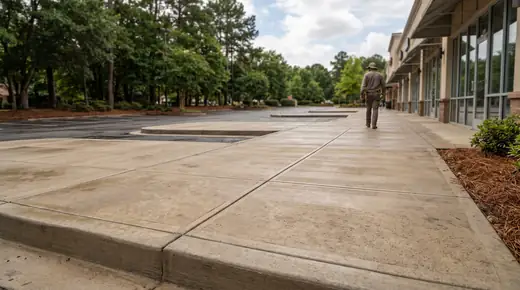
Concrete sidewalk and parking-lot island paving at a retail center in Savannah, GA, after a rain shower.

Retail & Shopping Centers

Storefront concrete gets tested every day by carts, pallet jacks and heat. We pour sidewalks with proper control joints so cracking lands where we put it, not across the middle of an entrance. Concrete installation runs in stages, one bay at a time, so the doors stay usable through the work.

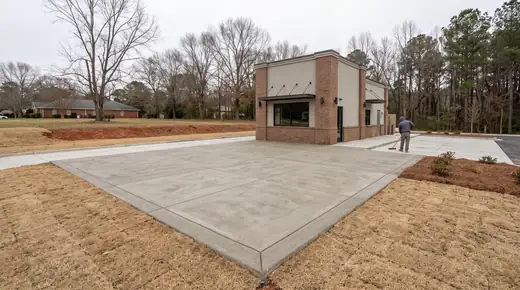
Concrete patio slab and service apron behind a restaurant in Savannah, GA, under an overcast sky.

Restaurants & Hospitality

Kitchens and patios need different concrete. Back of house wants a slab that drains toward the right point and takes grease without spalling; out front, stamped or colored work reads better to guests. We slope trash enclosure pads away from the building and reinforce them for dumpster wheels.

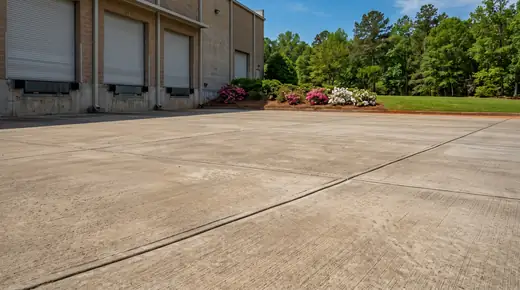
Concrete loading dock apron and truck pad at a distribution building in Savannah, GA, in clear late-morning sun.

Warehouses & Distribution

Loading areas fail at the edges first, where truck tires hammer the joint between apron and dock. We build those aprons thick, with rebar mats and doweled joints, on base that is compacted in lifts. Interior flatwork gets a hard troweled finish so pallet jacks roll clean.

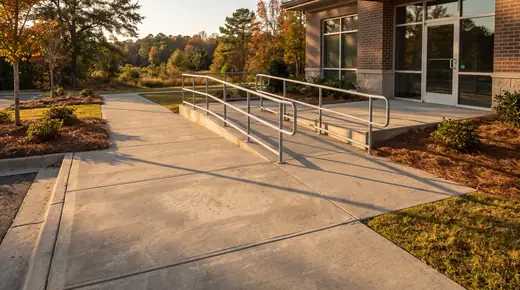
Concrete entry walk and ADA ramp at a medical office building in Savannah, GA, in late afternoon light.

Medical & Dental Offices

Patient access drives the whole layout here. We keep walk slopes and landings within accessible tolerances, hold cross slope tight, and finish surfaces with enough texture to stay safe wet without catching a walker or wheelchair caster. Ramps get rebar. Curb transitions get poured flush, not patched later.

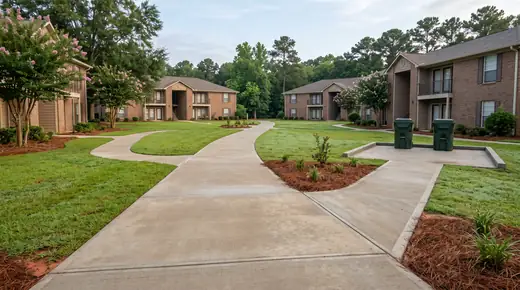
Concrete sidewalk network between buildings at an apartment community in Savannah, GA, in early morning light.

Multi-Family & HOA Properties

Apartment and townhome sites carry long runs of concrete: shared sidewalks, mailbox pads, dumpster enclosures, and concrete driveways at every unit. We phase driveways so residents keep parking, replace panels that have heaved rather than grinding them, and match the finish on adjacent sidewalks so repairs disappear.

Concrete for Homes in Savannah

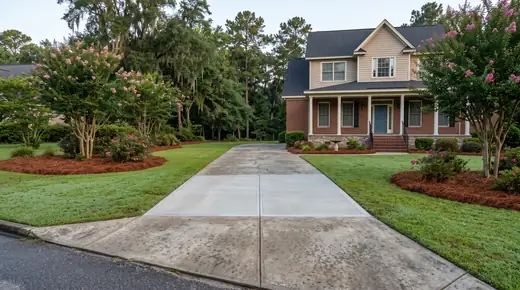
Replaced concrete driveway panel with clean saw-cut edges at a brick-and-siding two-story home in Savannah, GA, in early morning light.

Repair, Leveling & Resurfacing

Houses around Savannah average a 1971 build, so a lot of the original concrete work has settled, cracked or lost its surface. We lift sunken slabs, saw out and patch failed joints, and bond an overlay where the concrete underneath is still sound. Badly broken sections get repoured.

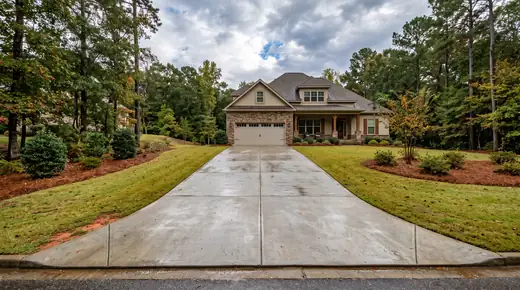
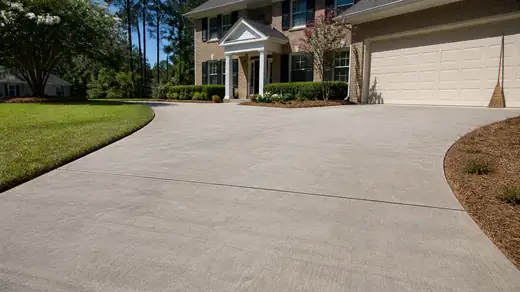
Broom-finished concrete driveway running up to a two-car garage at a stacked-stone and stucco home in Savannah, GA, after a rain shower.

Driveway Installation & Replacement

Most residential driveways go down at four inches over a compacted base, thickened to six where a truck parks. We set rebar or wire mesh, cut control joints on a grid, and break out the old drive first when it is past patching. Broom or exposed aggregate finish, your call.

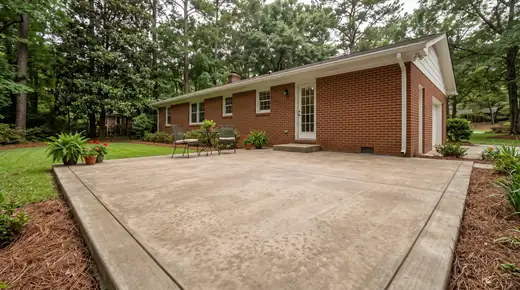
Rectangular concrete patio with a low step up to the rear door at a red-brick ranch home in Savannah, GA, under an overcast sky.

Patio Construction & Outdoor Living

Patios pour at four inches with wire mesh, sloped away from the house so water leaves. Stamped and colored concrete, exposed aggregate and plain broom finishes all work on the same slab. We form curves, steps down to grade, and pads for grills or a hot tub.

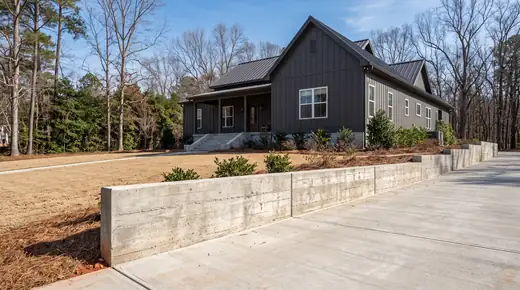
Board-formed concrete retaining wall holding a raised lawn at a charcoal farmhouse-modern home in Savannah, GA, in clear late-morning sun.

Retaining Wall Construction

Retaining walls start with a footing poured below grade and rebar doweled up into the stem. Behind the wall we run washed gravel and a drain line to weep holes, because trapped water is what pushes walls out of plumb over time. We build poured walls and segmental block.

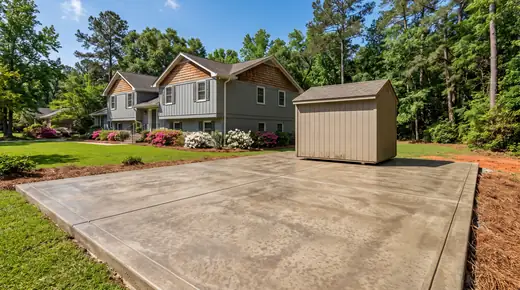
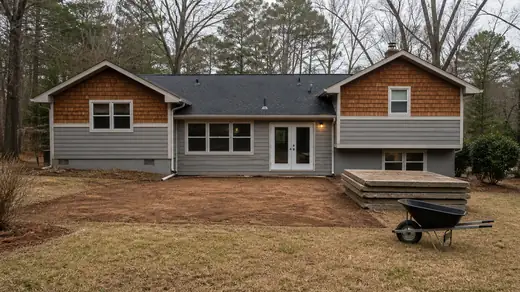
Square-edged concrete slab pad with a storage shed on it at a grey split-level home in Savannah, GA, in clear late-morning sun.

Concrete Slabs & Pads

Shed floors, garage slabs, workshop pads, generator and HVAC bases: the same process at different scales. Graded stone base, vapor barrier where it belongs, rebar or mesh, and a slab thick enough for whatever sits on top. Edges get thickened when the pad carries a wall.

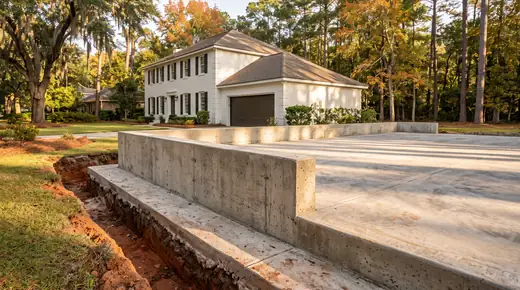
Poured concrete foundation wall and footing for a room addition at a painted-white-brick two-story home in Savannah, GA, in late afternoon light.

Foundation Pouring & Repair

Footings, stem walls and monolithic slabs for additions, garages and new outbuildings, formed and poured to the dimensions the plans call for. On existing foundations we repair spalled edges, fill and seal cracks, and rebuild sections where rusting rebar has pushed the concrete apart. That damage shows at the edges first.

Poured concrete front steps rising to a landing at the front door at a buff-brick ranch home in Savannah, GA, in early morning light.

Steps, Stoops & Landings

Steps get a footing under them so they do not pull away from the house. We form even risers and treads, tie the flight into the stoop with rebar, and finish with a broom texture that stays grippy wet. Handrail sleeves go in before the concrete sets.

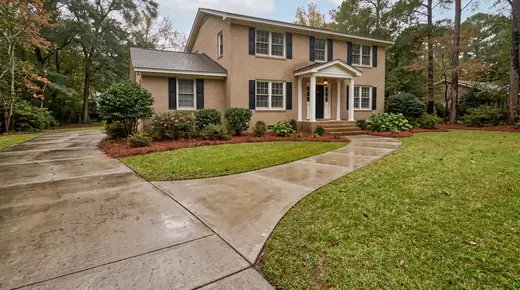
Concrete walkway meeting the driveway apron and front steps at a tan-brick colonial in Savannah, GA, after a rain shower.

Walkway & Sidewalk Installation

Sidewalk installation runs four inches thick over compacted base, with joints cut at regular spacing so the cracks land where we put them. Front walks, side paths, and runs from the driveway back to a gate. Widths and curves get laid out on the ground before we form anything.

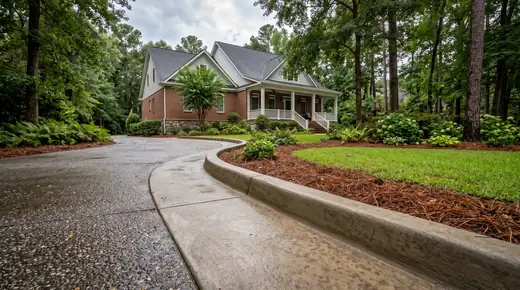
Poured concrete curbing with a rolled profile along a driveway edge at a brick-and-siding two-story home in Savannah, GA, after a rain shower.

Curbing & Edging

Extruded concrete curbing edges beds and borders in one continuous pour, with color or a stamped pattern if you want it. Mower strips along a fence line keep the trimming down. It is the smallest of the concrete services we offer, and it sharpens the line between lawn and bed.

Why Savannah Homeowners Call Us

Most calls start with a slab that has outlived its useful life. Savannah's housing stock carries a median build year of 1971, so much of the concrete work we look at was poured by someone who has long since retired. Cracked aprons. Sunken walks. A driveway that holds water where it once shed it. We come out, look at what is actually failing, and tell you plainly what we see.

Our flatwork gets built from the base up, because that is where most of it goes wrong. We grade and compact first, set rebar or wire mesh sized to what the pour has to carry, and keep the mix consistent from the first load to the last. Forms come off when the concrete is ready, not when the calendar would prefer. Finishing is hand work, and we clean up the site behind us.

Households here run below the Georgia median, $56,782 against $74,664, and that shapes how we talk about scope. We say which sections need replacing and which have good years left in them, because tearing out sound concrete on a home near the $225,200 median is money spent for nothing. You came to us about one thing. We quote that thing. If something else nearby is heading toward failure, we point at it and let you decide when.

From the First Call to the Final Walkthrough

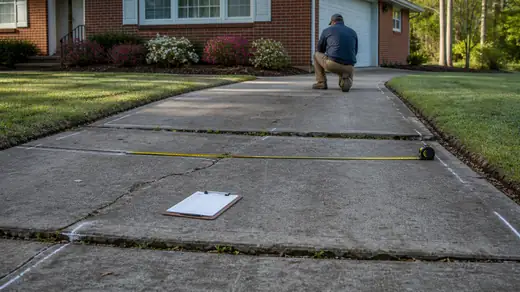
Existing driveway measured and marked before it is replaced at a red-brick ranch home in Savannah, GA, in early morning light.

Step 1: Site Evaluation

We walk the site with you, measure, and check where water runs. Root heave, a sunken apron, and a driveway that ponds all point back to the base. How the old slab cracked tells us what the new one needs, and where the truck can reach.

Settled garage approach slab the estimate would price to replace at a painted-white-brick two-story home in Savannah, GA, after a rain shower.

Step 2: Written Estimate and Permits

You get the scope in writing: square footage, slab thickness, reinforcement, finish, joint layout, and what we haul away. Concrete driveways in the right-of-way and most structural work need a permit, and we pull it and schedule inspections before demolition starts. Nothing in the scope changes without your say-so.

Old patio broken into slabs and stacked ready to be carried out at a grey split-level home in Savannah, GA, under an overcast sky.

Step 3: Demolition and Base Prep

Breaking out the old slab is the noisy half. Underneath, we cut the subgrade to grade, then compact graded aggregate base in lifts with a plate compactor so the fill under a new concrete patio or drive stays put. Soft spots get dug out rather than bridged over.

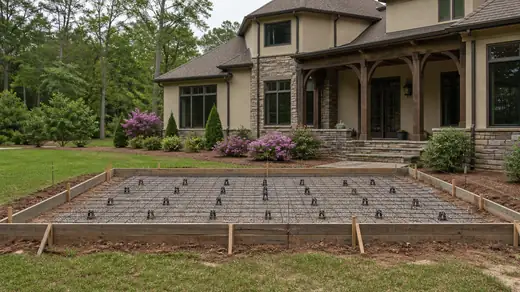
Patio forms squared up with reinforcing mesh on chairs at a stacked-stone and stucco home in Savannah, GA, under an overcast sky.

Step 4: Forming, Steel and the Pour

Forms go up, set to a slope that carries water off the slab. Rebar tied on chairs and wire mesh sit up in the middle of the pour, not on the ground. Thickened edges carry the load where vehicles turn. We place, screed, and bull float in one run.

Cured driveway swept clean with the forms stripped away at a tan-brick colonial in Savannah, GA, in clear late-morning sun.

Step 5: Finishing, Curing and Final Walkthrough

Finish is where the look happens: broom, exposed aggregate, or stamped and colored to a pattern you picked. Control joints get cut while the slab is green, and curing keeps it from drying too fast. Before we leave, we walk the finished work with you and point out the joints.

Top Decorative Concrete Styles for Savannah Homes

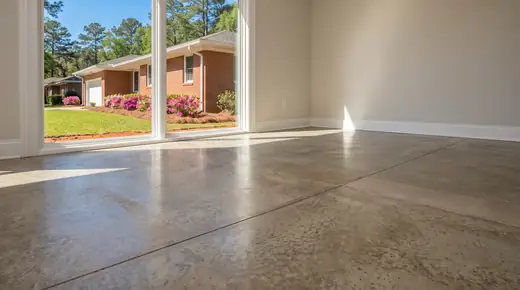
Polished concrete floor with a satin sheen in a finished interior room at a red-brick ranch home in Savannah, GA, in clear late-morning sun.

Polished Concrete Floors

We grind the slab down through progressively finer diamond pads, then densify and burnish it. Old adhesive, patched trenches and hairline cracks all show through, so we look at what sits under the tile before promising a mirror finish. Exposure can stop at cream, salt and pepper, or full aggregate.

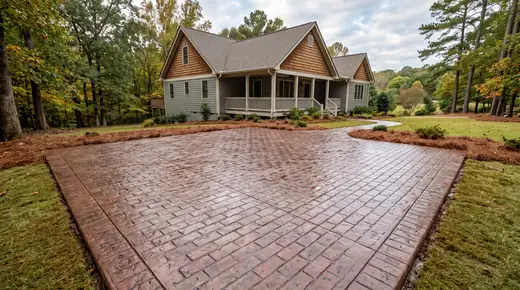
Stamped concrete patio in a running-bond brick pattern at a grey split-level home in Savannah, GA, after a rain shower.

Stamped Concrete Patterns

Ashlar slate, weathered wood plank and running bond brick are the mats we use most. Timing decides everything: stamp too early and the pattern closes up, too late and the imprint stays shallow. Four inches of concrete over wire mesh or rebar, with joints cut into the pattern lines.

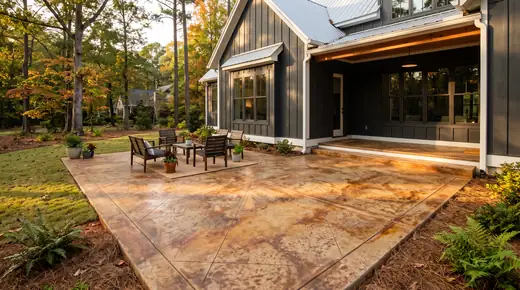
Acid-stained concrete patio in mottled earth tones at a charcoal farmhouse-modern home in Savannah, GA, in late afternoon light.

Stained Decorative Concrete

Median household income here runs $56,782 against $74,664 statewide, so staining a sound slab beats tearing it out. Acid stain reacts with the lime and mottles; water based dyes read more like colored concrete, even and repeatable. Patched areas take color differently, so we test a corner first.

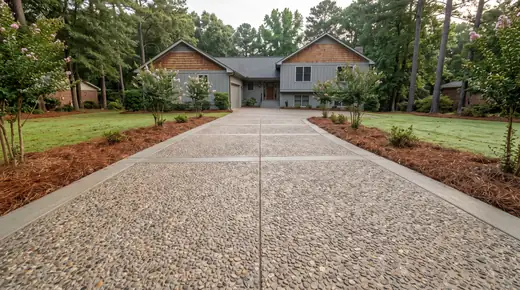
Exposed aggregate concrete driveway showing washed river-rock stone at a grey split-level home in Savannah, GA, in early morning light.

Exposed Aggregate Finishes

Surface retarder goes on after the pour, then we wash the paste off the next morning to bring up pea gravel or river rock. Traction holds when the surface is wet, which is why it shows up in concrete sidewalk installation. Wash unevenly and the color shifts panel to panel.

Service Areas in Savannah and Beyond

We pour concrete across Savannah and the surrounding area, including the neighborhoods that run out toward Pooler. Same crew, same forms, same approach to a slab whether the job sits downtown or forty minutes out. Call and tell us where you are.

Work we take anywhere in that range:

  • Concrete slab installation for garages, sheds, additions and equipment pads
  • Driveways and sidewalks, wire mesh or rebar depending on what the slab has to carry
  • Exposed aggregate finishes, patios and walkways
  • Tear-out and replacement of failed flatwork

Concrete Pricing in Savannah

What a concrete job costs comes down to four things: the square footage you are covering, the thickness of the slab and what goes inside it, how much work happens before any concrete arrives, and the finish on top. Those move the number more than anything else. Household income here runs at $56,782 against a Georgia median of $74,664, so we quote what the job actually needs and say plainly which parts are structure and which parts are appearance. The structural parts are not where a homeowner should economize.

Two or three bids on the same driveway are rarely pricing the same work. Read them for this:

  • Slab thickness and reinforcement: rebar tied and set on chairs, wire mesh, or nothing at all.
  • Base preparation: what gets excavated, what gets hauled away, what fill goes back, and whether it is compacted in lifts.
  • Formwork: forms set to grade and staked, with the drainage fall written down.
  • Scope: tear-out of the old slab, disposal, and how far the truck can reach the pour.
  • Finish and joints: broom, exposed aggregate, decorative concrete, and how control joints are spaced and cut.
  • Exclusions: the lines a bid leaves out tell you more than the total does.

A cheap number usually gets cheap by removing something you cannot see once the concrete is placed. An inch of thickness. The steel. The compacted base holding everything up. Concrete slab installation is not a finish you can correct later, and failed slabs come out with a saw. You pay for the demolition on top of the pour you already bought. Ask every contractor to write thickness, reinforcement and base into the bid. Call us for a free estimate.

What Happens After You Call Us

We come out and look at the ground the concrete is going on. That means measuring, checking how water moves across the site, and finding out whether a mixer truck can reach the pour or whether we are wheeling it. On residential concrete we walk the whole approach with you: where the driveway meets the street, where a patio wants to sit, what stays and what comes out.

Decisions come next. Thickness, rebar or wire mesh, joint layout, and whether you want plain gray or decorative concrete: stamped, colored, exposed aggregate. Concrete patios and driveways take different treatment, and we say which we would build. You get a written scope of the concrete construction we are proposing, with the prep, the pour and the finish spelled out. Nothing gets ordered until you have read it. Call for a free estimate.

What Goes Wrong With Concrete in Savannah

Most of what fails here was poured a long time ago. The median Savannah home dates to 1971, so plenty of driveways, sidewalks and concrete patios are still on their original slab or on one replacement done sometime after. Concrete that age cracks in predictable places: at the corners of a driveway apron, along a long unjointed run, anywhere a slab went down thin over a base nobody compacted. We read those patterns first.

Diagnosis starts at the low spot. We look at where water stands after a rain, how the slab moves under weight, whether cracks run straight through the panel or wander, and what the broken edges say about what is underneath. A slab that rocks has lost its support, and pouring over it just repeats the failure on a new surface. Sometimes one panel comes out. Sometimes the whole run does.

The causes are usually dull ones. Reinforcement left out entirely, or wire mesh laid flat on the ground and never pulled up into the pour. No rebar in a driveway that takes a work truck every day. Control joints cut too shallow, or cut two days late, so the slab picks its own crack line instead of the one we gave it. Water added at the chute to make the mix easier to place, which weakens the finished slab everywhere.

Getting it right takes time before the pour rather than repairs after it. That means grading and compacting the base, tying steel up off the ground, ordering concrete mixes matched to what the slab will carry, cutting joints on schedule, and curing the surface instead of leaving it to dry however it wants. We work that way on every concrete project, residential flatwork and commercial concrete alike, because the alternative shows up in three years. Our concrete projects run through Savannah, Pooler, Bluffton and Hilton Head Island, all on the same terms.
Concrete Questions Savannah Homeowners Ask

Does Savannah Precision Concrete handle the Savannah permits and inspections?

Yes. We pull what the job requires and we are on site for the inspections, so you are not the one making phone calls or standing in a line downtown. Driveway aprons, sidewalk replacement in the right of way, and larger commercial pours all have their own paperwork. We handle that as part of the work, and we tell you up front which approvals your specific project needs.

How do I book a free walkthrough and get a fixed-price quote from Savannah Precision Concrete?

Call us and tell us what you have in mind. We come out, measure, look at what is already there, and ask what you want the finished surface to do. Then you get a written quote with a fixed number on it, broken out so you can see what the concrete work covers. Nothing is owed for the walkthrough or the quote.

What is the difference between repairing and replacing concrete in Savannah?

Repair means we keep the existing slab and address what is wrong with it: grinding down a lifted edge, filling and sealing cracks, resurfacing a worn top layer. Replacement means the slab comes out and a new one goes in over fresh base and reinforcement. The deciding factor is usually the subgrade. Sound base under a tired surface is worth saving. Failed base is not.

How do you keep concrete from cracking or settling in Savannah's ground conditions?

Most of the answer happens before any concrete arrives. We excavate to a consistent depth, compact the base in lifts, and put steel in the slab, rebar or wire mesh depending on what the slab has to carry. Then we cut control joints at proper spacing so the inevitable shrinkage lands in a straight line you chose instead of a random crack.

How far in advance should I book concrete work in Savannah?

Sooner is better than later, particularly for driveways and anything on the larger side. Our schedule fills in blocks, and weather moves pours around, so a job booked with some runway ahead of it lands cleanly. Small repairs and patch work slot in more easily. When you call, we will tell you honestly where the calendar stands for your kind of project.

What maintenance or sealing will my new concrete need in Georgia?

Plain broom-finished flatwork is low maintenance. Keep it clean, keep standing water off it, and it will do its job. Decorative surfaces are different. Stamped concrete and colored concrete carry a sealer that protects the color and the texture, and that sealer wears. Resealing every few years keeps it looking the way it did the week we left. We walk you through the specifics for whatever finish you choose.

Are you insured to work on commercial property in Savannah?

We can provide current coverage documentation before we start, which is what most property managers and general contractors ask for anyway. Tell us what your building or association requires and who needs to be listed, and we will get the paperwork to the right person. That step happens during the quote, not on the morning of the pour, so nothing holds up the schedule.

How long does a typical concrete job in Savannah take from start to finish?

A residential driveway is usually a few days of on site work: demolition and haul off, base and steel, then the pour and finish. Patios and sidewalk installation often move faster. What people underestimate is cure time afterward. You are walking on it within a day or so and parking on it considerably later. We give you the actual dates for your slab.

What decorative finishes can I choose for a project in Savannah?

Stamped concrete takes a pattern off a mat while the slab is still workable, so you can get the look of stone, brick, or plank in a single monolithic pour. Colored concrete runs integral or applied. Exposed aggregate washes back the surface paste to reveal the stone underneath, which gives you texture and traction. We bring samples so you decide by looking, not by imagining.

Does Savannah Precision Concrete take on commercial work as well as residential?

Yes. Commercial concrete is a real part of what we do: loading areas, walkways between buildings, ADA compliant ramps and landings, pads for equipment and dumpster enclosures. The engineering is heavier and the scheduling has to work around a business that stays open, but the fundamentals do not change. Base, steel, mix design, finish, joints. We run both sides of the trade.

What does concrete cost per square foot around Savannah, Georgia?

It depends on thickness, reinforcement, access for the truck, how much demolition and haul off is involved, and whether the finish is broom or decorative. A flat number quoted over the phone before anyone has seen the site is a guess, and guesses get revised upward later. We measure your project and give you one fixed price in writing. That number is the number.

What concrete services do you offer in Savannah, Georgia?

Driveways, patios, sidewalks, slabs, footings, steps, and retaining walls, plus repair and resurfacing on concrete already in the ground. We do plain flatwork and decorative work, residential and commercial, new installation and replacement. Much of the housing here dates to around 1971, so a good share of our days go to concrete that has simply reached the end of a long service life.

Tap to call +1 912-206-8811