+1 912-206-8811
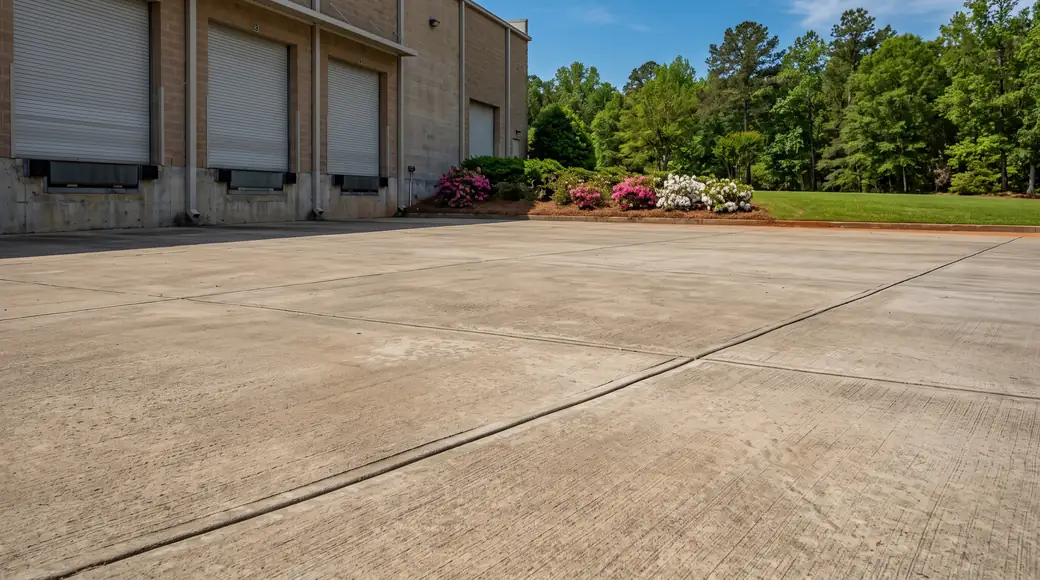
Concrete loading dock apron and truck pad at a distribution building in Savannah, GA, in clear late-morning sun.

Commercial Concrete for Warehouses & Distribution in Savannah, GA

We are a concrete contractor working on warehouse and distribution sites in Savannah, Georgia. Most of what we pour is flatwork: interior slabs, dock aprons, truck courts, approach pads. A slab under racking and forklift traffic has a different job than a driveway, and it gets reinforced for that, with rebar or wire mesh set to the load it will actually carry. That detail decides whether a floor stays flat once it is loaded.

Crews here are small, and the same people run a job from the forming through the final saw cut. We place, finish and cut the joints ourselves instead of handing a slab off partway through to someone who was not there when it went down. Buildings that are still receiving freight get poured in sections, and we set the schedule around your dock hours rather than around ours.

Warehouse work is most of what we do, though not all of it. We pour sidewalk and walkway runs along the property line, pads for compactors and transformers, ramps, and stamped concrete at an office entrance when the front of the building needs to read differently than the back of it. Permitting on jobs inside the city runs through the City of Savannah, and we handle the applications and meet the inspector on site. Call for a free estimate on your slab.

Call +1 912-206-8811

Licensed, Bonded, and Insured ยท A combined 15 years of experience

Get Your Free Quote

We warranty all of our work because we believe in what we do.

What Commercial Concrete for Warehouses & Distribution Involves

Commercial concrete on a warehouse or distribution building is mostly flatwork carrying weight that residential slabs never see. Loaded trailers sitting on a dock apron, forklifts turning in the same spot all day, drive lanes taking truck traffic in the wet. It also covers the parts people walk on: the sidewalk along the office front, the pad at the employee door, the ramp up from the lot. Same material, different jobs, and each one gets built for the load it actually carries.

Underneath every good slab is work nobody sees. We look at the subgrade first, because concrete only stays flat if what supports it stays put. Compacted base, uniform depth, no soft pocket left under the spot where trailer landing gear comes down. Reinforcement follows the load: wire mesh in lighter pedestrian flatwork, rebar on a grid where the weight is real. Thickness, joint spacing and joint depth get settled at this stage, not after the first truck shows up.

Failures in commercial concrete are usually predictable. Random cracking between joints sawn too late or spaced too far apart. Curled edges at an apron where the slab dried faster on top than underneath. Spalling where a hard trowel finish closed the surface before the bleed water was done. Most of it traces back to something skipped before placement, so a concrete contractor who slows down on prep and layout is buying you years, not just a better looking pour.

Walking surfaces get treated as their own work rather than leftovers. A concrete sidewalk along the office side needs slope that carries water away from the building and a broom finish that stays safe when it rains. Entries are where stamped concrete, colored concrete or exposed aggregate make sense, since that is the one stretch a visitor sees up close. Sidewalk installation around a commercial building also has to hold grade honestly against the parking lot and the door thresholds at both ends.

Getting it right takes attention more than anything else. Correct mix for the exposure, enough thickness for the heaviest thing that will ever park on it, cure time respected before traffic goes back on. On a Savannah building or a site out toward Pooler, we would rather tell you the base needs more work than pour over a soft area and hear about it in two years. Concrete is straightforward to build once and difficult to rebuild, so the honest conversation happens before we mobilize, not after.
What Savannah Properties Need From Commercial Concrete for Warehouses & Distribution

We pour and replace concrete for warehouses, distribution buildings and the yards around them in Savannah. That covers slabs on grade, truck aprons, dock approaches, trench drains framed into the pour, and the concrete sidewalk work that ties a building to the street. What crosses these floors is forklifts, trailers and pallet racking sitting on point loads, so the slab gets designed around that traffic and not around a house driveway. Rebar or wire mesh, joint layout, thickness, subgrade prep: those decisions are what keeps a floor flat once it is loaded.

Savannah's median home was built in 1971, and a good share of the industrial stock nearby went up over the same stretch. Concrete poured then was often sized for lighter equipment than what runs across it now. We see curled joints, spalled edges at the dock levelers, and cracks that open a little wider every year under weight the slab was never asked to carry. Sometimes a section replacement handles it. Sometimes the floor comes out and goes back in properly. We say which one we think it is after we have looked.

New construction, tenant fit-outs, and repairs inside buildings that keep operating while we are working in them: all of it is normal for us. An occupied warehouse gets staged so a bay stays open, and the flatwork goes in sequence rather than shutting the place down. Exposed aggregate, stamped and colored concrete tend to show up on the office and entry side of these projects, and that is our work too. We serve Savannah and the towns around it, Pooler included. Call for a free estimate.

How a Commercial Concrete for Warehouses & Distribution Job Runs in Savannah

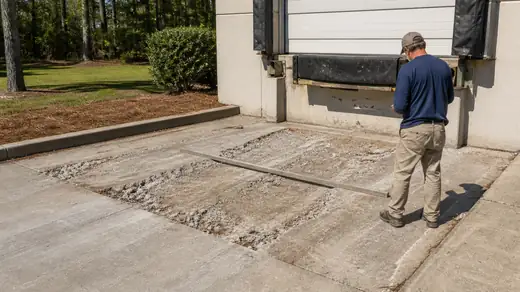
Loading dock apron inspected where truck traffic has broken the slab in Savannah, GA, in clear late-morning sun.

Step 1: Site Evaluation

We walk the site, measure the pour area, and check drainage and subgrade. Truck routes, dock approaches and existing slab edges all change the plan. Soft spots and buried utilities get flagged now, because finding them mid-pour is what turns a clean concrete installation into a mess.

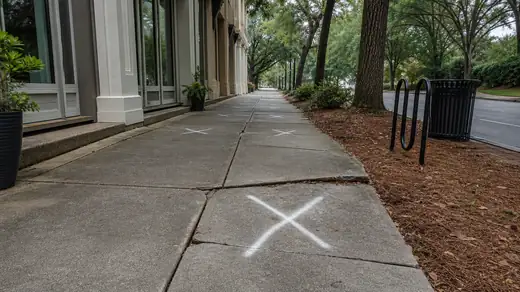
Public sidewalk frontage priced for replacement outside a shopfront in Savannah, GA, under an overcast sky.

Step 2: Written Estimate and Permits

You get the scope in writing: square footage, slab thickness, reinforcement, joint layout, finish and mix design. Permitting and any required drawings get handled before mobilization. Anything that could change the number later, like unexpected subgrade work, is spelled out instead of buried.

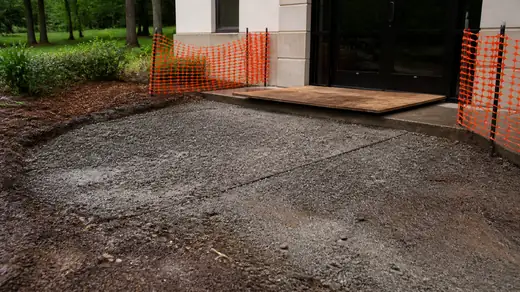
Entry pad removed at a business door with the ground prepared in Savannah, GA, after a rain shower.

Step 3: Demolition and Base Prep

Old slab comes out, spoils get hauled off, and the base gets built back in compacted lifts of graded aggregate. Compaction is the part nobody sees and the part that decides whether the slab settles. Loose fill under a heavy floor cracks it within a season.

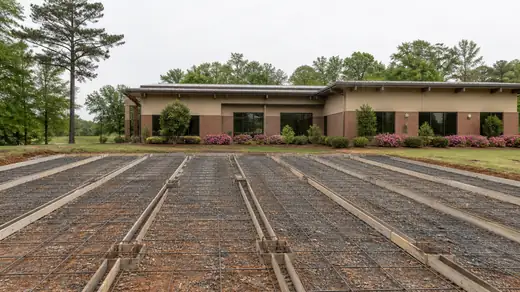
Long parking lot strips formed and reinforced ready to pour in Savannah, GA, under an overcast sky.

Step 4: Forming, Steel and the Pour

Forms are set to grade and string line, then rebar or wire mesh goes in on chairs so the steel sits inside the slab, not on the dirt. Placement runs continuously. Concrete gets screeded, bull floated and vibrated at the edges to eliminate honeycombing.

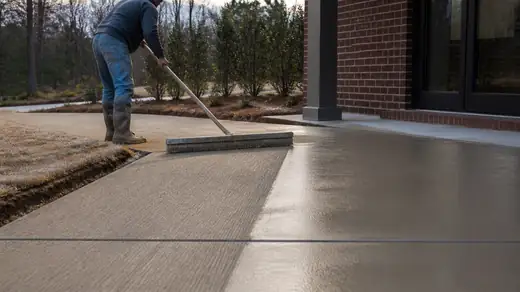
Broom texture drawn across a new commercial entrance pad in Savannah, GA, in early morning light.

Step 5: Finishing, Curing and Final Walkthrough

Finish depends on use: hard trowel for interior floors, broom texture for exterior driveways and sidewalks where traction matters. Control joints get cut early to steer the cracking. Curing compound goes down, and we walk the concrete driveway and slab with you before equipment leaves.

Commercial Concrete for Warehouses & Distribution Pricing in Savannah, GA

Every number in a warehouse slab bid traces back to conditions you can walk out and look at yourself. We read the same things on every site, in Savannah, Pooler, Bluffton and Hilton Head Island alike, and here is what moves the figure up or down.

What changes the priceWhich wayWhy
An old slab or asphalt already in placeCosts moreIt has to be broken out, loaded and hauled off before any concrete work starts
Buried utilities, footings or soft fill under the padCosts moreHand digging, relocation and replacement fill all happen before we set forms
How close a ready-mix truck can back to the pourCosts less when closeLong reaches mean a pump or buggies, and more hands moving concrete
Slab thickness the loading calls forCosts more as it goes upTrailer and forklift traffic needs depth, and depth needs stone base under it
Rebar mat instead of wire meshCosts moreBar is heavier material and gets tied on chairs in a grid
Grading and where water leaves the padCosts more if the fall is wrongSubgrade rework and drainage set the elevations everything else follows
Stamped, colored or exposed aggregate finishCosts more than a broom finishExtra labor, and the work runs longer at the surface
Pouring around live dock doorsCosts morePhased sections and off-hours work

Line the bids up on the specifics: slab thickness, reinforcement, base stone depth, joint spacing, and whether demolition and haul-off sit inside the number or outside it.

Commercial Concrete for Warehouses & Distribution: Questions We Are Asked Most

What slab thickness does a Savannah warehouse need for forklifts?

It depends on the truck and the wheel loading, not on a rule of thumb. Most warehouse floors carrying counterbalanced forklifts land between six and eight inches, and heavier reach trucks with post loads push thicker. We look at your equipment list, the subgrade, and where racking posts land, then size the slab and the rebar or wire mesh around that.

How flat can a Savannah warehouse floor be made, and how is it checked?

Flat enough for narrow aisle equipment if the floor is placed and finished for it, which means laser screed work, a tight pour sequence, and a crew that does not chase the finish too early. Flatness gets measured with a profileograph or a dipstick over defined runs, not by eye. We tell you what tolerance the pour is targeting before concrete shows up.

Can you repair Savannah warehouse floor joints without stopping work?

Yes, in most buildings. Joint repair is linear work, so we section it off, cut and clean the joint, fill with a semi rigid epoxy or polyurea, and shave it flush. Aisles come back one at a time. Scheduling around your shifts matters more than the repair itself, so we plan the sequence with your operations lead before starting.

What cure time should a Savannah warehouse plan for?

Foot traffic usually goes on the slab within a day or so. Forklifts and racking loads wait considerably longer, commonly a few weeks, because concrete gains strength on its own schedule and early loading shows up later as cracking. Coatings and joint fillers add their own waiting periods. We give you the dates for your specific mix before the pour.

How do you handle racking that cannot be moved in a Savannah warehouse?

We pour around it. Sections get isolated at the post lines, and we replace flatwork bay by bay while the racking stays anchored and loaded, provided the existing slab under those posts is sound. Where it is not, the racking has to come down in that bay. We walk the floor first and tell you which bays fall into which category.

Do you pour loading docks and aprons around Savannah?

Yes. Dock aprons take the worst of it: trailer landing gear, tractor turning, and constant point loading at the same spot every day. That work gets thicker slab, heavier reinforcement, and drainage that pulls water away from the pit rather than into it. We handle the dock leveler pockets, the bumper blocks, and the transition back to the yard.

Get a Free Estimate

Get Your Free Quote

We warranty all of our work because we believe in what we do.

Tap to call +1 912-206-8811