+1 912-206-8811
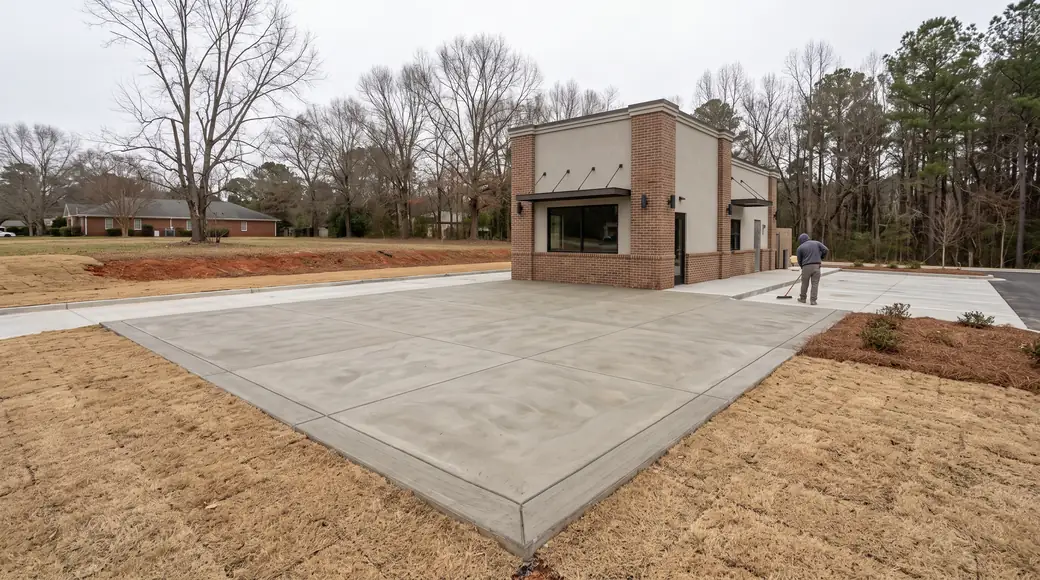
Concrete patio slab and service apron behind a restaurant in Savannah, GA, under an overcast sky.

Commercial Concrete for Restaurants & Hospitality in Savannah, GA

Concrete under a restaurant takes a beating a driveway never sees. Grease, cart wheels, hot water, deliveries at six in the morning, and a few hundred people crossing the same four feet of walk every night. We pour flatwork built for that: kitchen and back of house slabs, loading and dumpster pads, patios, entry walks, and the stamped concrete guests stand on while they wait for a table. The sidewalk out front counts as part of the building to everyone who uses it.

Thickness, reinforcement and joint layout decide whether a slab holds up or cracks through inside a year. Heavy traffic areas get rebar. Lighter flatwork gets wire mesh. Slopes get worked out before anyone mixes anything, because water has to leave a surface on its own or it will sit there. Finish is a maintenance decision as much as a looks decision, and that is true of stamped work and exposed aggregate both.

Savannah has 147,898 residents, and we take work in the city and out toward Pooler on the same terms either way. A concrete contractor should be able to tell you why a slab is failing before talking about the fix, and should say plainly where a pour is going to give you trouble down the road. Tell us what the space has to carry, when your deliveries land, and where your guests walk. Call for a free estimate.

Call +1 912-206-8811

Licensed, Bonded, and Insured ยท A combined 15 years of experience

Get Your Free Quote

We warranty all of our work because we believe in what we do.

What Commercial Concrete for Restaurants & Hospitality Involves

Commercial concrete at a restaurant or hotel is mostly flatwork that takes abuse. The entry walk, the patio slab, the dumpster pad, the loading area behind the kitchen, the ramp and the accessible parking aisle. Each one carries different weight and sees different traffic. A concrete sidewalk out front takes foot traffic and hand trucks. The pad under a dumpster holds a loaded truck twice a week, which is a different slab entirely. That is the first thing we sort out on a walkthrough: what each surface actually has to survive.

Scope comes first, then layout, then paperwork. Anything that touches the public sidewalk or the right of way is permitted through the City of Savannah, and that shapes a schedule more than the pour does. We break a site into sections so a door stays usable while something else cures. Demolition, subgrade, forms, steel, pour, finish, then the days nobody walks on it. Most of the planning is deciding which piece closes and when, since a kitchen entrance and a front walk cannot both go at once.

Failures here are usually the same handful. A slab poured too thin for delivery trucks cracks inside a year. Concrete placed without rebar or wire mesh comes apart at the crack instead of holding across it. Water that runs toward a door rather than away from it finds the threshold and stays there. Grease and constant washdown wear down an unsealed surface near the line, and a slab with no control joints will pick its own place to crack, usually where it shows.

Getting it right is unglamorous work. Compacted subgrade, the right thickness for whatever will drive on it, steel set at height instead of laid on the ground, control joints cut early and where they belong, and slope worked out before the forms go in. Finish gets chosen for the spot: broom texture where people walk in wet weather, exposed aggregate where grip matters, a harder trowel where carts roll all day. None of it is visible later, which is exactly why it gets skipped.

Patios and courtyards are where appearance carries weight. Stamped concrete takes its pattern and color while the surface is still workable, so it can read as brick or stone, and it still has to drain and still needs joints. A concrete contractor who pours nothing but driveways will treat a courtyard the same way, and that shows up the first time it rains. We do this work for restaurants, bars and hotels around Savannah and out toward Pooler. Call for a free estimate.
What Savannah Properties Need From Commercial Concrete for Restaurants & Hospitality

Restaurants and hotels here often sit in buildings older than the businesses running inside them. The median home in Savannah was built in 1971, and much of the commercial stock dates to the same stretch, so the slab under a kitchen has usually been carrying weight for decades. We handle the flatwork on those properties: kitchen and dish pads, loading and dumpster areas, walk-in cooler slabs, courtyard patios, and the concrete sidewalk that brings guests from the lot to the front door. Old concrete tells you a lot before anything new gets poured.

Age changes how the work goes in. A slab poured in the seventies may sit on fill that has settled, or drain toward a door instead of away from it, so we take the old concrete out rather than cap it. Reinforcement gets sized for what actually crosses the surface: wire mesh under a patio, rebar where beer trucks and grease haulers turn. Kitchens keep running, and that shapes the pour schedule more than anything else. We stage sections so a crew can still reach the walk-in.

Guest-facing concrete gets a different finish than back of house. Broom finish holds up in service areas where water and grease land daily. Out front, stamped concrete, colored concrete, and exposed aggregate read better against an old brick facade, and they take foot traffic without turning slick. A hotel courtyard near Pooler and a downtown patio ask for different things. Sidewalk installation along the street frontage is often part of the same job. Tell us what the space does on a Friday night and we will spec the concrete for it. Call for a free estimate on commercial concrete work.

How a Commercial Concrete for Restaurants & Hospitality Job Runs in Savannah

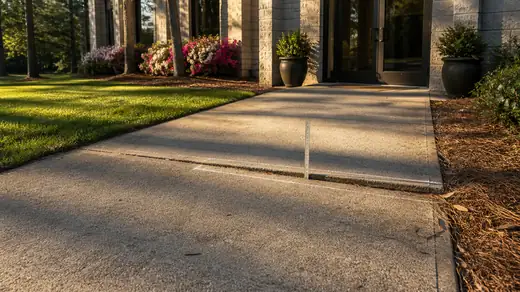
Entrance walkway checked for trip hazards at a business door in Savannah, GA, in late afternoon light.

Step 1: Site Evaluation

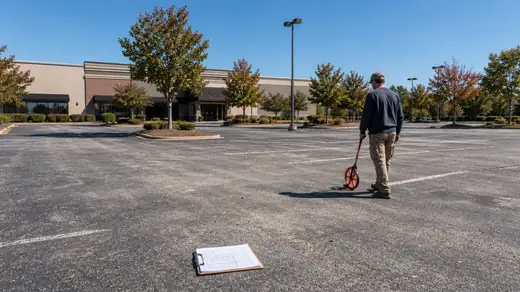
We walk the site with you and look at what the concrete has to do. Delivery traffic, grease carts, dumpster wheels and where water goes after a storm. We check the existing slab for settlement, measure the pad, and find the drains, gas lines and grease trap before anything gets scheduled.

Commercial parking field surveyed for a written concrete estimate in Savannah, GA, in clear late-morning sun.

Step 2: Written Estimate and Permits

You get the scope in writing: square footage, slab thickness, reinforcement, finish and how the work is staged around your service hours. We pull the permits the job needs and handle the inspections. Restaurants usually need the pour split into phases so the back door stays usable.

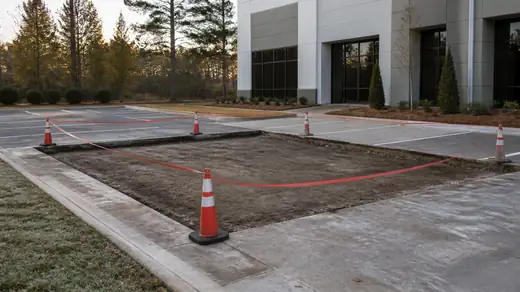
Section of parking lot saw-cut out with the base regraded in Savannah, GA, in early morning light.

Step 3: Demolition and Base Prep

Old concrete comes out, and we haul it off rather than burying it. Then we cut the grade, compact the base in lifts and set slope away from the building. Soft base is what cracks a slab, not the concrete itself, so we compact until the plate stops sinking.

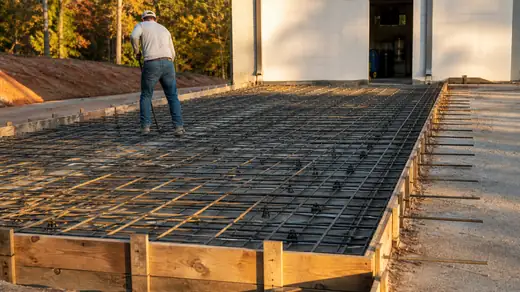
Heavy dock slab formed with a doubled rebar mat before the pour in Savannah, GA, in late afternoon light.

Step 4: Forming, Steel and the Pour

Forms go in on string lines so the edges run straight and the pitch is right. Rebar or wire mesh sits on chairs in the middle of the slab, not on the dirt. Thickened edges go under dumpster pads and truck routes. Then concrete installation runs in one continuous pour.

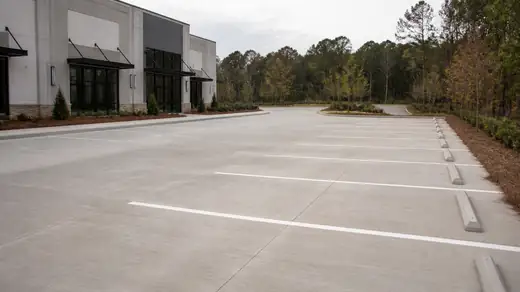
New parking concrete cured and freshly striped into bays in Savannah, GA, under an overcast sky.

Step 5: Finishing, Curing and Final Walkthrough

Broom finish gives grip where staff carry trays; kitchen aprons and loading areas get a harder trowel. We cut control joints the same day so cracks land where we put them. Concrete cures for days after it looks dry, so we tell you when to open sidewalks and driveways, then walk every joint with you.

Commercial Concrete for Restaurants & Hospitality Pricing in Savannah, GA

Most of what moves a concrete bid up or down is visible on the property before anyone quotes it. Walk the area with the questions below in mind and the numbers on competing bids will start to make sense.

What changes the priceWhich wayWhy
An old slab or asphalt still in placecosts moreIt has to be broken out, loaded and hauled off before any new concrete work begins.
How close the mixer truck gets to the pourcosts less when closeWithin chute reach we pour straight off the truck. Past that we wheel it in buggies or bring a pump.
Slab thickness the traffic calls forcosts more as it thickensA dumpster pad or delivery lane carries loads a patio never sees, so it gets a thicker slab.
Rebar on chairs instead of wire meshcosts moreTied bar takes longer to place than sheet mesh and holds its position under the pour.
Soft, wet or filled ground under the padcosts moreLoose material comes out and compacted stone goes in so the slab has something solid to sit on.
Grade already falling away from the buildingcosts lessLittle dirt work is needed to get water off the flatwork and away from the door.
Buried lines, cleanouts or a grease trap in the pour areacosts moreWe hand dig around them, box them out and set the finish to match.
Stamped, colored or exposed aggregate finishcosts more than broomExtra material, extra labor and a slower finishing window.

Comparing bids, look past the total. Check slab thickness in inches, reinforcement type and spacing, base depth, control joint layout, and whether demolition and haul-off are included or priced separately.

Commercial Concrete for Restaurants & Hospitality: Questions We Are Asked Most

How quickly can a Savannah restaurant floor be back in use?

It depends on the pour and the mix. A standard slab takes days before it carries traffic, and longer before heavy equipment or a sealed finish goes down on it. We can phase the work so part of the kitchen stays open while another part cures. Before we start, we walk the space with you and mark out what comes back first, so you know what you are losing and for how long.

How do you meet health inspection requirements on Savannah floors?

Kitchen concrete has to shed water and clean up. That means slope toward the drains, no low spots holding standing water, coved or tight transitions where the floor meets the wall, and a sealed surface that will not absorb grease. We set drains and screed to grade rather than pouring flat and hoping. Coring afterward is the expensive version of getting this right up front.

Can you pour a restaurant patio between services in Savannah?

Sometimes, for small areas. A patio slab needs forms set, base compacted, wire mesh or rebar tied, then the pour, finish and cure, which is more than the gap between lunch and dinner allows. Small sections or repairs fit that window. For a full patio we usually take a closed day or a slow stretch of the week and run continuously instead of starting and stopping.

What floor finish suits a commercial kitchen in Georgia?

A hard-troweled slab with a sealer built for kitchen chemicals and hot water holds up best behind the line. Add texture where the floor stays wet: broom finish or a broadcast grit under the dish station and in walk-in approaches. Stamped and colored concrete belong out front on the patio and entry, not in the back of house, where cleaning is more important than looks.

Do you handle grease trap and drain surrounds in Savannah kitchens?

Yes. We form and pour around trench drains, floor sinks and grease trap lids, and we set the surrounding concrete slightly proud so water runs in rather than pooling at the rim. Lids need to sit flush and stay removable. Where an old surround has broken up, we saw a clean edge, tie into the existing slab and pour back rather than patching over the failure.

Can you work around a restaurant's delivery times in Savannah?

Yes. Tell us your delivery windows and we schedule pours and demolition around them, since a truck at the back door and wet concrete at the back door do not mix. Night and early morning work is possible on flatwork where access allows. On a Pooler job we kept the walk-in path clear through the whole pour by staging the slab in two halves.

Get a Free Estimate

Get Your Free Quote

We warranty all of our work because we believe in what we do.

Tap to call +1 912-206-8811