+1 912-206-8811
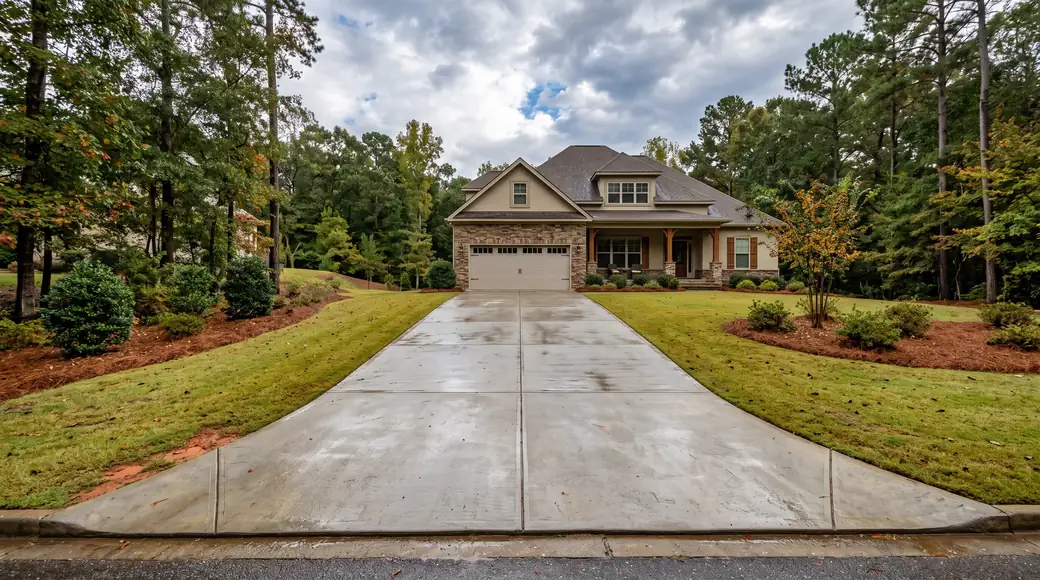
Broom-finished concrete driveway running up to a two-car garage at a stacked-stone and stucco home in Savannah, GA, after a rain shower.

Driveway Installation & Replacement in Savannah, GA

A driveway is the biggest piece of flatwork most homes ever get, and it either holds up for decades or starts telling on itself in the first few years. We are a concrete contractor working in Savannah, Georgia, along with Pooler, Bluffton and Hilton Head Island, all on the same terms. Some of what we do is a new pour on ground that has never carried a slab. Much of it is replacement: breaking out concrete that has done its job and putting something better in the same footprint. Either way, what makes a driveway last is settled below the surface, long before anyone sees the finish.

Housing stock explains a lot of that. The median home in Savannah was built in 1971, so plenty of the driveways we walk up to are as old as the house they belong to. Concrete that has been in the ground that long tends to show it: sections that have settled against each other, cracks that opened at a joint and kept going, crumbling edges where a slab was poured thin and never had steel under it. Patching buys time on some of that. On the rest, a tear-out and a proper repour is the honest answer.

Most of what we pour is a broom finish, because it holds up and does not ask much of you. If you want the driveway to read as part of the house, stamped concrete, colored concrete and exposed aggregate all sit on the same slab and the same base. We handle the sidewalk that runs off the drive, the apron at the street, and the walk to the front door, so the whole approach ends up one age of concrete instead of three mismatched ones. Commercial concrete runs the same way for us, at a bigger scale. Call for a free estimate.

Call +1 912-206-8811

Licensed, Bonded, and Insured ยท A combined 15 years of experience

Get Your Free Quote

We warranty all of our work because we believe in what we do.

What Driveway Installation & Replacement Involves

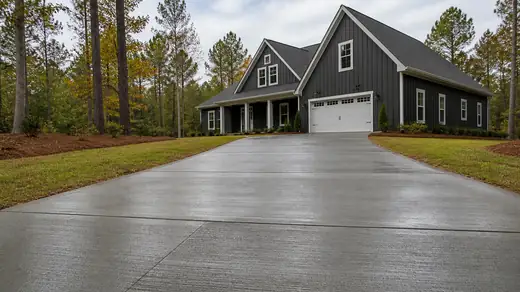
Freshly poured concrete driveway still curing, dark and damp at a charcoal farmhouse-modern home in Savannah, GA, under bright midday cloud.

Driveway installation

New driveways start with grading and a compacted base. We form the perimeter, set rebar or wire mesh on chairs, and pour four inches of concrete, thicker where trucks park. Control joints get cut within a day. Skipping that step is what cracks a slab.
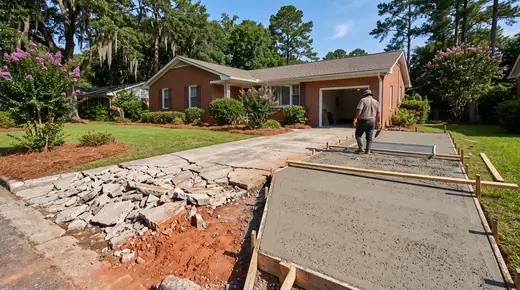
Old driveway broken out with a new concrete pour underway beside it at a red-brick ranch home in Savannah, GA, in clear late-morning sun.

Driveway replacement

Replacement means breaking out the old slab, hauling it off, and fixing whatever failed underneath: washed-out base, tree roots, poor drainage. A good concrete contractor checks that before pouring. New forms, new reinforcement, and a broom finish that sheds water instead of holding it.

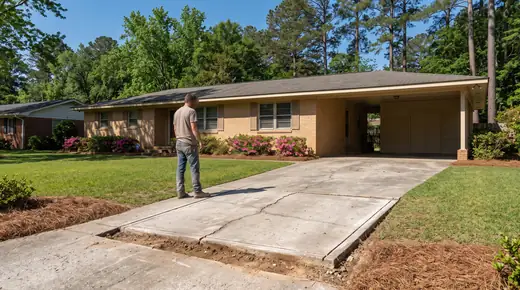
Cracked driveway panel cut out and marked for repair at a buff-brick ranch home in Savannah, GA, in clear late-morning sun.

Concrete driveway repair

Repair suits localized problems: a spalled apron, a settled panel, a cracked section next to the sidewalk. We saw cut to sound concrete, remove the panel, and pour back to the existing joints. Widespread cracking through the whole slab usually means the base is gone.

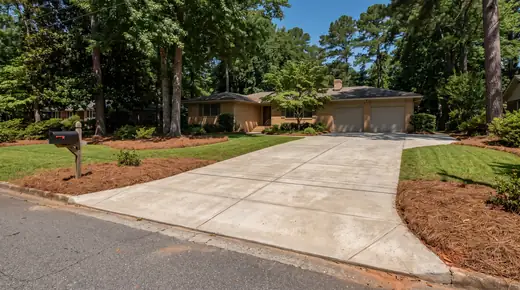
Wide concrete driveway viewed from the street toward the garage at a buff-brick ranch home in Savannah, GA, in clear late-morning sun.

Driveway paving

Paving covers the finish as much as the pour. Broom texture for grip, exposed aggregate for a rougher surface, stamped concrete when you want pattern and color. Stamped work uses the same slab and rebar underneath, so the flatwork has to be right first.

What Savannah Properties Need From Driveway Installation & Replacement

Savannah's housing stock has a median build year of 1971, which means a lot of the driveways here are original to the house. Concrete that old has usually done its job. It has carried vehicles for decades, and the cracking, spalling and settling you see now mark the end of a long service life rather than a defect. We install new concrete driveways and we replace worn ones. Same crew and same materials, whether the slab is going down on bare ground for the first time or over a footprint that has held concrete since the early seventies.

Older properties change the job in ways a fresh pour does not. Driveways from that era are often thinner than what we pour today, with no reinforcement in them, and they sit on a base that was never compacted much to begin with. A replacement is not just new concrete on the old footprint. We take the slab out, deal with what is underneath it, and set forms to the grade the property actually needs instead of the one it inherited.

Most driveway failures trace back to the same few things. A slab poured too thin cracks under weight it was never sized to carry. Skip the rebar or wire mesh and the concrete has nothing holding it together once it does crack, so a hairline separation turns into two pieces sitting at different heights. Water moving through a soft base pulls the support out from under a corner. Roots lift sections. None of it is mysterious, and nearly all of it is decided before any concrete gets mixed.

Doing it right is mostly discipline in the parts nobody sees: a compacted base, correct thickness, rebar or wire mesh set up on chairs rather than dropped in loose, control joints cut where they belong. The finish is the part you choose. A broom finish on flatwork wears well and hides a lot. Stamped and colored concrete gives you pattern and tone across the whole driveway, and exposed aggregate gives you texture underfoot. Call for a free estimate, whether you are putting a driveway in or taking an old one out.

How a Driveway Installation & Replacement Job Runs in Savannah

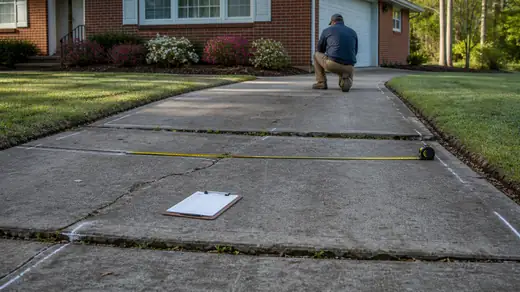
Existing driveway measured and marked before it is replaced at a red-brick ranch home in Savannah, GA, in early morning light.

Step 1: Site Evaluation

We walk the existing driveway with you and look at what is failing: settled panels, cracks wider than a pencil, edges crumbling where cars turn. We check drainage, tree roots, utility lines and how the slab meets the garage and the street.

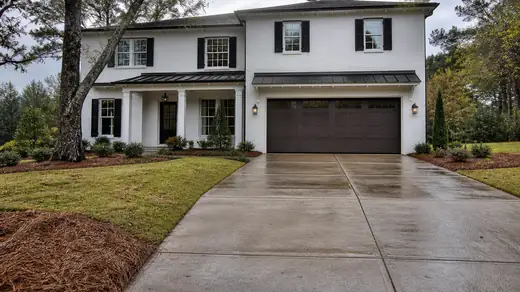
Settled garage approach slab the estimate would price to replace at a painted-white-brick two-story home in Savannah, GA, after a rain shower.

Step 2: Written Estimate and Permits

You get the scope in writing: square footage, slab thickness, reinforcement, finish, joint layout and how we handle the apron. Concrete installation on an older Savannah home often turns up a driveway poured thinner than current work, so we note that before signing.

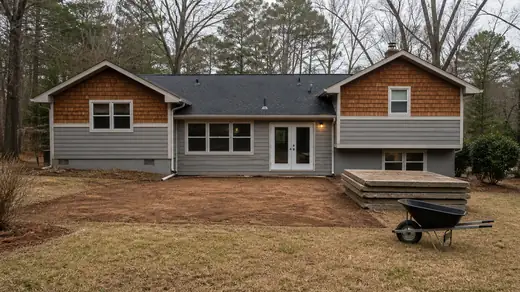
Old patio broken into slabs and stacked ready to be carried out at a grey split-level home in Savannah, GA, under an overcast sky.

Step 3: Demolition and Base Prep

Breaking out the old concrete driveway comes first, then hauling it off. We excavate to grade, compact the subgrade, and lay graded stone in lifts. Soft spots get dug deeper and rebuilt. Bad base is what cracks a slab, not bad concrete.

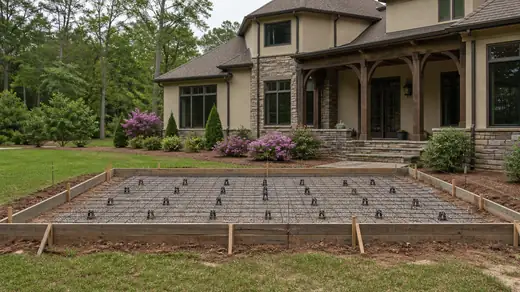
Patio forms squared up with reinforcing mesh on chairs at a stacked-stone and stucco home in Savannah, GA, under an overcast sky.

Step 4: Forming, Steel and the Pour

Forms set the grade and the fall away from the house. We tie rebar or run wire mesh on chairs so the steel sits mid-slab, not on the dirt. Then the pour, screeded and floated in one continuous placement.

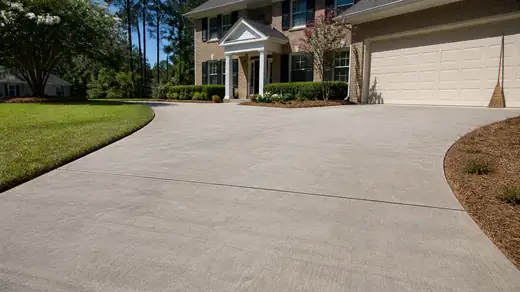
Cured driveway swept clean with the forms stripped away at a tan-brick colonial in Savannah, GA, in clear late-morning sun.

Step 5: Finishing, Curing and Final Walkthrough

Finish goes on once bleed water clears: broom texture for grip, or stamped and colored if that is what you picked. We cut control joints, seal, and cure. Stay off it with vehicles while it gains strength. Driveways and sidewalks both need that patience.

Driveway Installation & Replacement Pricing in Savannah, GA

Two driveways of the same size can land far apart on price, and most of the reasons are visible from your own front yard. What moves a bid is usually under the slab or around it: what has to come out, what a mixer truck can reach, and how much steel the job calls for.

What changes the priceWhich wayWhy
Condition of the base under the old slabcosts less when it is soundCompacted stone we can reuse saves excavation and imported base. Soft ground that pumps under a boot has to be dug out and replaced.
Tearing out the existing drivewaycosts moreBroken concrete is heavy. Demolition, loading and haul-off are a day of work on their own before anything gets poured.
How close the truck can get to the formscosts more when it is farA chute reaching the forms is the easy case. Narrow lots, side gates and low limbs mean a pump, a buggy or wheelbarrows.
Slab thickness the use calls forcosts more with thickerA drive that parks a work truck or an RV needs more depth and more concrete than one that carries a sedan.
Rebar in place of wire meshcosts moreBar tied on chairs costs more in material and labor than mesh, and heavier loads and wider slabs call for it.
Where water goes when it rainscosts more when it runs toward the houseFalling grade toward a garage means regrading, a trench drain, or both, and all of that happens before concrete.
Roots, stumps and shallow utilitiescosts moreWhatever sits under the driveway gets dealt with first, and old service lines are rarely as deep as people expect.
Stamped, colored or exposed aggregate finishcosts morePatterns, release color and sealing add material and hours over a broom finish on the same slab.

Put competing bids next to each other on the parts that are easy to leave vague: slab thickness, rebar or mesh, how much base stone goes down, and whether removal and haul-off of the old drive is inside the number. Ask where the control joints fall. A low bid is often a thinner slab.

Driveway Installation & Replacement: Questions We Are Asked Most

What causes driveway cracking in Georgia, and can it be prevented?

Concrete cracks when it moves, and it moves for a few ordinary reasons: the ground under it settles, the slab shrinks as it cures, and the sun heats it unevenly. Prevention is mostly boring work done early. We compact the base properly, keep the mix consistent, cut control joints at the right spacing, and let the concrete tell us where to crack instead of guessing.

Is a reinforced driveway worth the extra cost around Savannah?

Yes. Rebar or wire mesh does not stop a slab from cracking, but it holds the two sides together when it does, so you get a hairline instead of a step you feel in your tires. On a driveway carrying vehicle loads every day, that difference decides whether you are looking at a repair in a few years or a slab that stays flat and quiet.

Can you replace a Savannah driveway without damaging the garage apron?

Yes. We saw cut a clean line where the new work meets the apron rather than breaking concrete out blind, which keeps the existing edge square and intact. If the apron itself has failed, we will tell you before we start, because tying new concrete to a slab that is already sinking just moves the problem. Sometimes the honest answer is replacing both.

How thick should a concrete driveway be in Savannah, Georgia?

Four inches handles ordinary cars and light trucks on a well prepared base. We go to five or six where a heavy vehicle parks regularly, where a work truck turns tight, or where the driveway apron takes the load of anything larger. Thickness alone will not save a slab poured over soft ground, so we spend the effort on the base first and size the concrete to the traffic.

Do you remove the old driveway before pouring a new one in Savannah?

Yes, in almost every case. Pouring over failed concrete traps the old cracks underneath, and they work their way up through the new slab within a season or two. We break out the existing driveway, haul it off, then check what the base is doing underneath. Occasionally a sound old slab makes sense to build on, and we will say so if we find one.

How long before I can park on a new driveway in Savannah?

Concrete is walkable in about a day and ready for passenger vehicles after roughly a week, though heavy trucks should wait longer. The slab keeps gaining strength for a month after that. Weather shifts the timeline, so we give you the specific dates on your pour rather than a rule of thumb. Keep sharp turns off it early; that is what scuffs a fresh surface.

Get a Free Estimate

Get Your Free Quote

We warranty all of our work because we believe in what we do.

Tap to call +1 912-206-8811