+1 912-206-8811
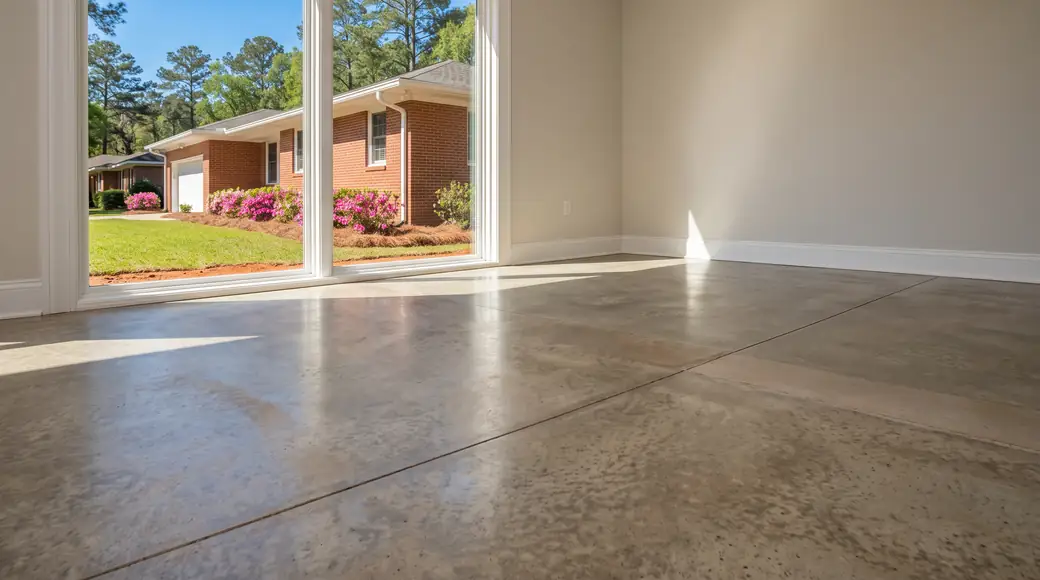
Polished concrete floor with a satin sheen in a finished interior room at a red-brick ranch home in Savannah, GA, in clear late-morning sun.

Polished Concrete Floors in Bluffton, Georgia

A polished concrete floor is the slab you already own, ground flat and brought up through progressively finer diamond grits until the surface reflects light on its own. No coating sits on top. The shine comes out of the concrete itself, from densifier soaking into the pores and hardening the paste at the surface. It wears the way a slab wears, which is slowly. Sweep it, damp mop it, and it takes chairs, dogs, and grit tracked in off the driveway without complaint.

Two decisions set the look. The first is how deep we cut. Stay up in the cream and you get a smooth, quiet floor. Cut past it and you get salt and pepper, and deeper still gives you full exposed aggregate with the stone showing. The second decision is gloss, anywhere from a soft matte to a hard mirror. We grind a test patch in a closet so you are judging your own slab instead of somebody else's photograph.

Median build year in this market is 1971, which means most of the floors we polish have spent decades under carpet, vinyl, or ceramic tile. Age itself is rarely the trouble. What matters is everything done to that slab since it was poured: mastic, thinset, cold patches, trenches cut for plumbing and filled back in by whoever was cheapest. We lift a corner of the existing flooring early, before anyone commits to a finish, so the surprises arrive on day one.

Cracks are the honest part of this conversation. Polishing does not hide a crack. It tends to make one easier to see, because the floor around it gets brighter and the eye goes straight to the line. We can fill and color them so they read as part of the floor, and most people decide they like the record of the slab once they stop fighting it. Control joints stay. A floor that pretends it has no joints will crack somewhere worse.

New concrete is a different animal from polishing what is already down. When we pour, the slab gets a compacted subgrade, rebar or wire mesh sized to the load, and joints cut before the concrete decides where to crack on its own. Thickness and cure time are not places to save. Permits for the work we do inside the city go through the City of Savannah, and we handle that paperwork rather than leaving it on the homeowner's kitchen table.

We are a concrete contractor first, and polished floors are one piece of what we pour and finish. The same crew forms a concrete sidewalk, replaces a driveway that has heaved at the joints, and lays a patio in stamped concrete or colored concrete when a client wants pattern instead of gloss. Flatwork is flatwork. The habits that make a good sidewalk, honest prep and patience during the finish, are exactly the habits that make an interior floor worth looking at. Call for a free estimate.

Call +1 912-206-8811

Licensed, Bonded, and Insured ยท A combined 15 years of experience

Get Your Free Quote

We warranty all of our work because we believe in what we do.

Our Concrete Work Around Bluffton

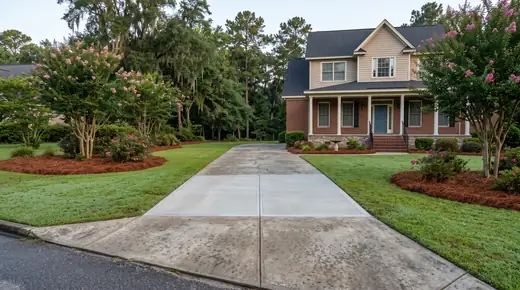
Replaced concrete driveway panel with clean saw-cut edges at a brick-and-siding two-story home in Savannah, GA, in early morning light.

Repair, Leveling & Resurfacing

Sunken sidewalk panels usually mean the base washed out, not that the concrete failed. We saw out the bad sections, recompact, and pour back to grade. A cracked concrete sidewalk with a lifted lip gets ground flat or replaced. Spalled surfaces take an overlay once we find the cause.

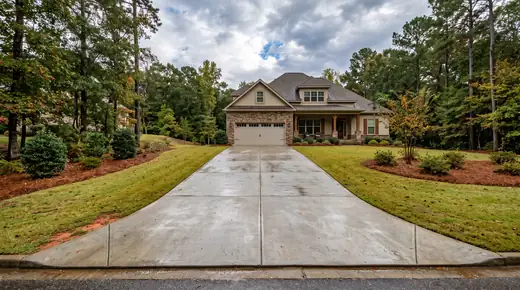
Broom-finished concrete driveway running up to a two-car garage at a stacked-stone and stucco home in Savannah, GA, after a rain shower.

Driveway Installation & Replacement

Most residential driveways go down at four inches over compacted base, five where trucks turn or park. We tie in rebar or wire mesh, cut control joints early, and finish with a broom texture. Old driveways come out whole, not patched over, when the subgrade is the problem.

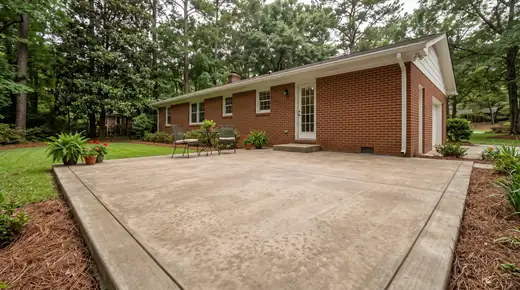
Rectangular concrete patio with a low step up to the rear door at a red-brick ranch home in Savannah, GA, under an overcast sky.

Patio Construction & Outdoor Living

Stamped concrete takes its pattern from the mat and its color from the mix, so a chipped edge does not read as gray. Exposed aggregate and colored concrete hold up well underfoot. Every patio gets pitched away from the house, and joints go where cracks want to go.

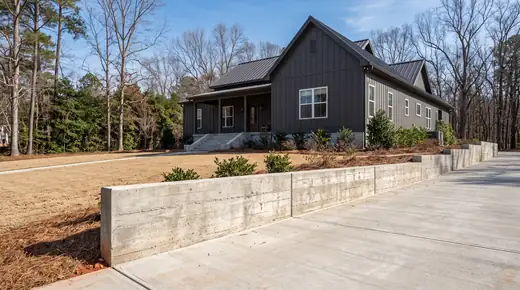
Board-formed concrete retaining wall holding a raised lawn at a charcoal farmhouse-modern home in Savannah, GA, in clear late-morning sun.

Retaining Wall Construction

Walls fail from water, not weight. Ours get a poured footing below grade, rebar tied vertically into the stem, gravel backfill and drain pipe behind the face, and weep holes through it. Short garden walls and walls holding up a driveway edge get different footings, different steel.

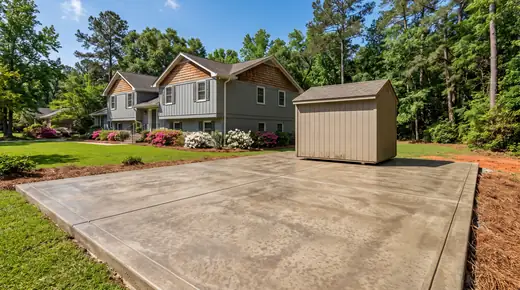
Square-edged concrete slab pad with a storage shed on it at a grey split-level home in Savannah, GA, in clear late-morning sun.

Concrete Slabs & Pads

Shed pads, generator and AC pads, walk-in cooler floors, loading areas: commercial concrete and residential flatwork use the same fundamentals. Vapor barrier, compacted stone, thickened edges where a wall lands, steel sized to the load. As a concrete contractor working across Bluffton, we pour a lot of these.

What to Expect on a Bluffton Concrete Job

A job starts with a walk of the ground you want poured. We measure it, we look at how the space gets used now, and we ask what you expect from it in ten years. The visit runs the same way in Savannah, Pooler, Bluffton and Hilton Head Island. No pitch. You get our read on what the site allows, what it will fight, and whether the work you have in mind is the work you actually need.

Water decides more about flatwork than almost anything else, so most of that first visit goes to figuring out where it goes. We check the fall away from the house, the height of thresholds and door sills, and where the downspouts dump. Access matters too. If a truck cannot reach the pour, we plan for buggies or a pump, and you hear about that early rather than on the morning of.

The estimate comes back as a written scope, not a number on the back of a card. It names thickness, reinforcement, finish, joint layout, square footage, and what we haul away. If there are two reasonable ways to build the thing, both go on the page with the tradeoffs spelled out. You are welcome to take that scope to another concrete contractor and compare it line for line. We would rather be chosen on the details.

Demolition comes first on most jobs. The median home in this market was built in 1971, so a good deal of what we break out has been in the ground for decades: cracked walks, patched aprons, driveways that have settled and opened at the joints. We saw a clean edge where the new work will meet what stays, break the rest, and haul it off. Nothing gets buried on your property to save a trip to the dump.

Grade and base are where a slab is won or lost. We cut to depth, pull out soft spots, bring in compactable stone, and compact it in lifts instead of dumping the whole load and hoping. Forms go up on stakes, then get strung and checked for line and fall before any mix comes near them. A form that looks right to the eye is usually off by enough to pond water in the corner.

Reinforcement gets chosen by what the slab has to carry. Rebar on a tied grid under a concrete driveway that takes trucks or a heavy vehicle, wire mesh where loads are lighter and the run is short. Either way, the steel sits on chairs at the correct height before the pour starts. It does not get hooked up off the base by hand while the truck is turning. Steel lying on the ground does nothing at all.

Pour day is the loud one. Concrete installation runs on a clock nobody controls, so we staff the pour for its size and start early enough to finish the surface before the mix gets ahead of us. Broom finish, exposed aggregate, colored concrete, a stamped pattern: that decision belongs in the estimate, not on the morning of, because each finish changes how we place, time, and work the slab.

Concrete cracks. Anyone telling you otherwise is selling something. Our job is deciding where it cracks, which is what control joints are for, cut to the right depth and spacing while the slab is still green. After the finish is on, the work is mostly patience. We tell you when foot traffic is safe, when a vehicle can go back on it, and how long to keep heavy loads and sealers off.

The last day is cleanup and a walk of the finished work with you. Forms and stakes come out, edges get backfilled so sidewalks sit flush with the grass instead of standing proud of it, and the site gets swept down. Anything that looks wrong to you, say so then and we will put eyes on it. Call for a free estimate on a patio, a slab, a walk, or commercial concrete work.
Common Questions From Bluffton Owners

Do you charge more to work in Bluffton than in Savannah?

No. Our pricing follows the work, not the address. A polished floor is priced on square footage, the condition of the existing slab, how much grinding it takes to open the surface, and the level of shine you want. Two identical garages, one here and one across the river, come out the same. Travel is our cost to absorb, and we have built it into how we quote from the start.

Do you work on older properties in Bluffton?

Yes, and much of what we polish is older. Around here the median home was built in 1971, so we spend a lot of time on slabs poured decades ago under carpet, tile or glued-down vinyl. Old concrete usually polishes well. It has cured hard, and the small variations in color that show up after grinding are what people end up liking most about the finish.

What is the drive time from Savannah to Bluffton for a site visit?

Short. Everything we serve sits inside about 22 miles of our shop, so a site visit is a normal part of the day rather than a trip we have to plan around. That matters more than it sounds. We can look at your slab before quoting, check moisture and old adhesive, and come back mid-job if something needs a second set of eyes.

How quickly can you get a crew to Bluffton?

Scheduling depends on what is already on the calendar and how big your floor is. A single room moves faster than a full house or a shop bay. Call us and we will tell you honestly what the current backlog looks like, along with what dates we can hold. We would rather give you a real date than a hopeful one and then miss it.

Is there a minimum job size for Bluffton?

We take small floors. A laundry room, a landing, a single bay: those are fine, though very small jobs carry a setup cost that spreads across fewer square feet, so the per-foot number looks higher than on a big open slab. If you are weighing a small floor against a larger one, tell us both. We will walk you through the difference.

Get a Free Estimate

Get Your Free Quote

We warranty all of our work because we believe in what we do.

Tap to call +1 912-206-8811