+1 912-206-8811
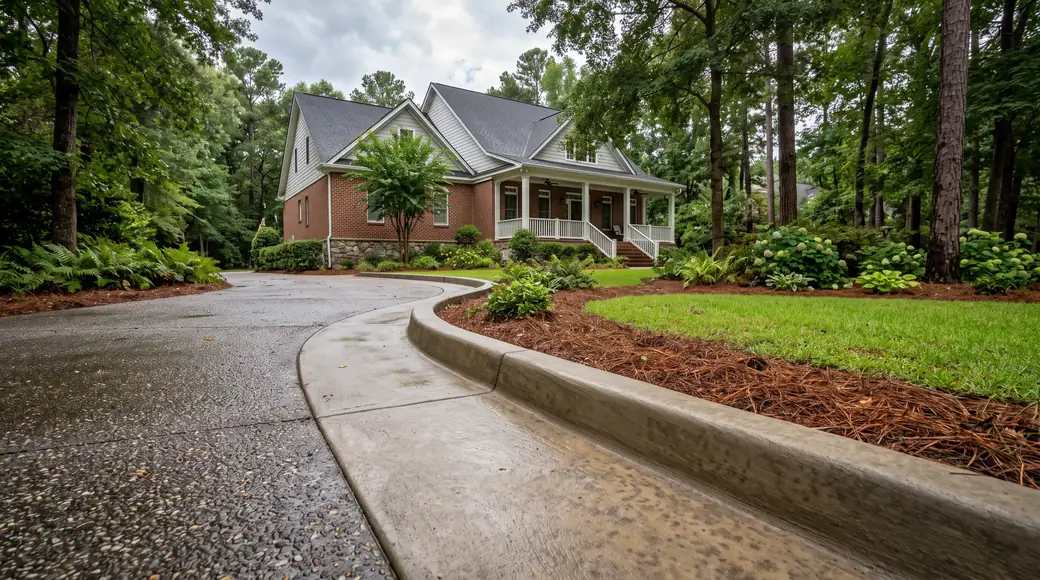
Poured concrete curbing with a rolled profile along a driveway edge at a brick-and-siding two-story home in Savannah, GA, after a rain shower.

Curbing & Edging in Savannah, GA

Curbing and edging is the finished line where one surface stops and another begins: lawn against driveway, planting bed against walkway, parking area against grass. We form and pour it in concrete, either as a standalone curb or as a border tied into a slab or sidewalk that is already there. It holds mulch where you put it, gives a mower a clean wheel line, and keeps a bed from creeping into the drive over a few seasons.

Every job starts with the line itself. We walk it with you, mark it out, then look at what sits under it, because a curb is only as straight and as durable as the base beneath it. Grades matter more than most people expect. Water has to go somewhere, and a curb set across its path will hold it against a house or a driveway. Once the layout is settled and the ground is right, the forming and pouring is the short part.

Most failed edging we take out failed early, and for ordinary reasons. Curb poured straight onto soft fill settles and cracks inside a year. Sections run too thin split under a truck tire. Skip the control joints and the concrete picks its own crack, which is never the line you would have chosen. Savannah's median home was built in 1971, so plenty of what we replace has simply been in the ground a long time.

Doing it right costs time more than anything else: base prep, honest thickness, reinforcement where the curb carries vehicle weight, joints cut at sensible spacing, and a cure left alone to do its work. Finish is a decision, not an afterthought. A plain broom edge, exposed aggregate and stamped concrete all sit on the same base, so the choice is about how you want it to look next to what you already have. We are a concrete contractor working Savannah and Pooler. Call and we will come look at the line and give you a free estimate.

Call +1 912-206-8811

Licensed, Bonded, and Insured ยท A combined 15 years of experience

Get Your Free Quote

We warranty all of our work because we believe in what we do.

What Curbing & Edging Involves

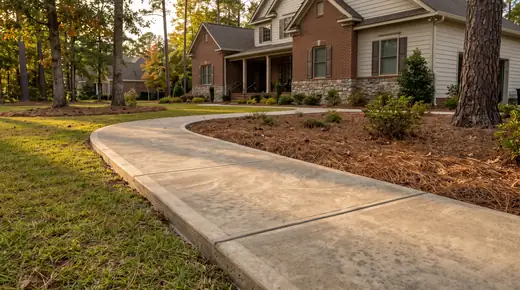
Low concrete edging strip along a mulched garden bed at a brick-and-siding two-story home in Savannah, GA, in late afternoon light.

Concrete edging

Formed and poured in place, not extruded, so the edging locks against the slab or bed it borders. We cut control joints at regular spacing, because unjointed edging cracks wherever it wants. Finishes run broomed, colored, exposed aggregate, or stamped concrete matched to an existing concrete sidewalk.

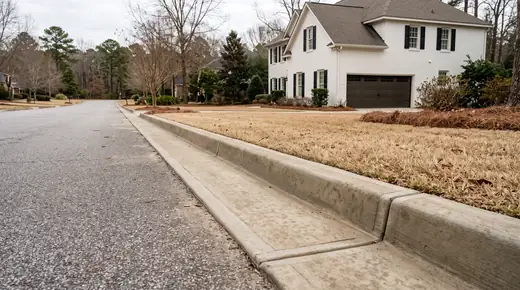
Concrete curb and gutter along a residential street at a painted-white-brick two-story home in Savannah, GA, under an overcast sky.

Curb and gutter

A curb face and gutter pan poured together, tied into existing curb with dowels rather than butted against it. Much of it is commercial concrete: parking lots, drive aisles, apron returns. Soft subgrade is what a concrete contractor sees later, as a pan that dips and holds water.

What Savannah Properties Need From Curbing & Edging

Curbing and edging is the concrete border that holds a bed line, a driveway shoulder or a walkway edge exactly where you put it, and keeps it there. The median Savannah home was built in 1971, so most of the yards we work in have had fifty-odd years of settling, root growth and two or three earlier attempts at an edge already buried in them. Plastic strip that heaved. Brick set in sand that wandered off the line. Poured concrete is the version that stays.

Our service area runs Savannah, Pooler, Bluffton and Hilton Head Island, and every one of them gets the same crew, the same mix and the same forms out of the same truck. Distance changes the drive, not the work. A curb line in one town is laid out, reinforced and finished the way it is in the next, because concrete does not care about the address on the mailbox. Call for a free estimate anywhere in that range.

On a straight run we set and pin forms, then pour a continuous curb with rebar or wire mesh through it wherever the edge has to take vehicle weight from a concrete driveway. Curves are hand-formed in short sections so the finished line reads smooth instead of faceted. Finish is your call: broom for grip, exposed aggregate, colored concrete, or a stamped pattern picked to match a concrete patio, slab or walkway that is already on the property.

Most failed edging we tear out failed underneath, not on top. Curb poured onto loose topsoil, nothing compacted, thin at the back edge, no control joints cut, so it cracks on its own schedule instead of along the line we chose for it. Trees that have had decades to grow will lift a shallow border and open every seam in it. We dig down to firm ground, compact the base, and keep the section thick enough that roots move dirt instead of concrete.

Getting it right is mostly the unglamorous half of the job: string layout, base prep, reinforcement held up off the ground rather than dropped in behind the pour, joints cut on time, and curing nobody hurries along. All of that is invisible the morning the forms come off, and it is the whole difference ten years later. We walk the line with you before anything gets dug and move it while it is still chalk on the grass.
How a Curbing & Edging Job Runs in Savannah

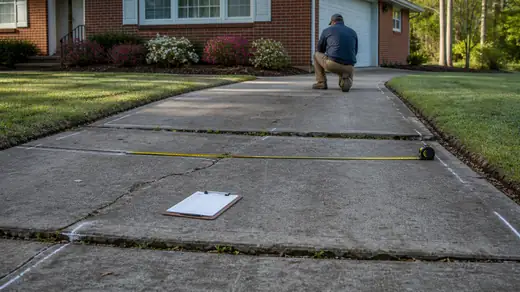
Existing driveway measured and marked before it is replaced at a red-brick ranch home in Savannah, GA, in early morning light.

Step 1: Site Evaluation

We walk the line you want curbed, check drainage and grade, and look at what the edging has to tie into. Existing driveways and beds tell us a lot. On homes from the early seventies, we usually find settled edging, tree roots, and irrigation lines sitting shallow.

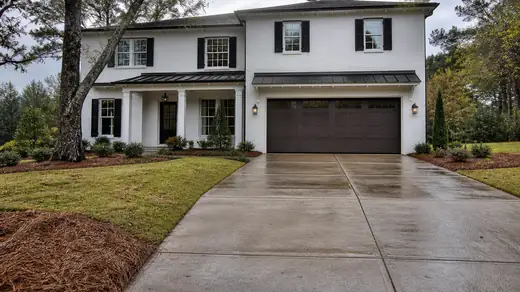
Settled garage approach slab the estimate would price to replace at a painted-white-brick two-story home in Savannah, GA, after a rain shower.

Step 2: Written Estimate and Permits

You get the scope in writing: linear footage, curb profile, radius work, finish and color if you want it. We handle any approvals the job needs before mobilizing. The quantities and finishes on that estimate are what gets poured, and you read it before we order material.

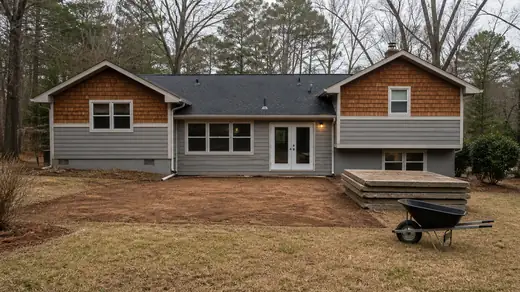
Old patio broken into slabs and stacked ready to be carried out at a grey split-level home in Savannah, GA, under an overcast sky.

Step 3: Demolition and Base Prep

Old edging comes out, roots get cut back, and the trench is dug to depth along the whole run. We compact a granular base underneath, typically four inches, because curbing set on loose fill cracks at the joints first. Irrigation gets rerouted here, not later.

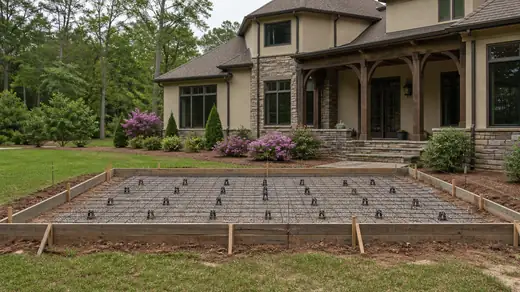
Patio forms squared up with reinforcing mesh on chairs at a stacked-stone and stucco home in Savannah, GA, under an overcast sky.

Step 4: Forming, Steel and the Pour

Forms are staked to a string line so the curve reads clean from the street. Continuous rebar runs through the length on structural curb, wire mesh where the work ties into flatwork. Concrete installation happens in one pour per run where we can manage it.

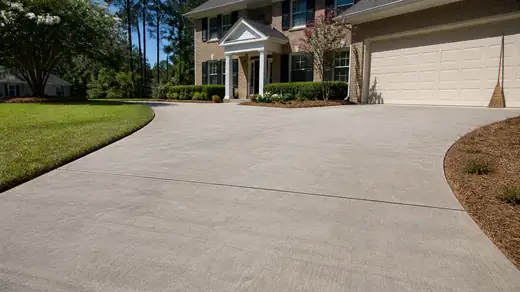
Cured driveway swept clean with the forms stripped away at a tan-brick colonial in Savannah, GA, in clear late-morning sun.

Step 5: Finishing, Curing and Final Walkthrough

We float, edge, and tool control joints at regular intervals so the concrete cracks where we put the line instead of somewhere random. Curing compound goes on the same day. Then we walk the job with you, along the driveways and sidewalks it borders, and check every transition.

Curbing & Edging Pricing in Savannah, GA

Two curbing jobs on the same street can land far apart, and the reasons are usually sitting in plain view on the property. What is already in the ground, how close a truck can get, and what the edge has to hold back move the number more than anything you pick out of a catalog.

What changes the priceWhich wayWhy
Old curb or asphalt edging still in placeCosts moreIt gets broken out and hauled off before any new concrete goes down.
Truck can reach the run without a wheelbarrow relayCosts lessMoving concrete across a yard by hand adds hours of labor to the same volume.
Soft or sandy subgrade under the lineCosts moreThe base gets cut deeper and compacted so the curb does not settle out of level.
Tree roots crossing the runCosts moreRoots come out, or the line shifts around them, and both take time before forms go up.
Rebar or wire mesh the job calls forCosts moreA driveway edge carrying wheel loads needs steel that a garden border does not.
Thicker slab where cars cross the curbCosts moreDepth and concrete volume both climb at the apron.
Ground already drains away from the houseCosts lessNo regrading, no pitch correction, no drain sleeve cast through the curb.
Stamped or colored finish instead of plain grayCosts moreRelease agents, sealer and a longer finishing window on the same footage.

Read past the total on every bid. Ask what thickness is quoted, whether steel is included or an add, who hauls the old material away, and how the base gets prepared. A bid that leaves those blank is not cheaper, it is just vaguer. Get all of them on paper in the same terms and the numbers start meaning something.

Curbing & Edging: Questions We Are Asked Most

How long does curbing take to install on a typical Savannah lot?

Most residential runs go in over a day or two. The first day covers layout, edging the sod back, and running the machine or setting forms. Cure time is the part people underestimate: the concrete looks finished long before it is ready for weight. We ask you to stay off it and keep mowers away until we say otherwise, which depends on the mix and the weather that week.

Can you edge existing Savannah beds without lifting the planting?

Yes, in most cases. We cut the trench along the bed line, and established plants back from the edge stay where they are. Anything sitting directly on the line has to move, and we will point those out before we start rather than after. Shallow-rooted shrubs and anything crowding the edge are the usual problem. Roots larger than a wrist change the plan.

What shapes and colors of curbing can I have in Savannah?

Profile options run from a low mow strip to a rolled or squared curb standing a few inches proud of the turf. Color goes in through the mix so it runs all the way through rather than sitting on top, and stamped patterns can be pressed into the surface while it is still green. Slate, brick and stone textures are the common ones. Bring a sample.

Will curbing crack when the ground moves in Georgia?

Concrete moves, so we plan for it. Control joints get cut at regular intervals along the run, which gives the material a place to crack where you will not notice it. On longer runs and around tight curves we watch the base preparation closely, since most of what people call cracking traces back to soft or uneven ground under the pour rather than the concrete itself.

What is the difference between curbing and edging on a Savannah property?

Edging is the line itself, the clean separation between bed and lawn. Curbing is one way to hold that line permanently, in concrete, rather than with steel, plastic or a spade twice a season. People use the words interchangeably and we answer to both. What matters on a walkthrough is height, profile and where the line runs, not the label.

Does curbing stop mulch washing out in Savannah storms?

It helps considerably. A raised curb gives water something to push against, and mulch that would otherwise end up across the driveway stays in the bed. Heavy rain will still move material inside the bed and over the top if the mulch is piled higher than the curb. Keep it below the lip and the curb does its job.

Get a Free Estimate

Get Your Free Quote

We warranty all of our work because we believe in what we do.

Tap to call +1 912-206-8811