+1 912-206-8811
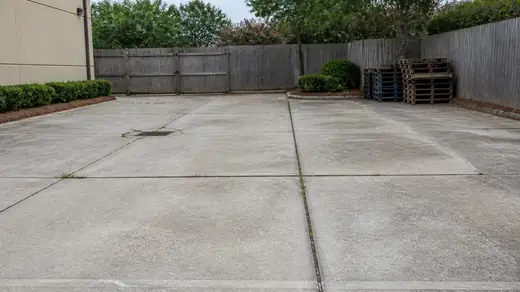
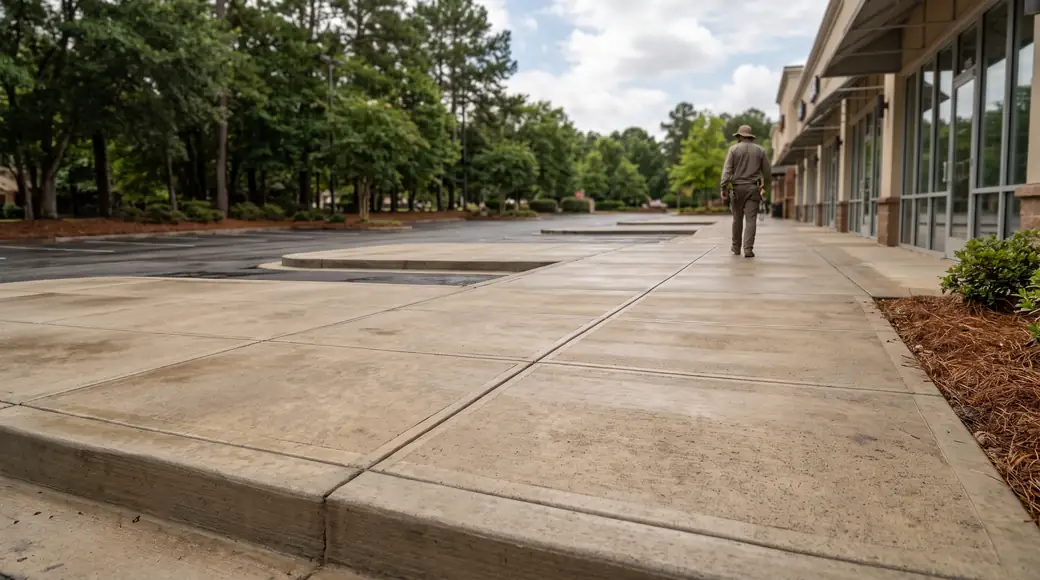
Concrete sidewalk and parking-lot island paving at a retail center in Savannah, GA, after a rain shower.

Commercial Concrete for Retail & Shopping Centers in Savannah, GA

We pour and repair the concrete that retail properties run on: parking lots, drive aisles, loading areas, the walkways along a storefront, and the sidewalk that carries people from a parking space to the door. Some of it is plain gray flatwork. Some of it is stamped concrete at an entry, or colored concrete broken up with bands of exposed aggregate. All of it takes traffic every day it exists.

Concrete on a shopping center fails in ways you can predict. Base that was never compacted settles under a delivery truck. Slabs poured thin, or without rebar and wire mesh where the heavy loads sit, crack across the middle instead of at the joints you put there. Water finds the low spot and stays in it. We settle the subgrade, the thickness, the steel and the jointing before anyone backs a mixer onto the site.

Savannah has 147,898 people, and most of them cross somebody's parking lot to get where they are going. We work here and out toward Pooler, doing commercial flatwork: new concrete installation, full replacement, tear-out of what has failed, and repair of what is still worth keeping. Hiring a concrete contractor for a property that has to stay open while the work happens is its own problem, and we know it. Call for a free estimate.

Call +1 912-206-8811

Licensed, Bonded, and Insured ยท A combined 15 years of experience

Get Your Free Quote

We warranty all of our work because we believe in what we do.

What Commercial Concrete for Retail & Shopping Centers Involves

Commercial concrete for a retail center covers everything a customer walks or drives on: parking lots, entry aprons, loading areas, ramps, curbs, and the concrete sidewalk running the length of the storefronts. Some of that is plain gray flatwork poured to take traffic. Some of it is stamped concrete at the entrances, where the property wants a finish that reads as deliberate rather than utilitarian. We do both, plus the drainage and jointing that keeps either one sitting flat.

Thickness and reinforcement get set by what rolls across the surface. A sidewalk in front of a bakery carries people and a mop bucket. A drive lane carries loaded delivery trucks, so it gets a thicker slab, rebar tied on chairs, and a compacted base that will not pump water up through the joints. Wire mesh has its place in lighter flatwork. Preparing subgrade takes longer than the pour does, and it decides most of what happens afterward.

Failures in retail flatwork are usually predictable. Cracks wandering diagonally across a walk mean the control joints went in late or too far apart. Slabs that rock under a tire mean the base was never compacted properly. Water standing at a door means the pour chased the old grade instead of correcting it. Colored and stamped surfaces go wrong when the release agent and the sealer get rushed. None of that is mysterious. All of it traces back to a skipped step.

Retail sites stay open while the work happens, which shapes how we break it up. Tenants need a walkable path to their door, and trash service needs a route in. So we pour in sections and stage the work around the traffic instead of shutting the whole frontage down at once. Ramps, landings, and transitions at entries get built to the slopes and dimensions they are supposed to hold. Curing time is fixed, and the sequence gets planned around it.

We are a concrete contractor working Savannah, Pooler, Bluffton, and Hilton Head Island, and a shopping center in any of those gets the same crew and the same specs. Savannah alone runs to 147,898 people, and the centers serving that many shoppers put real wear on their flatwork. If you have concrete breaking up in a parking field, a walk that needs replacing, or a new build that needs everything from the curb to the storefront, call for an estimate.
What Savannah Properties Need From Commercial Concrete for Retail & Shopping Centers

We pour and replace the concrete that retail properties run on: parking area flatwork, concrete sidewalks along the storefronts, entry aprons, dumpster pads, loading zones, curb, and the ramps that get carts and wheelchairs up onto the walk. Savannah's median home was built in 1971, so the neighborhoods a shopping center draws from are long since built out. That shapes the work. Most commercial concrete here is not a new center going up on raw ground. It is a slab going back in beside one that is still carrying traffic.

What we look at first is what is already there. A concrete driveway or sidewalk usually fails from underneath rather than from above, so we check the subgrade, the drainage, and how the old slab was reinforced before deciding whether individual panels come out or the whole section does. Rebar and wire mesh do different jobs, and a pad taking delivery trucks is not built like a walkway. Cutting clean joints and matching elevations at the doors matters as much as the mix does.

Decorative concrete has a place on retail sites too. Stamped concrete and colored concrete at an entry plaza, exposed aggregate on a courtyard walk: these hold up well when the base under them is right, and they go bad quickly when it is not. Concrete installation on an occupied property is mostly a question of sequencing, keeping a path open to every door while the work moves through in sections. We do this work across Savannah and out toward Pooler, on the same terms wherever the site sits. Call for a free estimate, whether it is one sidewalk panel or a full parking area.

How a Commercial Concrete for Retail & Shopping Centers Job Runs in Savannah

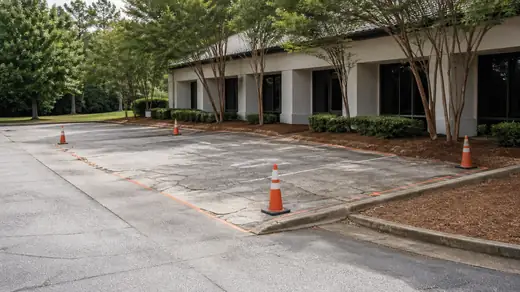
Cracked commercial parking bay marked out for replacement in Savannah, GA, under bright midday cloud.

Step 1: Site Evaluation

We walk the property and look at what the existing slab is doing: cracking, settling, water sitting where it shouldn't. Grades get checked, along with access for trucks. Retail lots bring their own questions about traffic loads and where the sidewalks meet parking.

Service yard slab assessed where heavy vehicles have broken it up in Savannah, GA, under bright midday cloud.

Step 2: Written Estimate and Permits

You get the scope in writing: square footage, slab thickness, reinforcement, finish, joint layout. Work in city limits goes through the City of Savannah for permits, and we handle that filing. Anything found later that changes the number gets discussed before we pour.

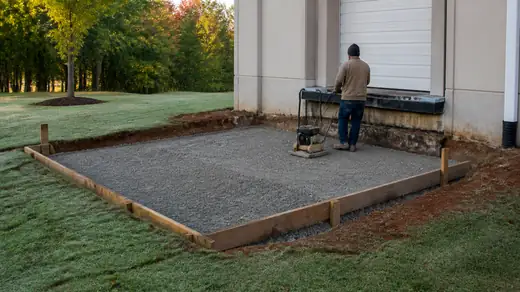
Loading dock apron broken out with the subgrade compacted in Savannah, GA, in early morning light.

Step 3: Demolition and Base Prep

Old concrete comes out and gets hauled off. Then we cut the subgrade to depth, compact it, and lay graded aggregate base, compacted in lifts. Weak or soft spots get dug out and replaced. Poor compaction here is the reason slabs settle and crack later.

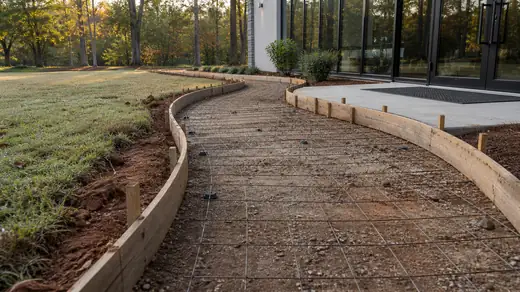
Curved walkway forms bent and staked outside a commercial entrance in Savannah, GA, in early morning light.

Step 4: Forming, Steel and the Pour

Forms go in set to the grade lines and staked solid so nothing moves. Rebar or wire mesh sits on chairs at the right height, not dragged up after. We pour, screed, and bull float, then run control joints on the spacing the slab thickness calls for.

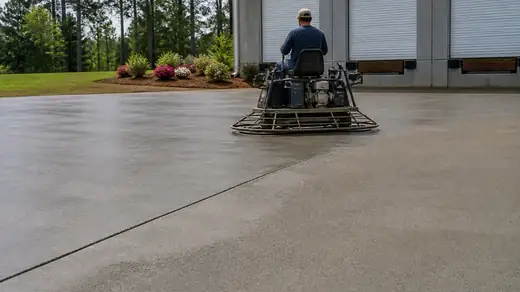
Dock slab power-trowelled to a hard dense surface in Savannah, GA, under bright midday cloud.

Step 5: Finishing, Curing and Final Walkthrough

Finish depends on the surface: broom texture for sidewalks and driveways, or stamped and colored work where the look matters. Curing compound goes down and we keep traffic off. When it's ready, we walk the whole concrete installation with you, including every concrete driveway approach.

Commercial Concrete for Retail & Shopping Centers Pricing in Savannah, GA

Two concrete lots on the same block can come in at very different numbers, and almost all of that difference is visible before anyone pours. Walk the site and look at what is already there, how a truck gets to it, and where the water goes.

What changes the priceWhich wayWhy
Existing slab or asphalt in the wayCosts moreIt has to be broken out, loaded and hauled off before any flatwork starts
Distance from where a mixer can park to where the concrete landsCosts more when it is farBeyond chute reach, the pour needs a pump or buggies and more hands
Slab thickness the traffic calls forCosts more as it climbsA delivery bay carrying loaded trucks needs more depth than a walkway
Rebar instead of wire meshCosts moreMore steel, tied by hand, in slabs that carry heavier wheel loads
Soft, wet or filled subgradeCosts moreBad ground gets dug out and replaced with compacted stone
Standing water or flat gradeCosts moreSlopes, drains and a fall to daylight get built into the pour
Stamped or colored finishCosts moreExtra labor, release agents and cure time over a broom finish
Storefront staying openCosts moreThe work gets phased so entrances and parking stay usable

Compare bids line by line: slab thickness, reinforcement, base depth, joint spacing, and who removes the old concrete.

Commercial Concrete for Retail & Shopping Centers: Questions We Are Asked Most

How fast can a Savannah car park be back in use after repairs?

That depends on how much of the lot we take up and what goes into it. Patchwork and single slab replacements come back in stages, so you lose a handful of bays at a time instead of the whole lot. Foot traffic returns first and vehicles later, because a fresh slab has to gain real strength before a delivery truck rolls across it.

Do you handle trip hazard and accessibility issues for Savannah retail?

Yes. Lifted sidewalk panels, settled slabs at door thresholds, cracked walkway sections and ramps that no longer run at the right slope are routine concrete work for us. We saw out the bad section, reset the grade, tie the new flatwork into what stays with rebar or wire mesh, then finish it so the joint reads clean.

Can you pour a retail entrance without closing the shop in Savannah?

Yes. The entrance gets split and poured in halves, so half stays open and walkable while the other cures, with matting or plating over the working side where the layout allows it. Tenants keep trading. Deliveries come through a marked route, and customers get a clear path in that never crosses fresh concrete.

How do you protect Savannah shopfronts and stock while working?

Glass, storefront framing and merchandise get covered before anything is cut or poured. We mask the frontage, run poly and board over whatever sits close to the work, and keep saw cutting wet so the dust stays down. Concrete is barrowed or pumped along a set route rather than carried past open doors, and we wash the area down at the end of each shift.

Can you work overnight at a Savannah shopping center?

Yes. Night suits retail concrete work: the lot empties out, we get clean access to the slab, and the pour has quiet hours to set before the morning trade arrives. We light the work area, keep the loud stages away from occupied units where the site allows, and hand the space back swept and barricaded wherever it still needs to stay off limits.

Do you take on multi-site retail work across Savannah?

Yes. Ownership groups with several properties get the same crew running the same details from site to site, so the finish, the jointing and the color match instead of drifting between locations. Work can go property by property, or run as a standing repair list we work through. That holds whether the sites sit inside the city or out toward Pooler.

Get a Free Estimate

Get Your Free Quote

We warranty all of our work because we believe in what we do.

Tap to call +1 912-206-8811